
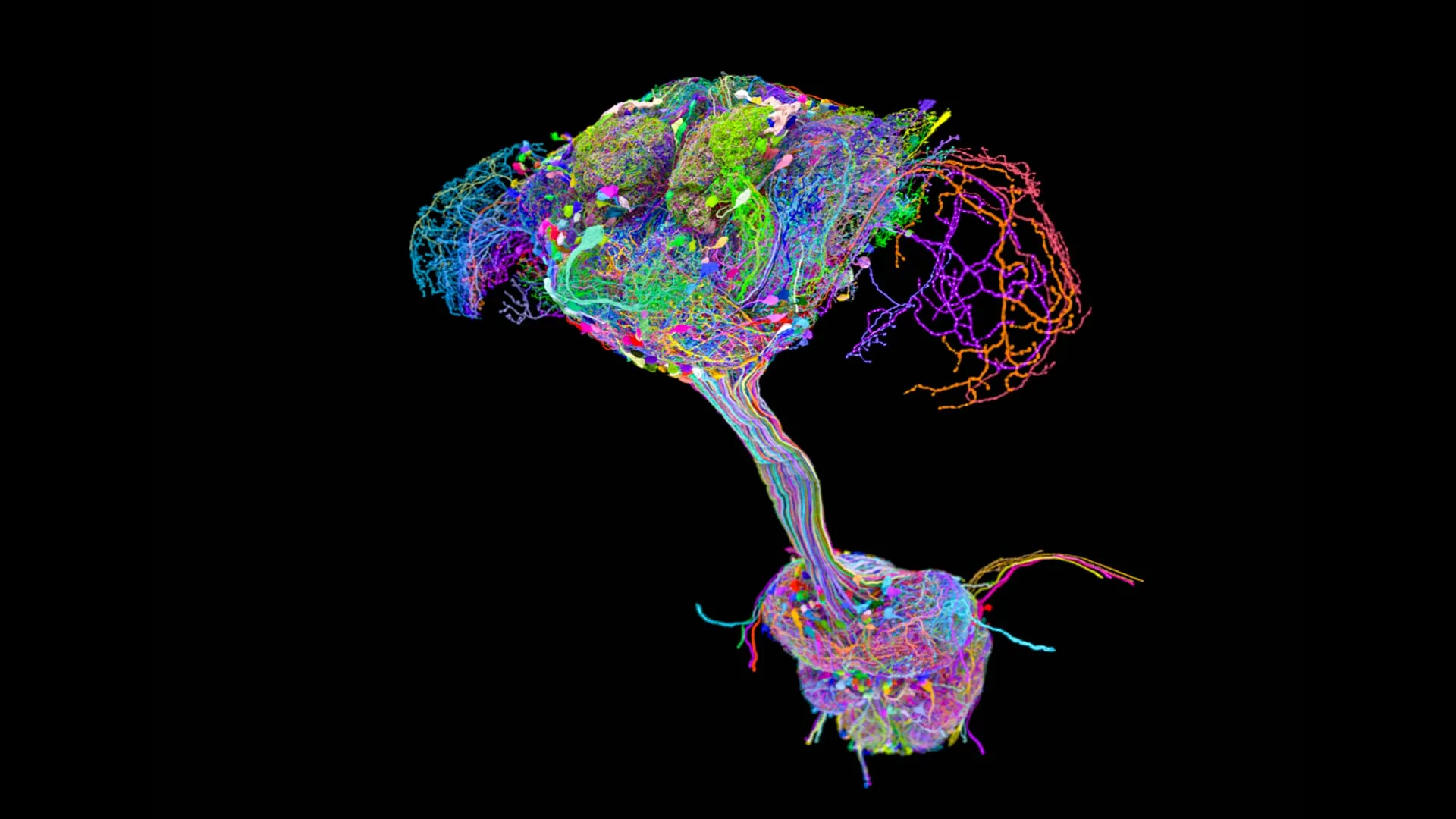
In a groundbreaking achievement poised to redefine our understanding of neural complexity, an extensive international collaboration led by researchers at Harvard Medical School and Princeton University has successfully mapped every connection between neurons in the central nervous system of an adult fruit fly. This monumental effort, published on June 8th in the prestigious journal Nature, represents a significant milestone in neuroscience, offering an unprecedented view of how biological circuits orchestrate behavior.
The newly completed connectome extends a previous map of the fruit fly’s brain by integrating the intricate neural network of its nerve cord, effectively providing a holistic blueprint of its entire central nervous system. This comprehensive visualization allows scientists to examine, for the first time, the complete interplay between the brain and the body, illuminating the fundamental rules governing nervous system function and the generation of complex actions such as walking and flying.
"We can see all of the neurons and their connections as a complete unit for the first time and ask, ‘What do we learn from that?’" stated co-senior author Rachel Wilson, the Joseph B. Martin Professor of Basic Research in the Field of Neurobiology at Harvard Medical School’s Blavatnik Institute. This complete map, now freely accessible online through the FlyWire project, provides a powerful new resource for neuroscientists worldwide.
The Significance of the Fruit Fly Model
The fruit fly, Drosophila melanogaster, has long been an indispensable model organism in neuroscience due to its relative simplicity and remarkable behavioral repertoire. Despite possessing a nervous system comprising approximately 160,000 neurons, a fraction of that in mammals, fruit flies exhibit sophisticated behaviors including navigation, social interaction, learning, and sensory processing. This complexity, coupled with a sophisticated genetic toolkit that allows for precise manipulation and observation of individual neurons, makes them an ideal subject for unraveling fundamental neurobiological principles.
The current achievement builds upon prior work by the FlyWire Consortium, a collaborative effort that in 2024 published a complete connectome of the fruit fly brain. Simultaneously, the research teams at Harvard Medical School, under the leadership of Wei-Chung Allen Lee, were meticulously constructing a connectome of the fruit fly’s nerve cord. The nerve cord, analogous to a spinal cord, plays a critical role in processing sensory information and controlling motor functions of the fly’s appendages, including its legs and wings.
"It is really important to have a central nervous system connectome that is as complete as possible so we can link up the brain and body and start thinking about behavior holistically," emphasized co-senior author Wei-Chung Allen Lee, an associate professor of neurobiology at HMS and a professor of neurology at Boston Children’s Hospital. The integration of these two datasets – the brain connectome and the nerve cord connectome – was crucial for understanding the seamless flow of information between these two vital components of the central nervous system.
Helen Yang, a research fellow in neurobiology in the Wilson Lab and a co-first author of the study, articulated the importance of this integration: "The brain and nerve cord connectomes are each useful on their own, but until you can bridge the two, it’s hard to understand how information moves between the brain and the body."
Unveiling the Brain and Artery Neural Network (BANC) Connectome
The newly published dataset, dubbed the Brain and Artery Neural Network (BANC) connectome, represents a significant leap forward. Co-senior author Mala Murthy, the Karol and Marnie Marcin ’96 Professor of Neuroscience at Princeton and director of the Princeton Neuroscience Institute (PNI), highlighted the team’s eagerness to connect the brain and nerve cord data. "The new connectome represents a major advance for the field, with the ability to understand how circuits in the brain receive feedback from and control the actions of the body," she stated.
The BANC connectome meticulously details the synaptic connections between individual neurons across the entire central nervous system of the fruit fly. This level of detail allows researchers to trace the precise pathways of neural communication, from sensory input to motor output. Co-author Arie Matsliah of the PNI added, "For the first time, we can follow information flow from sensation to action across an entire nervous system."
Alexander Bates, another research fellow in neurobiology in the Wilson Lab and co-first author, pointed out the complementary value of different neural regions. While the brain contains the majority of neurons, the nerve cord houses neurons directly linked to sensation and movement, making their connectivity patterns particularly insightful for understanding observable behaviors.
The Technological Feat: Constructing the Connectome
The creation of such an exhaustive map was a formidable technological undertaking. Researchers employed a multi-stage process involving ultra-thin serial sectioning of a single fruit fly, followed by high-resolution electron microscopy to capture millions of images. Advanced artificial intelligence (AI) tools were then instrumental in aligning these images and reconstructing them into a coherent three-dimensional model of the neural circuitry.
This process enabled the mapping of individual synaptic connections, the crucial junctions where neurons communicate. While the connectome primarily focuses on the central nervous system, the researchers ingeniously integrated existing scientific literature and identified key neurons to effectively "embody" the connectome, linking central nervous system activity to sensory organs and appendages.
A Paradigm Shift in Understanding Motor Control
Early analyses of the BANC connectome have already yielded surprising insights, particularly regarding motor control. A long-held tenet in neuroscience posited that the brain acts as a singular, centralized command center, dictating all animal actions. However, the fruit fly connectome suggests a more distributed model.
The research indicates that motor control in fruit flies is largely decentralized, with local neural circuits within specific body parts primarily governing their functions. For instance, the intricate movements of a single leg are predominantly orchestrated by neural circuits dedicated to that leg. These local circuits then communicate with neighboring circuits to achieve coordinated actions, such as the rhythmic motion of walking. This pattern extends to other body parts, including wings and mouthparts, suggesting a modular approach to motor control.
Furthermore, the study revealed that these motor circuits are intricately interwoven with other neural systems, including the visual and endocrine systems. This integration allows for the incorporation of diverse sensory information and internal state signals, dynamically shaping behavior. "Our findings suggest that control for actions is highly distributed in local modules that link up and work together in different ways," explained Bates. This distributed control mechanism challenges traditional hierarchical models of brain function and opens new avenues for research into how complex behaviors emerge from the coordinated activity of many specialized circuits.
Future Directions and Broader Implications
The complete BANC connectome is more than just a detailed map; it serves as a foundational resource for a multitude of future investigations. Researchers envision it as a catalyst for developing novel hypotheses and designing targeted experiments. Lee likened its utility to having detailed navigational data when planning a journey, stating, "The connectome has shown us that most of our hypotheses are too simple. Now, we can develop more complex hypotheses and move forward with experiments to test them."
The research team plans to enrich the connectome further by incorporating information about neuropeptides, signaling molecules that play a vital role in neural communication. This added layer of detail will provide a more nuanced understanding of how neurons interact and influence one another.
The implications of this work extend beyond the fruit fly. Many fundamental principles discovered in Drosophila neuroscience have proven transferable to more complex organisms, including mammals, shedding light on processes like navigation, olfaction, and memory. The researchers anticipate that the BANC connectome may reveal universal principles of nervous system organization that apply across species.
"I would be shocked if this is unique to the fly," commented Yang. "We don’t have this level of resolution in other animals, but we know that they have a lot of these local circuits." The next ambitious goal is to extend full-connectome mapping to significantly more complex organisms, a feat becoming increasingly feasible due to advancements in AI, computing power, and open collaborative science. Lee is already exploring the possibility of similar distributed control mechanisms in mice, indicating a potential universality of these findings.
Impact on Artificial Intelligence and Beyond
The BANC connectome also holds significant promise for the field of artificial intelligence. The detailed biological data can serve as a blueprint for designing more sophisticated AI agents capable of navigating and interacting with complex environments. As Yang noted, "One thing that always amazes me is that this tiny little fly does a hell of a lot; even our best AI agents and robots can’t do everything that a fly does. There may be lessons for AI in how the nervous system is organized." The efficiency and robustness of biological neural networks, as revealed by the connectome, could inspire novel architectures and learning algorithms for AI systems.
The publication of this comprehensive map was supported by significant funding from various U.S. federal agencies, including the BRAIN Initiative (Brain Research Through Advancing Innovative Neurotechnologies), the National Institutes of Health, and the National Science Foundation. This collaborative spirit and substantial investment underscore the global scientific community’s commitment to advancing our understanding of the brain.
The BANC connectome is now a freely available online resource, empowering researchers worldwide to explore its depths and contribute to the ongoing revolution in neuroscience. This landmark achievement not only provides an unparalleled view into the workings of a biological nervous system but also sets the stage for future discoveries that could illuminate the mysteries of cognition, behavior, and the very essence of life.
This article was compiled with contributions from a large international research team, including co-first authors Helen Yang, Alexander Bates, Jasper S. Phelps, and Minsu Kim, and co-senior authors Rachel Wilson, Wei-Chung Allen Lee, Mala Murthy, Sebastian Seung, and Jan Drugowitsch. The work was supported by numerous grants from the National Institutes of Health, the National Science Foundation, and various international funding bodies. Harvard University has filed patent applications related to some of the technologies used in this research.
