
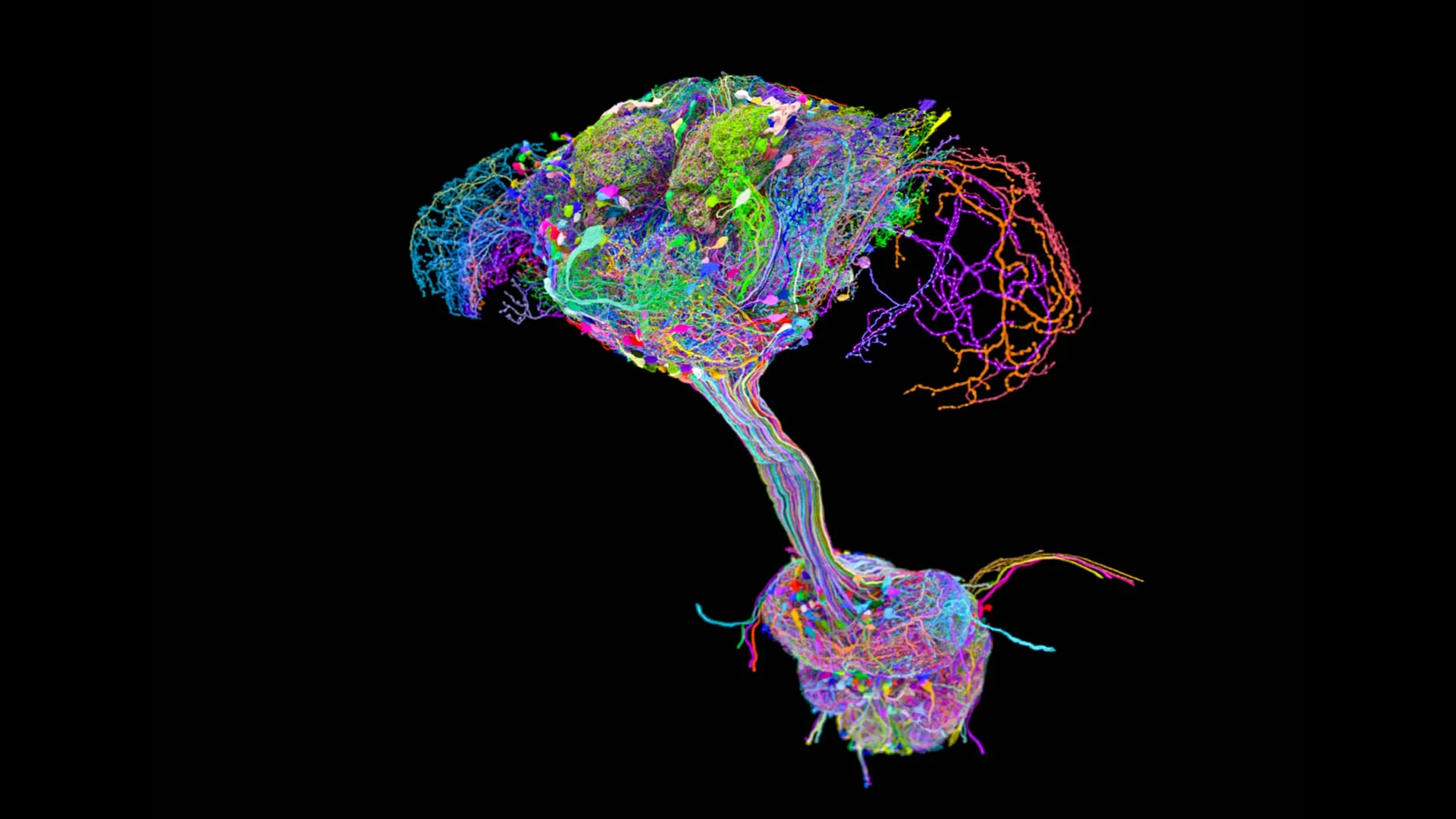
In a landmark achievement for neuroscience, an international consortium of researchers, spearheaded by luminaries from Harvard Medical School and Princeton University, has successfully charted the complete connectome of an adult fruit fly’s central nervous system. This monumental undertaking, published on June 8th in the prestigious journal Nature, offers an unprecedented, high-resolution blueprint of neural connectivity, extending from the fly’s brain to its nerve cord, the equivalent of a spinal cord. This comprehensive map promises to revolutionize our understanding of how complex behaviors are generated and executed, paving the way for deeper investigations into the fundamental principles governing all nervous systems.
The Dawn of a New Era in Neural Mapping
For the first time, scientists have a holistic view of the intricate network that dictates an organism’s actions. The newly completed connectome meticulously details every neuron and its synaptic connections within the fruit fly’s brain and nerve cord. This accomplishment builds upon previous efforts, most notably the 2024 publication of a complete fruit fly brain connectome by the FlyWire Consortium, a collaborative effort led by Mala Murthy and Sebastian Seung at Princeton. The current study integrates this brain map with a similarly comprehensive map of the fruit fly’s nerve cord, painstakingly assembled by Wei-Chung Allen Lee and his colleagues at Harvard Medical School.
"We can see all of the neurons and their connections as a complete unit for the first time and ask, ‘What do we learn from that?’" remarked Rachel Wilson, co-senior author and the Joseph B. Martin Professor of Basic Research in the Field of Neurobiology at Harvard Medical School’s Blavatnik Institute. This integrated view is crucial for bridging the gap between brain function and bodily action.
Wei-Chung Allen Lee, associate professor of neurobiology at HMS and professor of neurology at Boston Children’s Hospital, emphasized the significance of this unified approach. "It is really important to have a central nervous system connectome that is as complete as possible so we can link up the brain and body and start thinking about behavior holistically," he stated. This holistic perspective is already yielding fascinating insights, suggesting that many fruit fly behaviors are orchestrated by localized neural circuits within specific body parts, rather than being dictated solely by a single, overarching command center in the brain.
The Fruit Fly: A Powerful Model for Understanding Neural Complexity
The choice of the fruit fly (Drosophila melanogaster) as the subject of this ambitious mapping project is no accident. Despite its relatively simple nervous system, containing approximately 160,000 neurons—a fraction of the estimated 86 billion in the human brain—fruit flies exhibit a remarkable repertoire of complex behaviors. These include intricate navigation, sophisticated social interactions, learning capabilities, and rapid responses to sensory stimuli.
Furthermore, fruit flies possess an exceptionally well-developed genetic toolkit, as described by Lee. This toolkit empowers scientists to precisely manipulate, control, and record the activity of individual neurons or entire neural populations, making them an ideal model organism for dissecting the neural underpinnings of behavior. The ability to study such complex behaviors in a tractable system has made fruit fly neuroscience a cornerstone of the field, with many findings translating to more complex organisms, including mammals.
A Chronological Leap in Connectomics
The journey to this complete connectome has been a multi-year endeavor, characterized by significant collaborative progress. The FlyWire Consortium’s groundbreaking publication of the fruit fly brain connectome in 2024 marked a critical juncture. Concurrently, Lee’s team was meticulously constructing the connectome of the nerve cord, a structure vital for processing sensory information and controlling motor functions of appendages like legs and wings.
"The brain and nerve cord connectomes are each useful on their own, but until you can bridge the two, it’s hard to understand how information moves between the brain and the body," explained Helen Yang, a co-first author and research fellow in neurobiology in the Wilson Lab. The integration of these two datasets, forming the "Brain and Nerve Cord" (BANC) connectome, represents the culmination of these parallel efforts.
Alexander Bates, another co-first author and research fellow in neurobiology at HMS, highlighted the complementary nature of the two datasets. While the brain houses the majority of neurons, the nerve cord contains circuits directly implicated in sensation and movement, which are often more readily interpretable for understanding behavioral outputs. The FlyWire team’s enthusiasm to integrate their brain data with the Lee Lab’s nerve cord imaging, the BANC dataset, was a driving force.
Mala Murthy, co-senior author and the Karol and Marnie Marcin ’96 Professor of Neuroscience at Princeton and director of the Princeton Neuroscience Institute, underscored the significance of this integration: "The new connectome represents a major advance for the field, with the ability to understand how circuits in the brain receive feedback from and control the actions of the body." This capability allows researchers to, as co-author Arie Matsliah of the PNI aptly put it, "follow information flow from sensation to action across an entire nervous system."
The Technological Arsenal Behind the Connectome
The creation of such a detailed neural map relies on cutting-edge technologies and sophisticated computational analysis. The process began with the meticulous slicing of a single adult fruit fly into thousands of ultra-thin serial sections. Each section was then subjected to high-resolution electron microscopy, generating millions of images that captured the intricate three-dimensional architecture of neurons and their synaptic connections.
Artificial intelligence (AI) played a pivotal role in processing this massive dataset. AI tools were employed to meticulously align the vast number of electron microscopy images and then stitch them together into a cohesive, unified 3D model of the neural circuitry. The resulting connectome offers a synaptic-level understanding of how each neuron communicates with its neighbors within both the brain and the nerve cord. While the map focuses on the central nervous system, researchers have effectively "embodied" the connectome by linking central neurons to peripheral neurons in appendages and sensory organs, drawing upon identifiable neuronal populations and extensive scientific literature.
Groundbreaking Insights into Motor Control
The immediate application of this comprehensive connectome has been in unraveling the mechanisms of motor control, specifically how fruit flies coordinate their movements. A long-held paradigm in neuroscience posited that the brain functions as a centralized command center, unilaterally dictating an organism’s actions. However, the fruit fly connectome challenges this notion, revealing a more distributed and localized approach to motor control.
The research team discovered that the movement of individual body parts, such as a leg, is primarily governed by dedicated neural circuits within that specific appendage. These local circuits then communicate with circuits controlling other appendages to achieve coordinated actions, like walking. This pattern of distributed control extends to other motor systems, including those controlling wings and mouthparts. Furthermore, these motor circuits are shown to be intricately integrated with other neural systems, such as the visual and endocrine systems, allowing for dynamic modulation of behavior based on environmental cues and internal states.
"Our findings suggest that control for actions is highly distributed in local modules that link up and work together in different ways," stated Bates. This decentralized model of control offers a new framework for understanding how organisms execute a wide range of motor tasks with remarkable precision and adaptability.
The Connectome as a Catalyst for Future Research
The availability of the complete fruit fly central nervous system connectome, freely accessible online via http://codex.flywire.ai/?dataset=banc, is expected to catalyze a wave of new research. Yang likened its potential impact to that of the Human Genome Project, a foundational resource that has fueled countless discoveries across diverse biological disciplines.
Future research directions include the integration of additional molecular information, such as the role of neuropeptides—small signaling molecules that neurons use for communication—into the connectome. This will provide an even richer understanding of neural communication dynamics.
Moreover, the fruit fly connectome holds the promise of revealing fundamental principles of nervous system organization that may be conserved across species. Many discoveries made in fruit fly neuroscience, from insights into navigation and olfaction to memory formation, have proven to be generalizable to mammals.
The ultimate goal for many in the field, as articulated by Matsliah, is to extend this level of detailed mapping to more complex organisms. Advances in AI, computational power, and open collaborative science are making this ambitious objective increasingly attainable. Lee is already exploring the presence of distributed neural control in mice, hypothesizing that the principles observed in fruit flies are not unique. "I would be shocked if this is unique to the fly," Yang remarked, noting that while the resolution may differ, evidence of local circuits is present in more complex nervous systems.
Implications for Artificial Intelligence and Beyond
Beyond fundamental neuroscience, the fruit fly connectome has potential implications for the development of artificial intelligence (AI). The detailed biological data provided by the connectome can serve as a valuable blueprint for designing more sophisticated artificial agents. These agents, which navigate and interact within virtual environments, are crucial for studying intelligence and advancing AI training.
"One thing that always amazes me is that this tiny little fly does a hell of a lot; even our best AI agents and robots can’t do everything that a fly does," Yang observed. The intricate organization of the fly’s nervous system may hold crucial lessons for developing AI systems that exhibit greater adaptability, efficiency, and autonomy.
Funding and Collaborations Fueling Discovery
This monumental scientific endeavor was made possible through substantial support from various national and international funding agencies, including significant contributions from U.S. federal initiatives such as the BRAIN Initiative (Brain Research Through Advancing Innovative Neurotechnologies), the National Institutes of Health (NIH), and the National Science Foundation (NSF). Numerous other grants and fellowships from foundations and academic institutions underscore the broad collaborative nature of this research.
The research team comprises a vast array of scientists from multiple institutions. Key figures include co-senior authors Rachel Wilson and Wei-Chung Allen Lee, along with Mala Murthy and Sebastian Seung. Co-first authors Helen Yang and Alexander Bates were instrumental in the project’s success. The publication also acknowledges Jasper S. Phelps and Minsu Kim as co-first authors and Jan Drugowitsch as a co-senior author, alongside a comprehensive list of contributors from the BANC-FlyWire Consortium.
The authors have also disclosed potential conflicts of interest, including patent applications and financial interests in companies developing AI and neurotechnology. This transparency is vital for maintaining the integrity of scientific research and its translation into practical applications. The collaborative spirit, technological innovation, and extensive funding have converged to produce a resource that promises to shape the future of neuroscience for years to come.
