
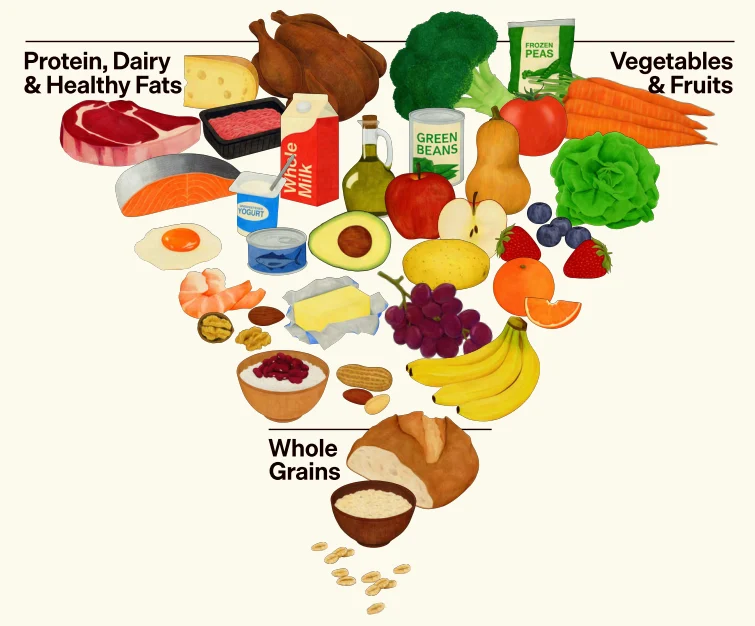
The latest iteration of the Dietary Guidelines for Americans (DGAs), spanning from 2025 to 2030, has been unveiled this week, championing the principle of "eat real food" with a notably stronger emphasis on curtailing added sugars and highly processed food consumption. However, alongside these welcome directives, the release has been met with scrutiny due to the reintroduction of a pyramid-like graphic that appears to contradict some of the core textual recommendations, particularly concerning saturated fat intake.
The new DGAs, a cornerstone of federal nutrition policy and guidance for Americans, are developed every five years by the U.S. Departments of Agriculture (USDA) and Health and Human Services (HHS). This process typically involves an independent Dietary Guidelines Advisory Committee (DGAC) tasked with reviewing the latest scientific evidence. For the 2025-2030 cycle, this committee’s comprehensive Scientific Report was initially released after extensive review. However, the administration opted to commission a supplemental scientific analysis, a departure from the usual process, which has raised questions about transparency and potential influences.
A Shift Towards "Real Food" and Processed Items
A significant development in the 2025-2030 DGAs is the explicit identification and discouragement of "highly processed foods." While previous guidelines have advocated for whole foods and cautioned against excessive added sugar and sodium, this is the first edition to broadly target this category. Although the term "highly processed" can be somewhat nebulous, as food processing exists on a continuum, the guidelines specify avoiding sugar-sweetened beverages, salty or sweet packaged snacks, and ready-to-eat meals. The accompanying visual even highlights "unsweetened" yogurt, reinforcing this direction.
The recommendations also prioritize whole, fiber-rich grains while urging a substantial reduction in highly processed, refined carbohydrates like white bread. This aligns with a growing body of research linking the consumption of ultra-processed foods to adverse health outcomes, including obesity, type 2 diabetes, and cardiovascular disease. A 2023 study published in The BMJ indicated that higher consumption of ultra-processed foods was associated with an increased risk of mortality from all causes, particularly cardiovascular diseases and certain cancers.
Stricter Limits on Added Sugars and a New Threshold for Children
The new DGAs adopt a more stringent stance on added sugars, stating that "no amount of added sugars or non-nutritive sweeteners is recommended or considered part of a healthy or nutritious diet." Practically, this translates to a recommendation that no single meal should exceed 10 grams of added sugars. While this is a departure from the previous guideline of limiting added sugars to 10% of daily calories (approximately 50 grams in a 2,000-calorie diet), it presents a new challenge for consumers accustomed to tracking percentages rather than absolute gram amounts per meal.
Furthermore, the guidelines now advise children to avoid added sugars entirely until the age of 10, a significant shift from the previous recommendation that extended this avoidance only until age two. This move reflects growing concerns about the impact of early and excessive sugar consumption on children’s long-term health, including the development of unhealthy eating habits and increased risk of childhood obesity. Data from the Centers for Disease Control and Prevention (CDC) consistently shows high rates of childhood obesity in the United States, a trend that public health officials are striving to reverse.
Conflicting Messages on Saturated Fats and the "New Food Pyramid"
Despite the enhanced focus on limiting added sugars and processed foods, the visual presentation of the 2025-2030 DGAs has generated considerable debate. The reintroduction of a pyramid-like graphic, albeit inverted, places a prominent emphasis on foods such as steak, full-fat milk, and butter. This visual prominence has led to concerns that it may overshadow the textual guidelines, particularly the long-standing recommendation to limit saturated fat intake to no more than 10% of total daily calories.
Dr. Frank Hu, Professor of Nutrition and Epidemiology and Chair of the Department of Nutrition at the Harvard T.H. Chan School of Public Health, expressed this concern. "I think the new Guidelines move in the right direction by reinforcing the importance of reducing added sugars and cutting back on refined grains and other highly processed foods," Dr. Hu stated. "However, there appear to be several contradictions within the DGAs and between the DGAs and the new pyramid. The mixed messages surrounding saturated-fat-rich foods such as red meat, butter, and beef tallow may lead to confusion and potentially higher intake of saturated fat and increased LDL cholesterol and cardiovascular risk."
The actual text of the DGAs does retain the 10% limit for saturated fat. However, the graphic’s emphasis on foods high in saturated fat, such as steak, cheese, whole milk, and butter, raises questions about practical implementation. To illustrate the potential for exceeding the saturated fat limit, consider a 2,000-calorie diet where 10% equates to approximately 22 grams of saturated fat. If a person consumes three servings of full-fat dairy – an 8-oz cup of whole milk (5 grams saturated fat), ¾ cup of full-fat Greek yogurt (6 grams), and 1 ounce of cheddar cheese (6 grams) – they have already consumed 17 grams of saturated fat. Adding a single tablespoon of butter (7 grams) or beef tallow (6 grams), both suggested cooking fats, would push them over the daily limit, even before accounting for other food intake.
While olive oil is depicted in the pyramid and acknowledged for its "essential fatty acids," experts point out that it is not the most potent source. Dr. Hu explained, "Olive oil contains mostly oleic acid, but relatively small amounts of essential fatty acids such as alpha-linolenic acid and linoleic acid compared with other oils that are rich sources of these fatty acids, such as soybean oil and canola oil. Importantly, all these plant oils have been shown to lower LDL cholesterol and cardiovascular risk compared with animal fats such as butter or tropical fats such as coconut oil and palm oil." This highlights a nuanced distinction between various healthy fats that the pyramid graphic may not adequately convey.
Increased Protein Recommendations and the "Protein Package"
The 2025-2030 DGAs also propose an increase in recommended protein intake for adults, suggesting 1.2 to 1.6 grams of protein per kilogram of body weight per day. This is a notable increase from previous recommendations for minimum intake. While protein needs are indeed variable and depend on factors such as age, activity level, and health status, the DGAs’ broader range and higher figures have drawn attention.
"Substantially raising overall protein intake without distinguishing between different protein sources may have unintended long-term health implications," warned Dr. Hu. "Evidence continues to suggest that plant-based proteins and fish are associated with more favorable health outcomes than diets high in red meat." This observation underscores the importance of the "protein package"—the accompanying fats, fiber, sodium, and other nutrients within a protein source—which significantly influences its overall health impact.
While the guidelines recommend a "variety of protein foods" from both animal and plant sources, there is a lack of clear guidance on prioritizing certain options. Given the stated saturated fat limits, the quality and type of protein consumed become critical. For instance, opting for lean poultry, fish, or plant-based proteins like legumes and tofu generally offers a healthier "package" compared to fatty cuts of red meat or processed meats, which can be high in saturated fat and sodium.
Ambiguous Guidance on Alcohol and Environmental Considerations
The advice regarding alcohol consumption is notably vague, simply urging individuals to "consume less alcohol for better health." Without specific quantitative limits, it remains challenging for the public to interpret what constitutes "less" alcohol. This lack of clarity stands in contrast to the more detailed recommendations provided for other food groups.
Another significant omission from the 2025-2030 DGAs is any consideration of the environmental and socioeconomic impacts of dietary choices. Food production and consumption are major contributors to environmental degradation, including greenhouse gas emissions, water usage, and land degradation. Concurrently, socioeconomic factors profoundly shape food access and dietary patterns. The exclusion of these critical dimensions means the guidelines miss an opportunity to promote a more sustainable and equitable food system.
Transparency and the Supplemental Analysis Process
The development process for the 2025-2030 DGAs has been subject to particular scrutiny this year. The traditional route involves an independent DGAC reviewing scientific evidence. However, for this cycle, the administration did not fully adopt the DGAC’s report, instead commissioning a supplemental scientific analysis. This analysis was conducted by a group selected through a federal contracting process, a departure from the established vetting and selection of DGAC members.
Concerns have been raised regarding the transparency of this supplemental analysis. Dr. Deirdre Tobias, an assistant professor at the Harvard Chan School of Public Health who served on the 2025-2030 DGAC, noted in a Q&A with Harvard Chan News, "As of today, there has not been transparency in who wrote the new DGAs. Although there are documents included in the appendices by named scientists, there is no transparency in the methodology and rigor that was employed, or why certain topics were selected to be relitigated. The reviews themselves, as well as their overall presentation and integration, deviate significantly from the rigorous process that the HHS developed for the DGAs to ensure the evidence base and its committees’ conclusions were replicable, unbiased, transparent, and free from non-scientific influences."
Further adding to these concerns, some have pointed to the financial ties of reviewers involved in the supplemental analysis to the beef and dairy industries. These disclosed financial connections have fueled discussions about potential biases influencing the prominent placement of meat and dairy products in the accompanying visuals.
The Bottom Line: Navigating Mixed Messages
In conclusion, the 2025-2030 Dietary Guidelines for Americans present a mixed bag of progress and perplexing contradictions. While the stronger stance against added sugars and highly processed foods is a positive step, the visual emphasis on saturated-fat-rich animal products in the "New Food Pyramid" creates a disorienting message. The guidelines, historically policy-oriented, appear to be aiming for a more consumer-friendly presentation with a shorter format and associated graphics, a strategy designed to increase public engagement.
However, historical data from the CDC indicates that Americans have consistently struggled to adhere to dietary guidelines. It remains to be seen whether this latest edition will achieve greater compliance. For individuals seeking clearer, more consistent advice, resources like Harvard’s Healthy Eating Plate, which prioritizes fruits, vegetables, whole grains, and healthy protein sources, offer a valuable alternative. Consulting with a registered dietitian can also provide personalized guidance tailored to individual needs and health goals, helping to navigate the complexities and potential confusions presented by the new DGAs. The ongoing debate surrounding the transparency of the advisory process also underscores the critical importance of an open, evidence-based approach to shaping national nutrition policy.
