
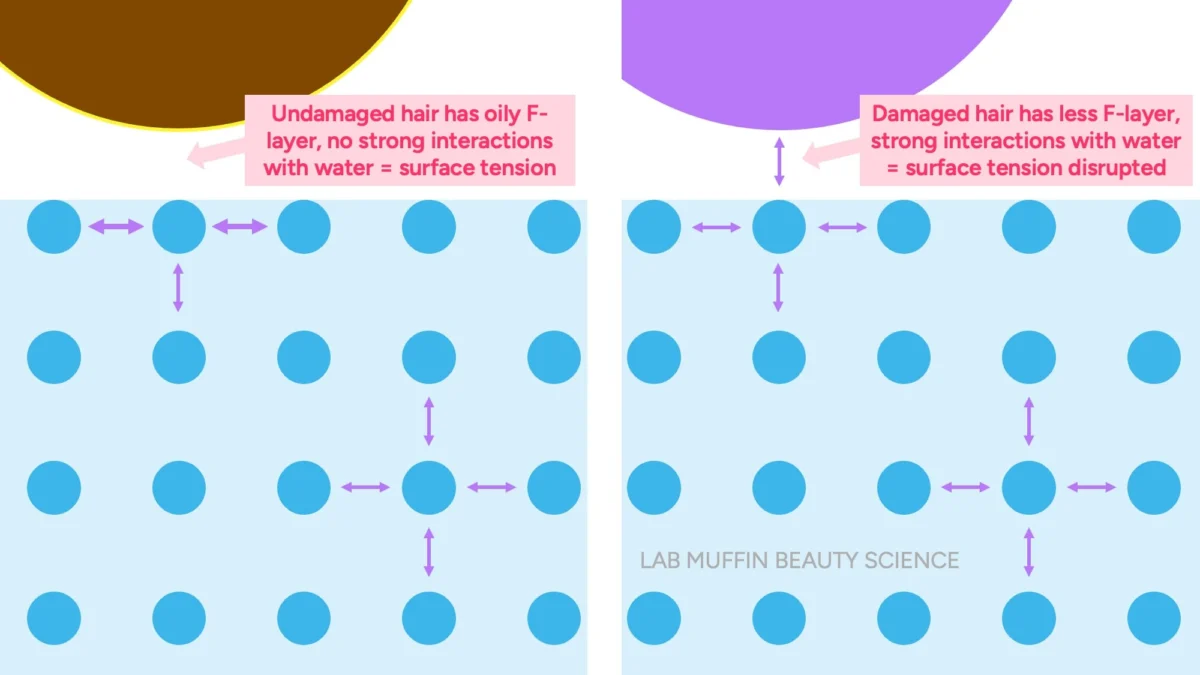
The widespread belief that popular at-home "hair porosity tests" accurately diagnose hair’s internal structure and water absorption capabilities is fundamentally flawed, according to advancements in cosmetic science. These prevalent methods, such as the float test and the drop test, do not measure the true porosity of hair but rather its surface condition and the intricate physics of water interaction, primarily surface tension. While often leading individuals to products that coincidentally suit their hair, the underlying scientific explanations for these tests are largely inaccurate, creating a disconnect between popular haircare wisdom and empirical evidence.
The concept of "hair porosity" has permeated the beauty industry, particularly within communities focused on textured and natural hair. It posits that hair can be categorized as low, medium, or high porosity, influencing product absorption and retention. This categorization often dictates product recommendations, from heavy butters for "high porosity" hair (believed to have open cuticles) to lighter formulations for "low porosity" hair (thought to have tightly sealed cuticles). However, this simplified model overlooks the complex biochemical and physical realities of human hair. The pervasive nature of these tests, often shared widely on social media platforms and beauty blogs, highlights a broader challenge in translating scientific understanding into accessible consumer advice.
Debunking the Myth of Waterproof Hair
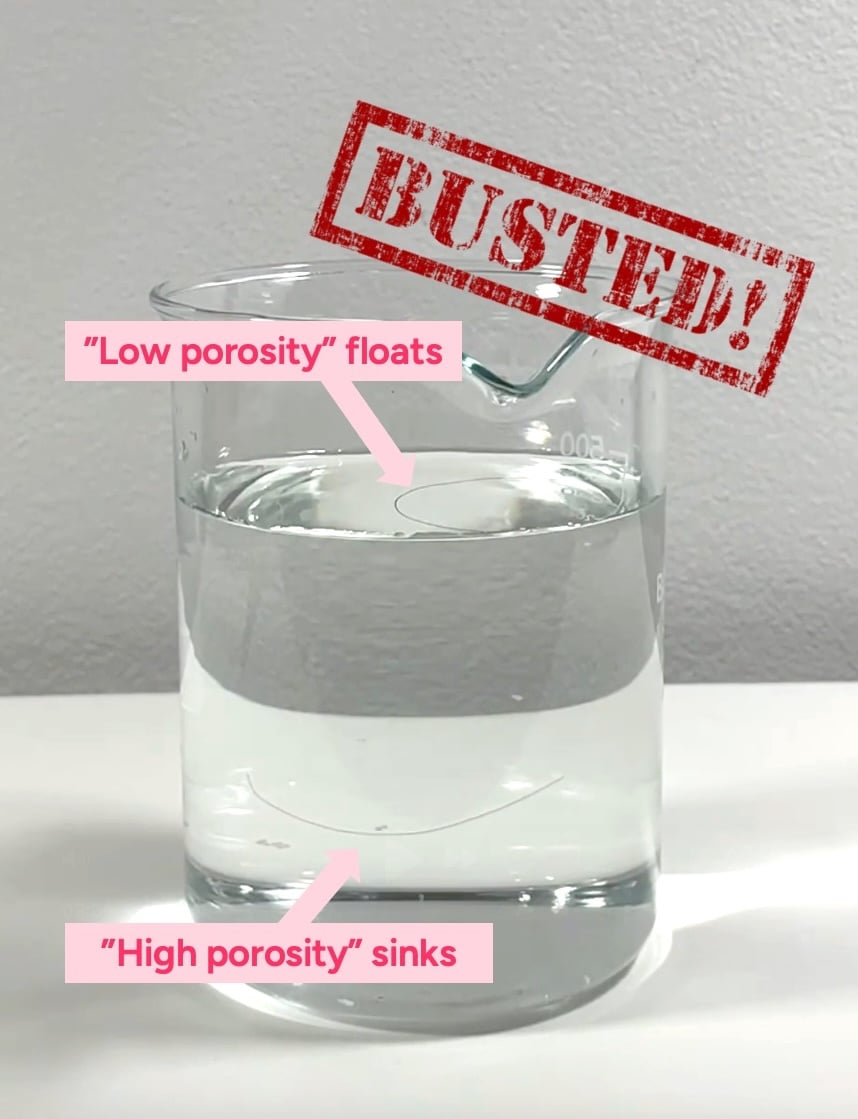
A central misconception underpinning the traditional understanding of hair porosity is the idea that healthy, undamaged hair is effectively waterproof. Proponents of this myth suggest that a perfectly intact cuticle, the outermost layer of the hair shaft, seals out water, and that conditioners mimic this function to protect damaged hair. Scientific research, however, unequivocally refutes this.
Far from being waterproof, undamaged human hair possesses a remarkable capacity to absorb water. Studies, such as those detailed in Robbins CR.’s authoritative "Chemical and Physical Behavior of Human Hair," demonstrate that even healthy, conditioned hair can absorb approximately 30% of its own weight in water within minutes. This absorption is not a slow process but occurs rapidly, with the hair’s water content fluctuating significantly with ambient humidity.
| Relative humidity (%) | Weight of water absorbed (%) |
|---|---|
| 0 | 0 |
| 8 | 3.9 |
| 40 | 10.2 |
| 63 | 14.8 |
| 86 | 22.6 |
| 100 | 31.2 |
Data adapted from Robbins CR. Chemical and Physical Behavior of Human Hair. Springer Berlin Heidelberg 2012.
This data illustrates a direct correlation between atmospheric humidity and the amount of water absorbed by hair, even in its undamaged state. At 100% relative humidity, hair can hold nearly a third of its dry weight in water. This phenomenon is a fundamental characteristic of hair’s protein structure, primarily keratin, which is highly hygroscopic—meaning it readily attracts and holds water molecules. The keratin proteins within the hair cortex contain numerous hydrophilic (water-attracting) sites, allowing water to penetrate and bind to the internal structure.
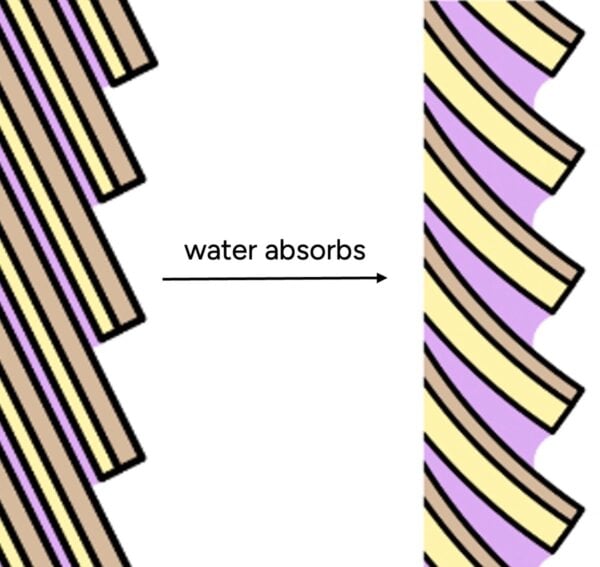
The natural F-layer, a thin lipid layer covalently bonded to the outer surface of each cuticle scale, provides some hydrophobic (water-repelling) properties. However, this layer is not a continuous, impenetrable seal. Hair cuticles are arranged like overlapping shingles on a roof, creating microscopic gaps and edges. These inherent structural characteristics mean that hair is not a hermetically sealed cylinder but rather a fibrous material with pathways for water molecules, particularly in their gaseous state, to enter. The "pinecone" analogy often used by scientists effectively describes this structure, where overlapping scales allow for flexibility and, crucially, for some permeability.
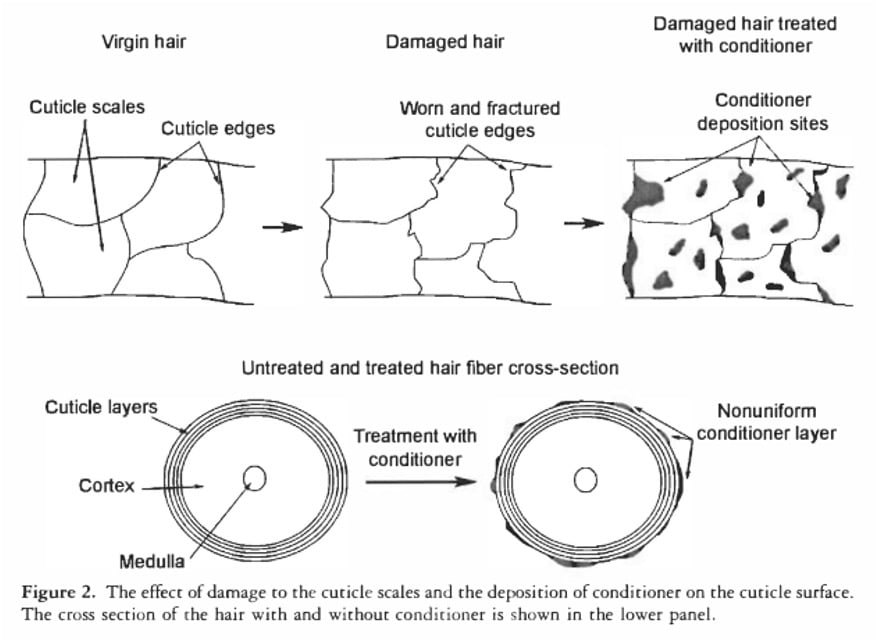
Similarly, the role of conditioners is often misunderstood. Conditioners are designed to smooth the cuticle, reduce friction, and impart softness and shine. They achieve this by depositing a thin layer of conditioning agents, typically cationic surfactants and silicones, onto the hair surface. However, these deposits are not continuous, uniform films that completely "seal" the hair. Instead, they form microscopic "blobs" or patches, as evidenced by studies utilizing techniques like atomic force microscopy (AFM), such as research by La Torre and Bhushan (2006). While these blobs are sufficient to alter the macroscopic feel and appearance of hair, individual water molecules are infinitesimally small and can readily bypass these discontinuous layers, negating any notion of a waterproof seal.
Deconstructing the At-Home Porosity Tests
Given that even healthy hair absorbs a significant amount of water, the observations from popular at-home porosity tests require a different explanation. These tests include:
- The Float Test: A strand of hair is placed in a glass of water. If it sinks quickly, it’s deemed "high porosity"; if it floats, "low porosity." The common explanation attributes sinking to "high porosity" hair rapidly absorbing water and becoming denser.
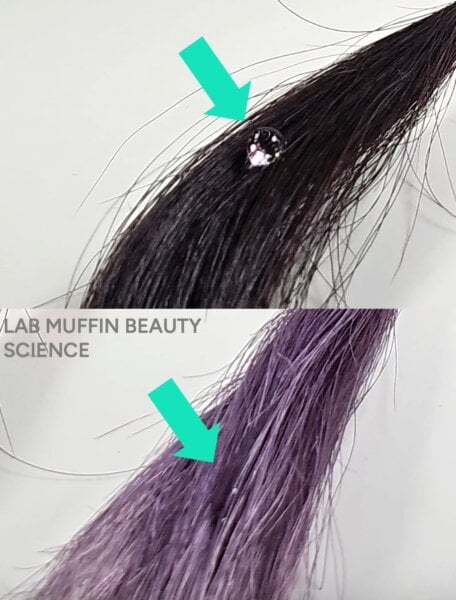
- The Drop Test: A drop of water is placed on a lock of hair. If it beads up, the hair is "low porosity"; if it flattens and spreads, it’s "high porosity." This is typically explained by "high porosity" hair having more "holes" to absorb the water.
These explanations are misleading because they ignore the critical role of surface tension.
Understanding Surface Tension: The Real Culprit
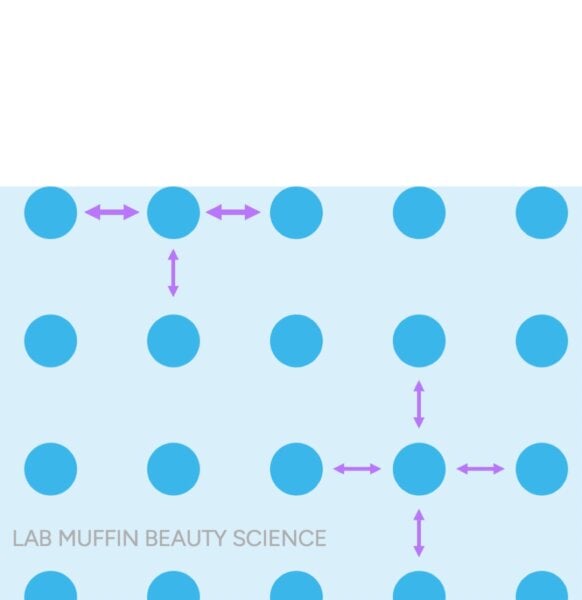
Surface tension is a fundamental physical property of liquids, particularly water, arising from the cohesive forces between liquid molecules. Water molecules exhibit strong hydrogen bonding, attracting each other. At the surface of a liquid, molecules have fewer neighboring molecules to bond with compared to those in the bulk of the liquid. This imbalance creates an inward pull, minimizing the surface area and resulting in a "skin-like" effect. This "skin" is strong enough to support objects denser than water, such as insects, paperclips, and even hair strands, allowing them to "float" on the surface without sinking.
-
Explaining the Float Test through Surface Tension:
The float test is primarily an indicator of the hair’s surface hydrophobicity or hydrophilicity, which is directly related to its surface damage. Undamaged hair retains a relatively intact F-layer, a naturally occurring, covalently bound lipid layer that renders the hair surface hydrophobic (water-repelling). This hydrophobic surface allows the hair strand to be supported by the water’s surface tension, causing it to float.
However, when hair is damaged (e.g., from chemical treatments, heat styling, harsh brushing, or UV exposure), the F-layer can be eroded or completely removed. This exposes the underlying keratin proteins, which are more hydrophilic (water-attracting). When a damaged, hydrophilic hair strand encounters water, its surface readily forms hydrogen bonds with the water molecules. This interaction disrupts the water’s surface tension around the hair, effectively breaking the "skin" that would otherwise support it. Consequently, the hair, which is denser than water, sinks. The sinking is not due to rapid internal water absorption increasing density but rather the collapse of surface tension due to the altered surface chemistry of the hair.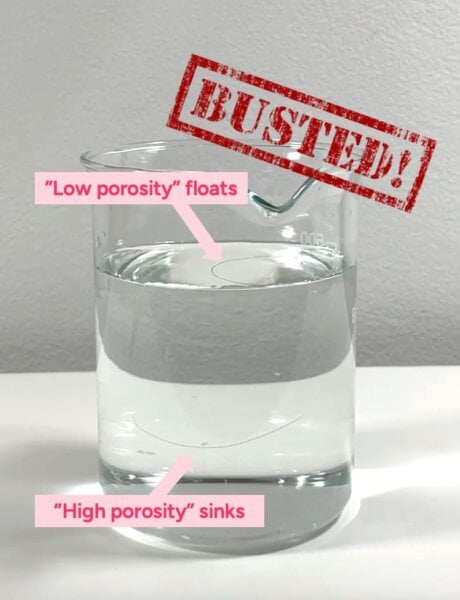
-
Explaining the Drop Test through Surface Tension:
Similarly, the drop test is an assessment of the hair’s surface wettability, governed by surface tension. On an undamaged hair strand with its hydrophobic F-layer intact, water molecules prefer to bond with each other rather than with the hair surface. This high cohesive force within the water drop, combined with low adhesive force to the hair, causes the water to bead up into a spherical shape, minimizing contact with the hair surface. This is a classic demonstration of surface tension at play, where the water forms the smallest possible surface area against the hydrophobic material.
Conversely, on damaged hair where the F-layer is compromised and the surface is more hydrophilic, water molecules readily adhere to the hair shaft. The adhesive forces between water and hair become stronger, overcoming the cohesive forces within the water drop. This causes the water drop to flatten out and spread across the hair surface, indicating increased wettability. Again, this is not an indication of water rapidly soaking into the hair’s internal structure but rather spreading across its surface due to altered surface chemistry.
It’s crucial to differentiate between water absorption in its gaseous state (humidity) and liquid state. Hair readily absorbs water vapor from the air because individual water molecules are small enough to navigate the microscopic gaps in the cuticle without encountering significant surface tension barriers. When immersed in liquid water or subjected to a water drop, the interaction is dominated by the macroscopic forces of surface tension and the wettability of the hair’s outer layer.
The Functional Utility and Scientific Limitations of Porosity Advice
Despite their scientific inaccuracies, "porosity" tests have gained widespread traction because the advice derived from them often yields positive results for consumers. This apparent success is largely coincidental, stemming from the fact that these tests do provide a proxy for hair surface damage.
- "High porosity" hair (sinks/spreads): This diagnosis often correlates with damaged hair that has a compromised F-layer and/or lifted cuticles. Such hair tends to feel rougher, tangles more easily, and can be more susceptible to further damage. Products recommended for "high porosity" hair often include heavier conditioners, leave-in treatments, and oils designed to smooth the cuticle, provide lubrication, and mimic the protective functions of the F-layer. These products can indeed improve the feel and appearance of damaged hair by coating it and reducing friction, regardless of the hair’s actual internal "porosity."
- "Low porosity" hair (floats/beads): This diagnosis typically indicates relatively undamaged hair with an intact F-layer and smooth cuticles. Such hair often appears shiny and feels smooth. The advice for "low porosity" hair usually involves lighter products that won’t build up, as this hair type might be prone to feeling greasy or weighed down. While the underlying science of "low porosity" being resistant to water absorption is incorrect (as all hair absorbs water), the product recommendations often work because undamaged hair benefits from lighter formulations that enhance its natural luster without overwhelming it.
However, the scientific mischaracterization embedded in these tests can lead to problematic conclusions. For instance, a hair professional relying on a float test to determine chemical treatment times might be severely misled. Chemical treatments (like perms, relaxers, or color) require precise timing based on how quickly the chemicals penetrate the hair cortex. While surface damage might make hair appear "high porosity," the internal structure might still be relatively resistant to chemical penetration, leading to under-processing if the professional incorrectly assumes rapid absorption. Conversely, hair coated heavily with oils or certain styling products might yield a "low porosity" result in the float test due to enhanced surface hydrophobicity, even if the hair underneath is structurally damaged and would benefit from different chemical processing times.
Implications for Hairdressers and Consumers
For professional hairdressers, relying on these anecdotal tests for critical procedures like chemical treatments can have serious consequences. Incorrect processing times, dictated by a flawed understanding of "porosity," can lead to poor results, uneven color, or even significant hair damage. Cosmetic scientists and trichologists emphasize that the most reliable method for assessing how hair will react to a chemical treatment is a strand test—directly applying the product to a small, inconspicuous section of the client’s hair and observing its actual reaction. This empirical approach bypasses the erroneous interpretations of surface tension tests and provides real-world data.
For consumers, while the product recommendations often align with what damaged or undamaged hair needs, the misinformation can foster a misunderstanding of hair science. This can lead to unnecessary anxiety about "correctly" diagnosing porosity or investing in products based on faulty scientific premises. A more accurate and empowering approach involves understanding the actual condition of one’s hair—whether it’s damaged, dry, oily, fine, or coarse—and selecting products that address those specific, observable characteristics.
In conclusion, while the vernacular of "hair porosity" has become deeply ingrained in popular haircare discourse, the scientific community maintains that the common at-home tests are not accurate measures of hair’s internal water absorption. Instead, they primarily reflect the hair’s surface integrity and its interaction with water via surface tension. Recognizing this distinction is crucial for advancing evidence-based haircare, ensuring both professionals and consumers make informed decisions grounded in actual scientific principles, rather than misleading home experiments. The focus should shift from an elusive concept of "porosity" to a clear understanding of hair damage, surface chemistry, and the real mechanisms of hydration and conditioning.
References
- Robbins CR. Chemical and Physical Behavior of Human Hair. 5th ed. Springer Berlin Heidelberg 2012.
- La Torre C, Bhushan B. Nanotribological effects of silicone type, silicone deposition level, and surfactant type on human hair using atomic force microscopy. J Cosmet Sci. 2006;57(1):37-56.
