
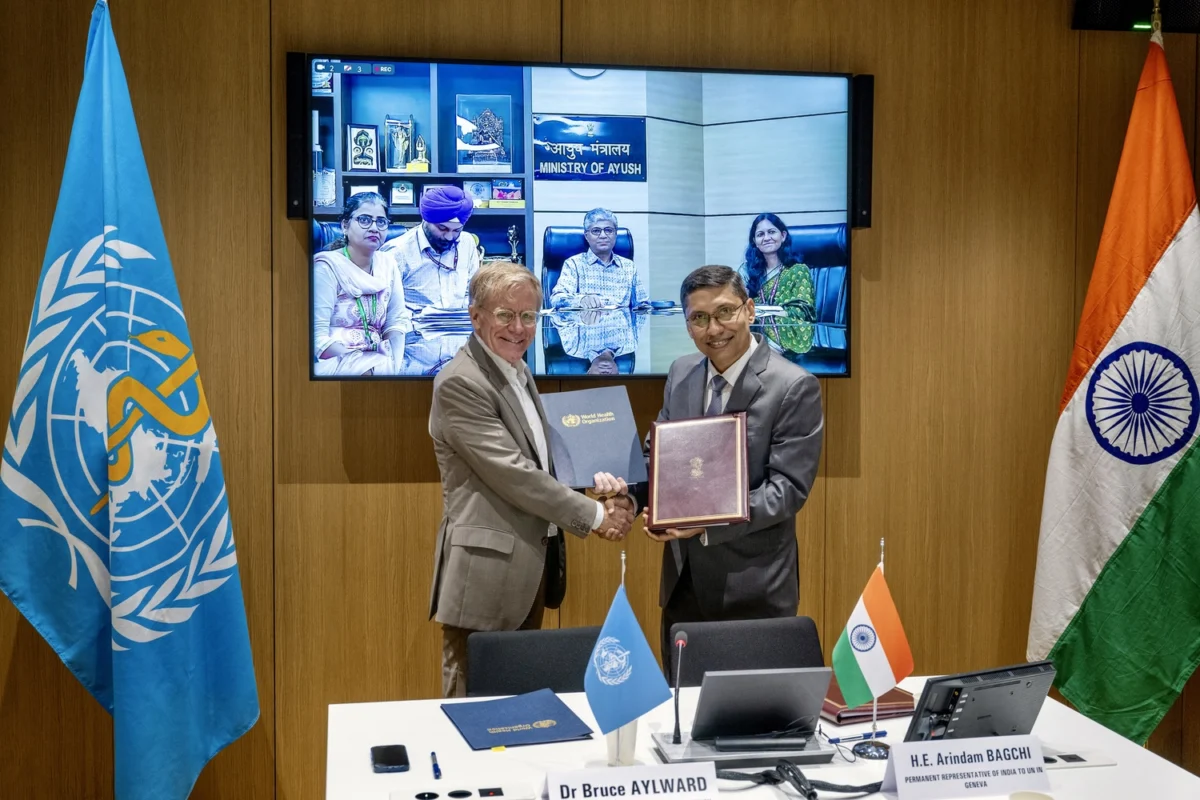
Traditional medicine remains a cornerstone of health and well-being for billions of people across the globe, serving as a primary or complementary source of care in diverse cultural contexts. In a significant move to formalize and scientifically validate these practices, the Government of India has committed US$ 85 million over a ten-year period, spanning 2022 to 2032, to support the programming of the World Health Organization (WHO) Global Traditional Medicine Centre (GTMC). This financial injection is designed to strengthen the evidence base for traditional medicine, providing a rigorous framework for policies, clinical practices, product safety, and public utilization.
A Landmark Donor Agreement and Strategic Investment
The recent signing ceremony in Geneva serves as the latest chapter in a broader US$ 250 million investment by India aimed at establishing the GTMC as a permanent, global knowledge hub. This total commitment encompasses not only the core programmatic workplan but also the operational costs associated with the Centre’s interim premises and the construction of a new, purpose-built facility in Jamnagar, Gujarat.
Beyond its immediate mandate, a portion of this funding is strategically earmarked for the WHO’s upcoming Investment Round, which aims to resource the organization’s core operational activities from 2025 to 2028. This move highlights India’s intent to position traditional medicine not as a peripheral health interest, but as an essential, integrated component of universal health coverage (UHC). By scaling up the WHO’s technical capacity across various regional offices and divisions, this collaboration fosters a "One WHO" approach, ensuring that traditional, complementary, and integrative medicine (TCI) is evaluated with the same scientific scrutiny as conventional pharmaceutical interventions.
Chronology of the WHO-India Partnership
The path to the current funding commitment began with a vision to harmonize ancient wisdom with modern clinical science. The following timeline outlines the evolution of this partnership:
- 2022: The WHO Global Centre for Traditional Medicine is officially established in Jamnagar, India, with the support of the Indian government.
- August 2023: The inaugural WHO Global Traditional Medicine Summit is held in Gujarat, leading to the adoption of the "Gujarat Declaration," which emphasizes the need for high-quality, evidence-based integration of traditional practices.
- 2023: India signs a five-year technical partnership agreement specifically focused on the WHO’s Traditional, Complementary, and Integrative Medicine (TCI) unit.
- 2025 (Upcoming): The launch of the new WHO Global Strategy for Traditional Medicine (2025–2034) is anticipated at the 78th World Health Assembly in May.
- November 2025: The second WHO Global Traditional Medicine Summit is scheduled to take place, serving as a platform to monitor the implementation of the new global strategy.
The Five Pillars of the Global Traditional Medicine Centre
Led by Director a.i. Dr. Shyama Kuruvilla, the GTMC functions as a knowledge hub focused on five interconnected domains. These pillars are designed to address the challenges of regulation, quality control, and scientific validation:
- Research and Evidence: Conducting systematic reviews and clinical trials to determine the efficacy and safety of traditional treatments.
- Primary Health Care and UHC: Developing frameworks to incorporate traditional practitioners into national primary health systems.
- Indigenous Knowledge and Biodiversity: Protecting traditional intellectual property and ensuring the sustainable use of natural resources in medicine production.
- Digital Health Applications: Utilizing AI and big data to map trends in traditional medicine usage and clinical outcomes.
- Collaborations and Summits: Facilitating international dialogues and the biennial Global Traditional Medicine Summit to build consensus among member states.
Official Perspectives and Institutional Alignment
The commitment from India is viewed by WHO leadership as a critical intervention in global health equity. Dr. Bruce Aylward, Assistant Director-General of the Universal Health Coverage and Life Course division at the WHO, emphasized that the timing of this investment is pivotal. "India’s commitment and leadership in expanding the evidence-based contribution of traditional medicine to the health and well-being of all people and the planet comes at an opportune moment," Dr. Aylward stated. He noted that traditional medicine, when integrated properly into national systems, acts as a vital tool to reach marginalized populations who may otherwise lack access to conventional care.
Vaidya Rajesh Kotecha, Secretary of the Ministry of Ayush, underscored the diplomatic and technical significance of the agreement. "The signing of this donor agreement is a major milestone towards achieving the shared vision of Prime Minister Shri Narendra Modi and WHO Director-General Tedros," Kotecha remarked. Similarly, Ambassador Arindam Bagchi, Permanent Representative of India to the UN in Geneva, reaffirmed that the Jamnagar-based centre serves as a beacon for member states seeking to harness indigenous health systems to serve humanity.

Implications for Global Health Policy
The integration of traditional medicine into modern healthcare is not without challenges, primarily regarding safety standards, quality control, and the risk of misinformation. The WHO’s TCI unit, in collaboration with the GTMC, is actively addressing these issues by publishing standardized terminologies and benchmark documents. These technical products are essential for countries that wish to regulate traditional practitioners and ensure that herbal products meet international safety criteria.
The launch of the 2025–2034 Global Strategy represents a paradigm shift. Historically, international health policy often overlooked traditional medicine or treated it with skepticism. The current multisectoral agenda signals a transition toward a more inclusive, pluralistic model of healthcare. By providing the data necessary to evaluate traditional medicine, the WHO-India partnership aims to reduce the "evidence gap" that has long hindered the widespread acceptance of these practices.
Furthermore, the focus on biodiversity and indigenous knowledge suggests that this initiative also carries implications for sustainable development. As climate change threatens the natural habitats of many medicinal plants, the GTMC’s work on biodiversity ensures that these health resources are managed responsibly, preventing over-harvesting while preserving the cultural heritage of indigenous communities.
Economic and Technical Impact
From an economic perspective, the support for the TCI unit and the GTMC’s technical expert networks allows for a coordinated global approach. Instead of individual nations attempting to build regulatory frameworks in isolation, the WHO provides a centralized repository of evidence-informed technical products. This reduces the administrative burden on member states and helps standardize the practice of traditional medicine, which is essential for global trade in medicinal products.
The US$ 85 million donation is specifically designed to sustain this technical support over a decade, ensuring that the work is not merely project-based but part of a long-term shift in health infrastructure. By linking this funding to the broader WHO Investment Round, India has ensured that traditional medicine is embedded into the core operations of the organization, rather than being sidelined as an auxiliary initiative.
Conclusion: A Path Toward "Health for All"
As the world moves toward the goal of Universal Health Coverage, the integration of traditional, complementary, and integrative medicine offers a viable path to expanding care. The partnership between the Government of India and the WHO creates a structured, scientific, and collaborative environment to evaluate these practices.
With the upcoming 2025 World Health Assembly serving as a catalyst for the new Global Strategy, the work being conducted in Jamnagar and Geneva is expected to have far-reaching consequences. By bridging the gap between historical practice and contemporary clinical evidence, the WHO Global Traditional Medicine Centre is positioning itself as a vital instrument in the ongoing effort to achieve equitable, sustainable, and culturally sensitive health outcomes for the global population. The decade-long commitment from India provides the necessary stability to transform this vision into a tangible reality for the millions of people who rely on traditional medicine as their first line of defense in maintaining health.
