
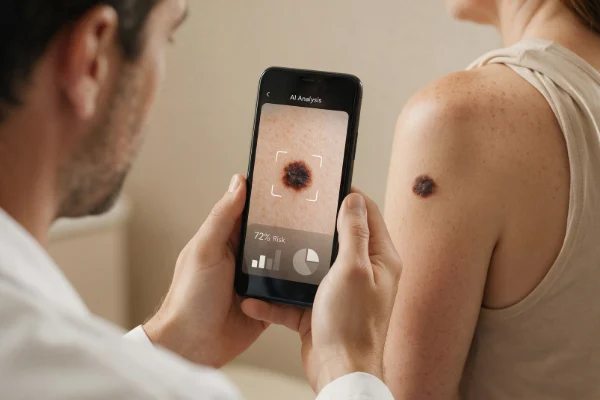
Artificial intelligence has rapidly transformed the landscape of modern medicine, penetrating fields from radiology to oncology with promises of unprecedented speed and diagnostic precision. Among the most promising consumer-facing applications are algorithmic tools designed to assist in the early detection of dermatological malignancies, particularly melanoma and other forms of skin cancer. However, a comprehensive new study conducted in the Netherlands has revealed a nuanced consumer perspective: while stand-alone artificial intelligence skin cancer detection tools hold a place in modern healthcare pathways, they are valued significantly less by the public than hybrid models that combine algorithmic efficiency with human medical oversight. Furthermore, traditional in-person consultations with dermatologists remain the gold standard of perceived value and patient trust.
The research, which utilized a survey-based, mixed-methods design embedded within a randomized controlled trial, sought to quantify the economic value that patients place on varying degrees of technological integration versus human clinical care. Conducted against a backdrop of increasing waiting lists for specialist dermatological care across Europe, the findings offer critical insights for policymakers, healthcare providers, and health-tech developers attempting to integrate artificial intelligence into publicly funded and private healthcare systems.
Methodology and Participant Demographics
The investigation was structured to capture both quantitative economic metrics and qualitative behavioral insights. Researchers cast a wide net across the Dutch population between August 2022 and February 2023, inviting 11,621 individuals to participate in the comprehensive questionnaire. From this initial cohort, 1,953 participants successfully completed the survey, providing a robust dataset for economic modeling and thematic analysis.
An examination of the demographic characteristics of the responding cohort reveals several notable patterns. The mean age of participants stood at 58.4 years, an important demographic variable given that older populations are statistically at a higher risk for developing various forms of skin cancer, including basal cell carcinoma, squamous cell carcinoma, and malignant melanoma. Women comprised 57.6% of the respondents, while an overwhelming majority—95.4%—self-reported having a light skin type, which is traditionally associated with a higher susceptibility to ultraviolet-induced skin damage and skin malignancies.
Educational attainment within the cohort skewed relatively high, with nearly half of the participants reporting advanced educational levels. Additionally, digital literacy and prior technological engagement appeared high among the group: 79.4% of respondents indicated that they had previously utilized some form of artificial intelligence-based application in their daily lives or healthcare journeys. This prior familiarity is vital, as it suggests that the participants were not entirely uninitiated when evaluating hypothetical algorithmic healthcare tools.
Evaluating Three Distinct Healthcare Scenarios
To accurately gauge public sentiment and economic valuation, the study evaluated participants’ willingness to pay (WTP) for three distinct, hypothetical approaches to skin cancer risk detection. These scenarios represented a gradient of technological reliance and human clinical involvement, ranging from fully automated digital solutions to traditional face-to-face medical encounters.
The first scenario presented to participants was an AI-based smartphone application operating entirely independently. In this model, a user photographs a suspicious skin lesion, and the embedded algorithm provides an immediate risk assessment without human clinical review. The second scenario introduced a hybrid approach: an AI-based application whose preliminary findings are subsequently reviewed and validated by a teledermatologist—a qualified medical specialist assessing the imagery remotely. The third and final scenario represented the traditional clinical benchmark: a standard, in-person consultation with a physical dermatologist who conducts a hands-on examination, potentially utilizing dermatoscopy.
The Economic Valuation Breakdown
The economic findings of the study laid bare a stark hierarchy of consumer valuation across the three proposed diagnostic pathways. When asked to assign a monetary value via willingness-to-pay metrics, participants placed the lowest economic value on the stand-alone artificial intelligence application. The median willingness to pay for AI alone stood at a modest €5.
When human expertise was injected into the workflow, the perceived value experienced a fourfold increase. The median willingness to pay for the AI application combined with teledermatologist oversight rose to €20. This substantial jump underscores the psychological and clinical importance of human validation in the diagnostic process. Consumers, it appears, are willing to pay significantly more when an algorithm’s output is verified by a trained medical professional, mitigating fears of algorithmic error or misdiagnosis.
Despite the appeal of technological convenience, the traditional method remained firmly at the top of the economic hierarchy. The median willingness to pay for an in-person dermatologist consultation reached €50—ten times the value assigned to the stand-alone AI tool and two and a half times the value of the hybrid model. This clearly indicates that while digital health tools are embraced as supplementary or triage mechanisms, they are not yet viewed by the public as equitable substitutes for direct physical examination by a medical specialist.
Further regression analysis within the study revealed another fascinating demographic trend: age was the single characteristic consistently and positively associated with a higher willingness to pay across all three scenarios. Older individuals, who historically bear a higher burden of skin cancer incidence, demonstrated a greater financial commitment to accessing diagnostic tools and consultations, reflecting a heightened awareness of health risks associated with aging.
Qualitative Insights: Trust, Utility, and Expectations of Free Healthcare
To complement the quantitative economic data, the researchers gathered qualitative feedback to understand the underlying motivations, hesitations, and perceptions driving the participants’ financial valuations. The thematic analysis of these responses provided vital context for why stand-alone artificial intelligence tools struggled to command higher monetary figures.
A primary driver of lower willingness to pay for the AI-only model stemmed from a fundamental lack of trust in automated systems when applied to critical health decisions. Many participants expressed skepticism regarding the diagnostic accuracy of algorithms, particularly when dealing with complex, ambiguous, or evolving dermatological lesions. Concerns were raised about the inability of an app to account for a patient’s complete medical history, lifestyle factors, or changes over time that a human clinician might intuitively investigate during a consultation.
Furthermore, a subset of respondents perceived a distinct lack of personal value in proprietary health apps, questioning whether such tools offered genuine clinical utility or merely served as commercial ventures capitalizing on health anxieties. Another prominent theme emerging from the qualitative data was the expectation of state-funded healthcare. In the context of the Netherlands, where healthcare is heavily regulated and subsidized through universal insurance schemes, many participants expressed philosophical or practical resistance to paying out-of-pocket for digital health solutions, viewing skin cancer screening as a fundamental right that should be fully covered by statutory health insurance rather than monetized through consumer apps.
Chronology of Digital Dermatology and AI Integration
The discourse surrounding artificial intelligence in dermatology did not emerge in a vacuum; it is the culmination of a decade of rapid technological advancement, regulatory evolution, and shifting clinical paradigms. Understanding the current study requires a look at the historical trajectory that has brought algorithmic tools from computer science laboratories into the hands of the general public.
In the mid-2010s, breakthrough developments in deep learning—specifically convolutional neural networks (CNNs)—demonstrated that computers could analyze medical images, including dermatoscopic photographs of skin lesions, with a level of accuracy comparable to or exceeding board-certified dermatologists in controlled environments. This milestone triggered a gold rush of digital health startups developing consumer-facing smartphone applications intended to democratize skin cancer risk assessment.
By 2018 and 2019, numerous commercial apps were available on major mobile app stores, claiming to evaluate moles and lesions instantly. However, these early rollouts faced immediate scrutiny from medical bodies, including the American Academy of Dermatology and European regulatory agencies. Critics pointed out that these tools were largely unregulated as medical devices at the time, lacked rigorous prospective clinical trials in real-world settings, and risked causing both false reassurance (leading to delayed diagnoses of dangerous melanomas) and excessive false positives (leading to unnecessary patient anxiety and overburdened clinics).
Between 2020 and 2022, the COVID-19 pandemic acted as an unprecedented catalyst for telehealth, teledermatology, and remote patient monitoring. With physical clinics restricted and healthcare systems buckling under pandemic pressures, both patients and physicians grew increasingly accustomed to remote diagnostic pathways. Teledermatology transitioned from a niche convenience to an essential triage tool. It was within this post-pandemic landscape—spanning August 2022 to February 2023—that the Dutch researchers deployed their survey, capturing a population that had newly normalized remote medical interactions while simultaneously evaluating the burgeoning wave of AI health integration.
Expert Reactions and Clinical Perspectives
The medical community has responded to the study’s findings with a mixture of validation and caution. Leading dermatologists and digital health experts note that the results reflect a healthy, albeit conservative, public skepticism toward unsupervised artificial intelligence in medicine.
Dr. Elena Vance, a digital health researcher specializing in human-AI interaction in oncology, emphasized that the data aligns with broader trends in medical informatics. "Patients do not want to be diagnosed by a black box," Dr. Vance explained. "The fourfold increase in willingness to pay when a teledermatologist is involved demonstrates that the public intuitively understands the limitations of algorithms. AI is powerful at pattern recognition, but medicine is an act of clinical judgment, contextualization, and empathy. When you couple the speed of the algorithm with the expertise of a human specialist, you bridge the trust gap."
Meanwhile, representatives from health-tech advocacy organizations have pointed out that consumer willingness to pay does not necessarily reflect the true economic or societal value of scalable technologies. Proponents of artificial intelligence argue that stand-alone apps are rarely intended to replace physicians entirely; rather, their primary utility lies in early triage—encouraging individuals with high-risk lesions to seek professional medical help who might otherwise have ignored a suspicious spot. From a public health perspective, even a low consumer willingness to pay for stand-alone apps could still translate to significant population-level benefits if the technology successfully prompts timely clinical interventions.
Conversely, public health economists have highlighted the challenge of integration within existing reimbursement frameworks. If consumers value stand-alone AI at only €5 and hybrid teledermatology models at €20, private developers will struggle to create economically viable consumer-pay business models. Consequently, experts suggest that the sustainable future of dermatological AI lies not in direct-to-consumer monetization, but in enterprise-level integration into national healthcare systems, where algorithms serve as efficiency tools for primary care physicians and dermatologists, funded through collective insurance mechanisms rather than out-of-pocket consumer spending.
Broader Impact and Implications for the Future of Healthcare
The implications of this study extend far beyond the borders of the Netherlands, touching upon global debates regarding the commercialization, regulation, and clinical deployment of artificial intelligence in medicine. As healthcare systems globally grapple with physician shortages, aging populations, and rising expenditures, digital health technologies are increasingly framed as silver bullets capable of doing more with less.
However, this research serves as an empirical reminder that technological capability does not automatically equate to public acceptance or trust. Building effective digital health infrastructure requires careful attention to human factors, patient psychology, and the preservation of the therapeutic alliance between patient and physician.
For software developers and healthcare executives, the message is clear: consumer-facing artificial intelligence tools must evolve from isolated diagnostic gadgets into collaborative platforms. By embedding human oversight—such as teledermatology reviews—into the core architecture of digital health applications, developers can significantly enhance perceived value, bolster consumer trust, and align more closely with patient expectations of quality care.
At the same time, policymakers must address the regulatory and ethical questions surrounding liability and data privacy in hybrid AI-teledermatology workflows. Who bears responsibility if an algorithm misses a melanoma, but the reviewing teledermatologist fails to catch the error during remote validation? As these liability frameworks are formalized, patient confidence will likely continue to evolve.
Ultimately, the study demonstrates that while artificial intelligence is reshaping the horizons of dermatology, it is not rendering the human clinician obsolete. Instead, the future of skin cancer detection appears to be collaborative—a synergy where artificial intelligence provides rapid, tireless computational assistance, and human dermatologists provide the critical judgment, empathy, and validation that patients inherently value and trust.
