
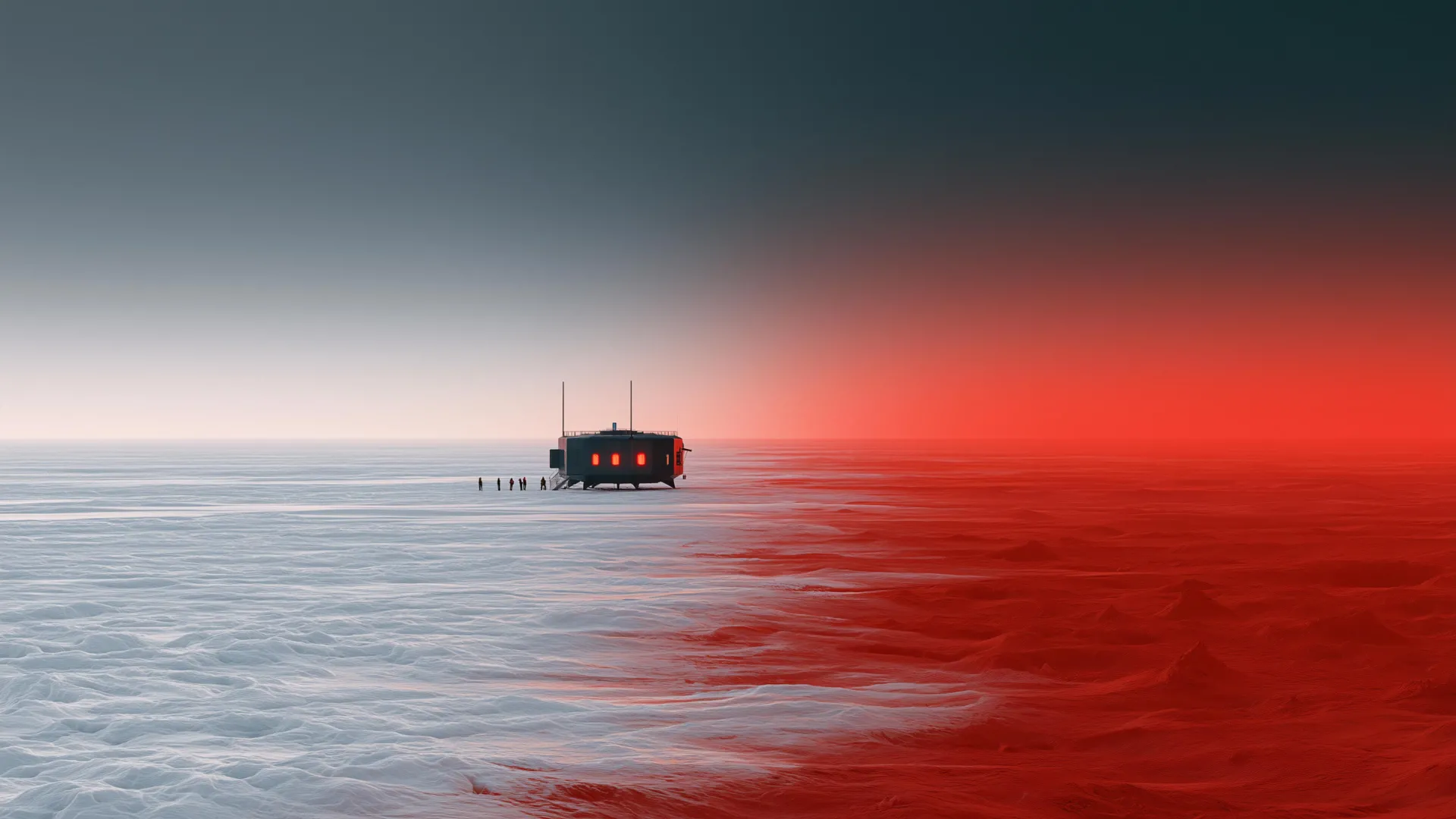
Long-duration space exploration presents a formidable paradox for the human psyche: while astronauts are cut off from the rest of humanity by millions of miles of empty void, they are simultaneously trapped in relentless, inescapable proximity to one another. To better understand how these grueling confinement conditions shape teamwork, psychological resilience, and social cohesion, an international team of researchers recently turned their attention away from the stars and toward the most inhospitable corners of Earth. Focusing on a ten-month overwintering mission at Concordia Station in Antarctica, the study offers unprecedented insight into the fragile social ecosystem of small teams living under extreme pressure.
The research was spearheaded by Jan Schmutz, a professor in the Department of Psychology at the University of Zurich, alongside Andrea Cantisani, a psychiatrist and research associate at the University of Bern. Situated on the Antarctic plateau at an elevation of 3,233 meters, Concordia Station is widely regarded as one of the most remote, hostile, and alien environments on Earth. During the brutal winter months, ambient temperatures routinely plummet to minus 80 degrees Celsius, rendering the station entirely inaccessible from the outside world for nearly nine months. Because of this absolute geographical isolation and the physiological challenges of high altitude and hypobaric hypoxia, Concordia Station is routinely utilized by space agencies as one of the closest and most reliable terrestrial analogues for future crewed missions to the Moon or Mars.
Tracking Social Dynamics in Extreme Isolation
The study tracked a twelve-member crew throughout their arduous ten-month overwintering period. To capture the subtle shifts in group psychology and interpersonal behavior, the researchers deployed a dual-methodology approach. Crew members were required to complete structured psychological questionnaires at four distinct milestones over the course of the mission. These surveys were designed to evaluate a broad spectrum of psychosocial metrics, including subjective feelings of loneliness, levels of interpersonal trust, the frequency and severity of conflicts, overall social relationships, team cohesion, and individual perceptions of performance.
Complementing these subjective self-reports, the participants wore specialized digital sensors throughout the duration of the study. These wearable devices automatically and continuously tracked physical proximity, registering precisely when individuals were in close physical contact with other team members and calculating the exact duration of these daily encounters. By cross-referencing the subjective questionnaire data with the objective, high-resolution sensor logs, the research team was able to map out a precise longitudinal timeline of how human social structures evolve when people are forced into prolonged, hyper-confined coexistence.
The Chronology of Confinement
The psychological trajectory of isolation missions typically follows a distinct temporal pattern, often studied through the lens of analogue environments like polar stations and simulated space habitats. In the early weeks of the Concordia mission, crew members experienced an initial honeymoon phase characterized by high motivation, enthusiasm, and a strong sense of shared purpose. However, as the months dragged on and the long polar night set in—bringing months of continuous darkness and extreme cold—the psychological toll began to accumulate.
By the midpoint of the mission, the novelty of the environment had worn off, and the physical constraints of the station began to weigh heavily on the crew. It was during this extended middle phase that the wearable sensors and questionnaires detected significant fractures in the social fabric. The final stretch of the mission brought anticipatory stress, as crew members prepared for reintegration into society while managing the cumulative exhaustion of nearly a year of confinement. This chronological progression underscores the reality that psychological fatigue in isolated environments does not remain static; rather, it compounds over time, mutating from simple cabin fever into complex interpersonal friction.
More Contact Did Not Always Help
One of the most counterintuitive and profound findings of the study challenged long-held assumptions about team dynamics and social support in high-stress environments. Conventional wisdom suggests that when individuals are isolated from their broader social support networks, increasing social contact and spending more time together will foster solidarity, alleviate loneliness, and strengthen team cohesion. However, the data collected at Concordia Station revealed precisely the opposite trend.
The researchers discovered that spending more time in physical proximity to other crew members was not consistently associated with positive social outcomes. On the contrary, participants who maintained more frequent and prolonged contact with their peers were statistically more likely to report heightened levels of interpersonal conflict, diminished trust, and even lower self-reported task performance.
This phenomenon points to the acute hazards of spatial saturation. In environments where physical privacy is virtually nonexistent and escape is impossible, continuous closeness ceases to be a source of comfort and instead transforms into an acute stressor. When people have no personal space to decompress, every quirk, habit, and minor grievance of their colleagues becomes magnified.
As Jan Schmutz observed, in small teams operating under extreme conditions, more contact does not automatically equate to effective social support; rather, it can actively stoke tensions. The researchers are careful to note that because the study relied on correlational data, it cannot definitively establish a unidirectional cause-and-effect relationship. For instance, it is entirely possible that individuals who felt an acute sense of loneliness instinctively sought out more interaction, even when those encounters failed to provide the emotional validation or relief they desperately needed. Conversely, pre-existing friction may have caused certain crew members to monitor or crowd one another, exacerbating the cycle of distrust.
Crew Members Formed Insular Subgroups
As the ten-month mission progressed, the objective sensor data revealed another critical behavioral adaptation: the crew gradually fractured into smaller, more insular social clusters. Rather than functioning as a cohesive, unified team of twelve, individuals increasingly gravitated toward colleagues who shared their native language, cultural background, or nationality.
While these micro-communities undoubtedly served an adaptive function—offering a psychological sanctuary and a sense of cultural familiarity during periods of intense stress—they also carried significant organizational risks. The emergence of tight-knit cliques within a small crew can inadvertently foster systemic in-group and out-group dynamics, laying the groundwork for tribalism, communication silos, and a dilution of overall team unity. In culturally diverse crews, such as those typically assembled for international space missions, the splintering of the core group threatens to undermine collaborative problem-solving when it is needed most.
Implications for Future Moon and Mars Missions
The findings emerging from the Concordia Station study carry profound implications for the future of human spaceflight. As space agencies and private aerospace companies look toward establishing permanent outposts on the lunar surface and executing crewed missions to Mars, flight planners must confront the reality of psychological endurance over multi-year timelines. Astronauts journeying to the Red Planet will face communication delays of up to twenty minutes each way with Earth, effectively cutting them off from real-time psychological support from mission control or their families. They will live in highly restricted habitats with severely limited personal space, making the management of interpersonal dynamics a critical mission-safety parameter.
Beyond the aerospace sector, the insights gleaned from this research extend to any high-stakes, highly confined professional environment. Submarine crews, offshore oil and gas platform operators, remote mining camps, and Antarctic support personnel all grapple with the same fundamental psychosocial pressures. Recognizing how proximity breeds tension and how teams naturally fragment under duress allows organizational psychologists to design better interventions for terrestrial industries as well.
Reflecting on the broader application of the work, Schmutz emphasized the operational imperative of early intervention: the results demonstrate how vital it is to identify shifting social dynamics early on and provide teams with targeted support before minor irritations metastasize into mission-jeopardizing conflicts.
Technical Validation and Future Research
From a methodological standpoint, the study also achieved a significant technological milestone. By demonstrating that wearable proximity sensors can operate reliably in extreme sub-zero environments without disrupting the daily routines of the participants, the research team has opened new avenues for behavioral monitoring. Traditional psychological assessments in isolated environments have historically relied entirely on self-reported surveys, which are susceptible to memory bias, fatigue, and deliberate underreporting. Continuous sensor data provides an objective, passive layer of behavioral tracking that captures the unvarnished reality of human interaction.
Building upon these foundational insights, future research initiatives will seek to dissect the precise mechanics of these interactions. Subsequent studies will aim to differentiate between various types of social contact—determining which conversational exchanges or shared activities actively alleviate stress and foster resilience, and which interactions act as catalysts for friction and burnout. As humanity prepares to venture further into the cosmos, understanding the invisible architecture of human relationships will prove just as critical to mission success as any rocket engine or life-support system.
