
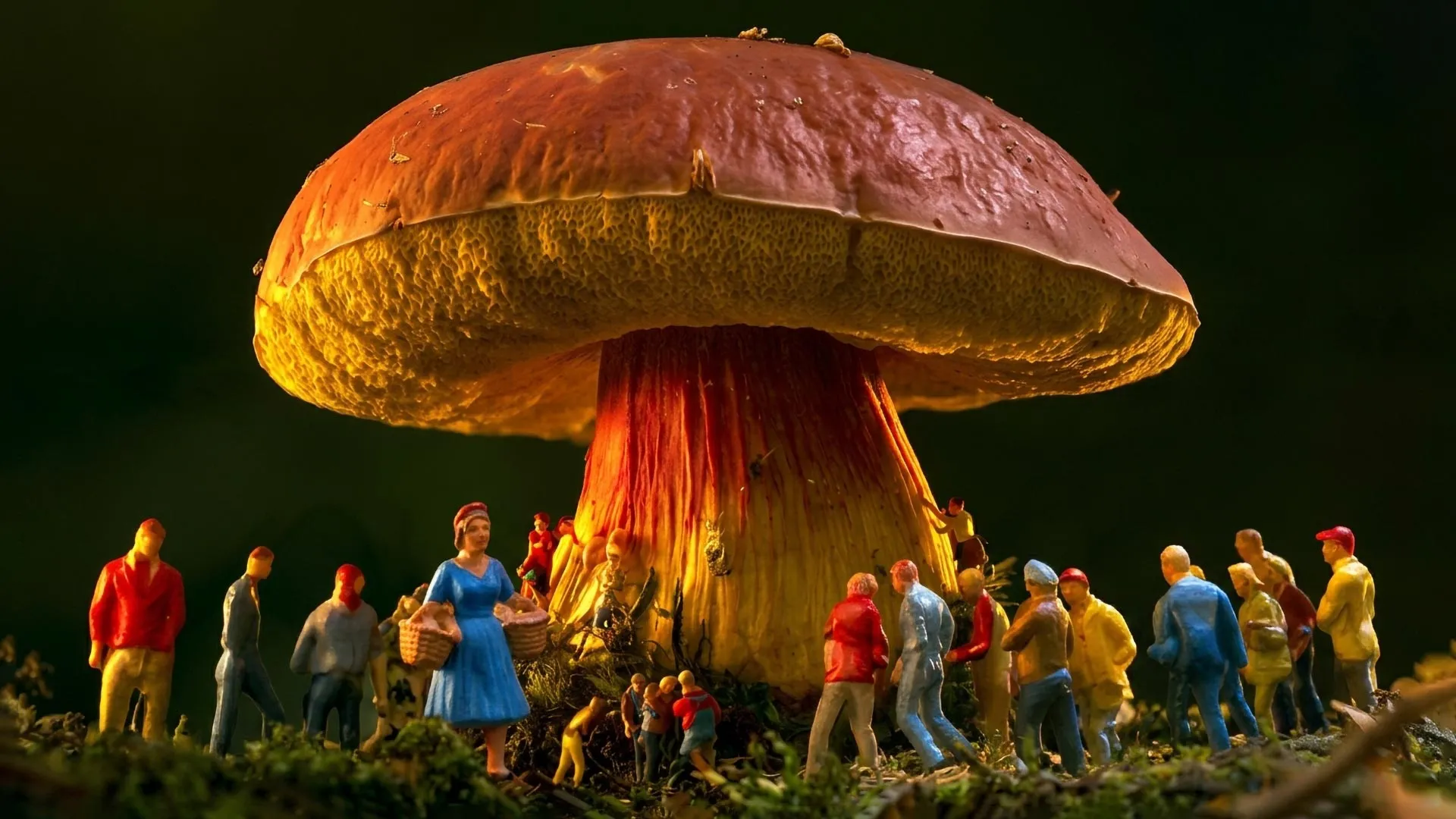
For decades, anthropologists, mycologists, and neurologists have puzzled over remarkably consistent reports from disparate corners of the globe regarding a singular, bizarre hallucinatory experience. Individuals thousands of miles apart, separated by vast cultural and geographical divides, have described consuming specific wild mushrooms and subsequently witnessing tiny human figures traversing their physical environment. These miniature beings—reportedly standing anywhere from 3 to 30 centimeters tall—do not merely flicker in the peripheral vision; they interact with the physical world in a remarkably coherent manner, climbing over household objects, walking around obstacles, and occasionally tumbling from tables.
Long dismissed by skeptics as cultural folklore or psychological projection, this phenomenon is scientifically known as Lilliputian hallucinations, a term derived from the diminutive inhabitants of Jonathan Swift’s classic satirical novel, Gulliver’s Travels. Now, a groundbreaking genetic and field study conducted by researchers at the University of Utah has provided definitive biological evidence underpinning these extraordinary accounts. By sequencing the DNA of specimens gathered across international borders, scientists have identified a specific wild mushroom species responsible for the visions in Southwest China and the northern Philippines. Crucially, chemical and genetic testing revealed an absolute absence of known psychoactive compounds, such as psilocybin, pointing instead toward an entirely novel, unisolated hallucinogenic substance. This discovery not only resolves a decades-old mycological mystery but also offers neuroscientists a potential pharmacological tool to investigate how the human brain constructs perceptual reality.
The Chronology of a Global Mycological Enigma
The scientific documentation of this phenomenon dates back nearly a century, establishing a long timeline of bafflement among researchers who encountered the effects of the so-called "mushroom madness."
In 1934, Western researchers first documented that indigenous populations in Papua New Guinea occasionally suffered from vivid, hyper-specific visual disturbances involving miniature humans after ingesting certain wild fungi. During the 1950s and 1960s, a wave of anthropologists and ethnomycologists traveled deep into the tropical highlands of Papua New Guinea to investigate these claims. Their preliminary field investigations suggested that the causative agents belonged to the Boletaceae, or bolete, family of mushrooms.
Despite extensive efforts, chemical testing of the harvested samples yielded no known psychoactive constituents. The scientific inquiry reached a high-profile plateau when samples were sent to Swiss chemist Albert Hofmann, the world-renowned researcher who first synthesized LSD and isolated psilocybin from magic mushrooms. Even with advanced analytical chemistry of the era, Hofmann was unable to identify any active psychotropic ingredient within the bolete specimens. Lacking a verifiable chemical mechanism, the academic community largely pivoted toward sociological hypotheses, suggesting that the visions were culturally conditioned hallucinations rather than pharmacological realities. By the end of the 1960s, formal scientific investigation into the Papua New Guinea cases effectively ground to a halt.
The mystery experienced a revival in the 1990s, when residents in Yunnan province in Southwest China reported startlingly similar hallucinations following the consumption of local bolete mushrooms. Although exact species identification remained elusive at the time, researchers strongly suspected a newly characterized fungus known scientifically as Lanmaoa asiatica.
The final piece of the contemporary puzzle fell into place in 2024, when doctoral student Colin Domnauer learned of parallel traditions maintained by an Indigenous community residing in the remote Northern Cordillera region of the Philippines. Local villagers described consuming a wild edible mushroom known colloquially as "Sedesdem," which occasionally induced the signature visions of tiny humans. Recognizing the geographical triad—Papua New Guinea, China, and the Philippines—Domnauer, alongside mycologist Bryn Dentinger of the University of Utah and the Natural History Museum of Utah, launched a targeted international investigation to determine whether a single biological agent linked these disparate regions.
Genomic Breakthroughs and Fieldwork Methodology
To test the hypothesis of a biological common denominator, the research team undertook rigorous fieldwork, traveling directly to Yunnan and the northern Philippines. There, they conducted the first comprehensive scientific survey of fungi in the rugged northern Philippine terrain, interviewing local foragers, documenting traditional culinary preparations, and harvesting specimens of Lanmaoa asiatica alongside related taxa within the Lanmaoa genus.
Back in the laboratory, the researchers utilized advanced DNA sequencing to establish the precise phylogenetic identities of the collected material. The genetic data delivered a startling revelation: the mushrooms recognized as "Jian shou qing" in China and "Sedesdem" in the Philippines were genetically identical, both belonging to the species Lanmaoa asiatica. Prior to this analysis, conventional scientific consensus held that L. asiatica was endemic exclusively to China. The discovery of its presence in the Philippines expanded the known range of the species by thousands of miles.
Although Dentinger subsequently traveled to Papua New Guinea in an attempt to secure authentic specimens from the original historical sites, uncooperative weather patterns and dry conditions precluded successful foraging and genetic comparison. Nonetheless, the confirmed genetic match between the Chinese and Philippine populations provides a robust empirical bridge. Two distinct, geographically isolated cultures ingest the same mushroom species and report identical phenomenological side effects, strongly implying a shared physiological trigger.
Beyond L. asiatica, the research team conducted a broader genomic assessment of the entire Lanmaoa genus. Analyzing 53 specimens sourced from wild habitats and international fungarium collections, the DNA sequencing unveiled 17 distinct species within the group—four of which were entirely unknown to science. Remarkably, two of these newly identified species had been sitting unrecognized in American museum archives for years, highlighting the latent scientific value of preserved natural history collections when interrogated with modern genomic tools. Subsequent evaluations confirmed that among the entire genus, L. asiatica stands alone as the sole species linked to psychoactive properties.
Phenomenology of the Visions: Mechanics of the Miniature
The consistency of the reported hallucinations has remained one of the most compelling aspects of the research. According to data compiled by Domnauer through field interviews and historical accounts, approximately 90% of individuals who experience the phenomenon describe seeing dozens or even hundreds of miniature figures. These entities typically measure between 3 and 30 centimeters in height and appear with exceptional visual clarity, possessing the solid opacity of real human beings rather than translucent ghosts.
Descriptions of the figures frequently invoke traditional cultural archetypes, such as elves, clowns, or fairy-like beings garbed in vivid, brightly colored attire. However, the most neurologically striking feature of these hallucinations is their adherence to the physical laws of the real world. Unlike conventional psychedelic visions, which often involve geometric patterns, fluid melting effects, or abstract spatial distortions, Lilliputian hallucinations integrate seamlessly into the observer’s physical environment.
The miniature figures are routinely reported to navigate around solid obstacles, climb over furniture surfaces, and occasionally misjudge distances, resulting in falls from tabletops. In one illustrative account documented by researchers, an individual consuming a bowl of soup observed tiny humans leaping from a spoon into the broth to swim, remaining fully visible inside the individual’s mouth during subsequent bites. This high degree of behavioral complexity and environmental interaction suggests that the yet-unknown compound engages specific visual processing circuits within the brain in a highly organized fashion.
Pharmacological Analysis and the Search for a Novel Compound
Armed with preserved and freshly harvested samples of L. asiatica, the University of Utah team subjected the biological material to rigorous chemical screening and genetic profiling. Their objective was to determine whether the mushroom harbored trace amounts of psilocybin, psilocin, ibogaine, muscimol, or other established entheogenic molecules common to myco-toxicology.
The results were entirely negative. Extensive chromatographic and spectroscopic analyses detected no trace of known psychoactive compounds. This chemical vacuum is perhaps the most significant takeaway of the study, published in the peer-reviewed journal Mycologia and funded by the National Science Foundation under award #DEB-2114785.
The absence of standard hallucinogens confirms that Lanmaoa asiatica synthesizes a novel, unidentified psychoactive chemical agent. Because this substance has not yet been isolated or purified in a laboratory setting, its precise chemical structure and pharmacodynamics remain completely unknown. Toxicologically, the mushroom requires careful handling; while popular in regional cuisines when thoroughly cooked, consuming improperly prepared specimens triggers these neurological episodes alongside potential gastrointestinal distress.
Broader Implications for Neuroscience and Medicine
While the phenomenon of Lilliputian hallucinations is reliably triggered by the ingestion of L. asiatica in specific regions, the underlying visual disturbance is not exclusive to mushroom consumption. Similar clinical manifestations have been documented in medical literature among patients experiencing severe alcohol withdrawal, advanced dementia, Charles Bonnet syndrome associated with macular degeneration, and various focal neurological disorders.
These clinical overlaps indicate that visions of miniature humans may stem from a fundamental vulnerability or operational quirk in how the human brain processes complex visual data and spatial awareness. Historically, studying these medical conditions has proven difficult due to their sporadic and unpredictable nature within clinical populations.
By providing a reliable, exogenous trigger for the phenomenon, L. asiatica offers neuroscientists an unprecedented potential research vehicle. If researchers succeed in isolating and synthesizing the active chemical agent responsible for the hallucinations, the compound could serve as a precision pharmacological probe. Such a tool could allow researchers to map the precise neural circuits responsible for scaling objects within the visual field and generating complex autonomous figures in conscious awareness.
Furthermore, this discovery underscores the vast, underexplored chemical diversity of the fungal kingdom. Much like the historical discovery of penicillin from a contaminating mold revolutionized modern pharmacology and saved hundreds of millions of lives, continued bioprospecting of fungi may yield novel therapeutics for psychiatric and neurological conditions. As the research team prepares for the next phase of their work—isolating the elusive compound—the humble bolete mushroom stands as a potent reminder of how much of human neurobiology and natural chemistry remains waiting to be uncovered.
