
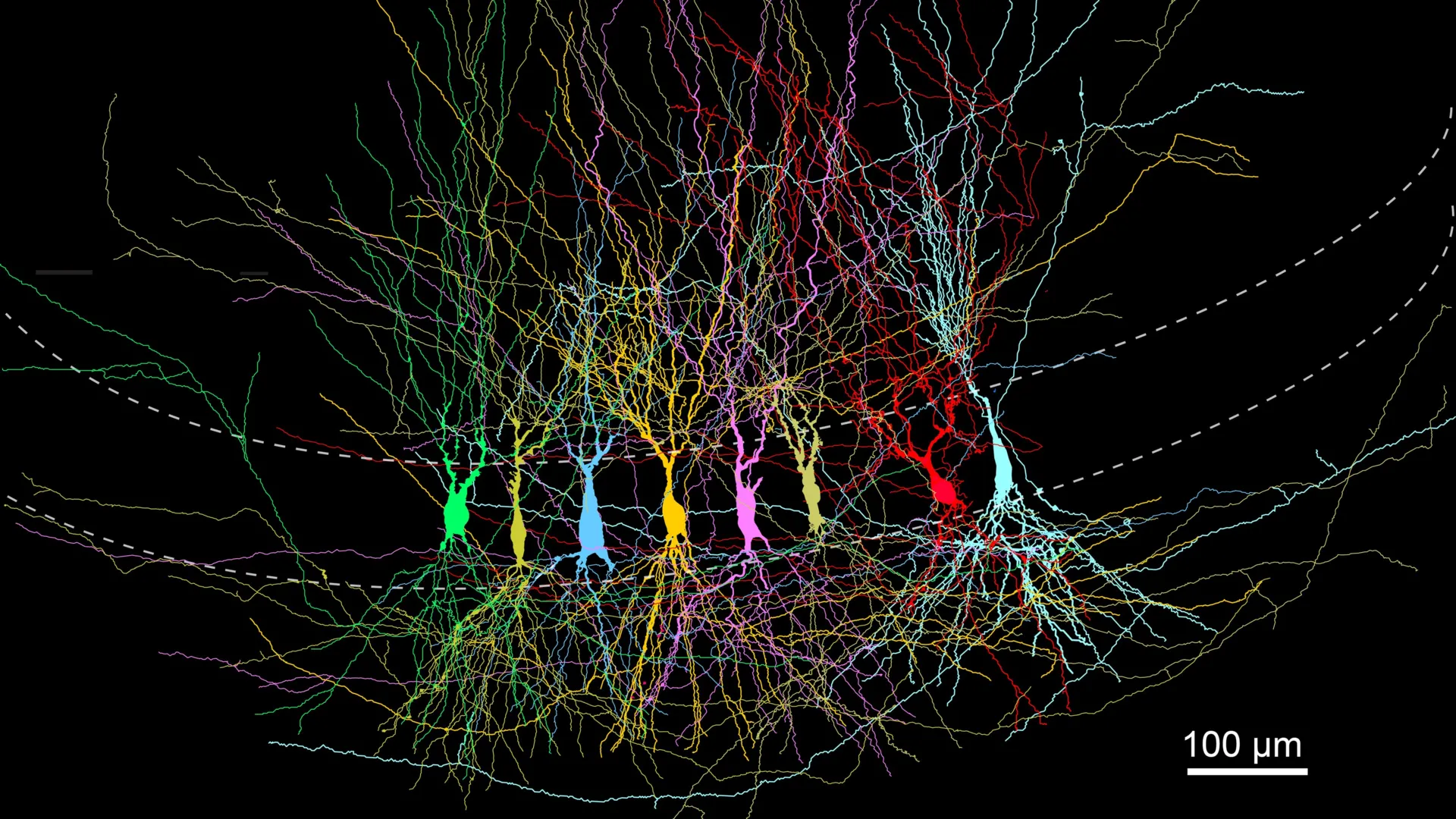
The intricate architecture of the human brain, particularly its capacity for memory formation and spatial navigation, has long been a subject of intense scientific scrutiny. At the heart of these crucial functions lies the hippocampus, a seahorse-shaped structure within the temporal lobe. Its role in transforming fleeting sensory experiences into enduring memories, thereby enabling learning and the construction of our personal narratives, is paramount. Now, groundbreaking research from the Institute of Science and Technology Austria (ISTA) is shedding new light on the developmental trajectory of one of the hippocampus’s fundamental neural networks, challenging prevailing notions of early brain development.
A team of scientists, spearheaded by Magdalena Walz Professor for Life Sciences Peter Jonas, has meticulously investigated how the primary neural network within the hippocampus, specifically the CA3 pyramidal neurons, matures after birth. Their findings, published in the esteemed journal Nature Communications, reveal a developmental process that more closely aligns with the concept of a "full slate" (tabula plena) rather than a "blank slate" (tabula rasa), suggesting that the brain begins with a rich, albeit unrefined, connectivity that is subsequently streamlined.
The Enduring Debate: Nature vs. Nurture in Brain Development
The concept of the "blank slate," popularized by philosophers like John Locke, posits that individuals are born without innate mental content, and all knowledge and personality are acquired through experience. In the biological realm, this translates to the debate about the relative influence of genetic predispositions versus environmental stimuli in shaping an organism’s development. Conversely, the "full slate" model suggests that certain organizational principles or structural predispositions are present from birth, which are then modified and refined by environmental interactions.
For decades, neuroscientists have grappled with which of these models best describes the development of complex brain structures like the hippocampus. Understanding this fundamental developmental principle is critical for comprehending learning disabilities, cognitive decline, and the very essence of what makes us who we are. The ISTA research team directly applied this dichotomy to the hippocampal circuitry, seeking to unravel whether its internal network emerges as an empty canvas awaiting information or as a pre-organized, albeit immature, structure.
Unraveling the CA3 Network: A Focus on Memory and Plasticity
The research concentrated on a pivotal neural circuit within the hippocampus: the CA3 pyramidal neurons. These neurons are indispensable for the storage and retrieval of memories, acting as a crucial hub for associative learning. Their remarkable function hinges on neural plasticity – the brain’s inherent ability to adapt and change by modifying the strength of connections between neurons (synapses), forming new connections, or even altering their physical structure. This plasticity is the biological bedrock upon which learning and memory are built.
The study’s principal investigator, Victor Vargas-Barroso, a former doctoral student at ISTA, meticulously examined the brains of mice at three distinct developmental stages: a very early postnatal period (days 7-8), adolescence (days 18-25), and adulthood (days 45-50). This chronological approach allowed the researchers to observe the dynamic changes occurring within the CA3 network as the animal matured.
To achieve this, the team employed a suite of cutting-edge neuroscience techniques. The patch-clamp technique, a cornerstone of electrophysiology, was utilized to precisely measure the minute electrical signals generated within specific neuronal compartments. This included probing presynaptic terminals, the output sites of neurons, and dendrites, the input receivers. Complementing this electrophysiological analysis were advanced imaging technologies and sophisticated laser-based methods. These tools enabled the scientists to visualize cellular activity in real-time and, crucially, to activate individual neural connections with unparalleled precision. This combination of techniques provided a comprehensive, multi-faceted view of the CA3 network’s functional and structural evolution.
A Developmental Shift: From Dense and Random to Streamlined and Efficient
The experimental results unveiled a developmental trajectory that defied initial expectations. In the early postnatal stages, the CA3 network was found to be extraordinarily dense, characterized by a vast number of connections that appeared largely random in their organization. As the mice transitioned into adolescence and then adulthood, this dense and somewhat chaotic network underwent a remarkable transformation. It became less crowded, but simultaneously more organized, refined, and significantly more efficient in its operations.
Professor Peter Jonas described the findings as "quite surprising." He elaborated, "Intuitively, one might expect that a network grows and becomes denser over time. Here, we see the opposite. It follows what we call a pruning model: it starts out full, and then it becomes streamlined and optimized." This observation directly supports the "full slate" hypothesis, suggesting that the foundational structure of the network is established early on with an abundance of connections, which are then selectively eliminated or strengthened.
The Rationale Behind an "Initially Exuberant" Network
While the precise evolutionary and developmental reasons for this "pruning model" are still under active investigation, Professor Jonas offered a compelling hypothesis. He suggests that initiating development with a highly interconnected network may be a crucial strategy for the hippocampus. This rapid and widespread connectivity would allow neurons to establish functional links swiftly, a vital prerequisite for the hippocampus’s demanding role in integrating diverse streams of sensory information.
The hippocampus is tasked with weaving together disparate inputs – visual cues, auditory signals, olfactory information, and even emotional context – into coherent and stable memories. This complex integration process requires neurons to communicate extensively and efficiently. "That’s a complex task for neurons," Jonas explained. "An initially exuberant connectivity, followed by selective pruning, might be exactly what enables this integration."
The alternative scenario, a true "blank slate" where neurons begin with no inherent connections, would necessitate a much slower and potentially less efficient process of neuronal communication. In such a case, neurons would first have to locate and establish connections with their appropriate partners. This trial-and-error period could significantly delay the onset of efficient information processing, potentially hindering the development of robust memory formation capabilities. The "full slate" model, with its initial over-connectivity and subsequent refinement, appears to offer a more advantageous developmental strategy for a region as functionally critical as the hippocampus.
Broader Implications for Understanding Brain Development and Disorders
The implications of this research extend far beyond the intricate workings of the CA3 network. It provides crucial empirical evidence that challenges the simplistic "blank slate" narrative for neural development. Instead, it suggests a more nuanced model where the brain inherits a sophisticated, genetically predisposed organizational blueprint that is then sculpted by experience. This finding has significant ramifications for our understanding of various neurological and psychiatric conditions.
For instance, disruptions in synaptic pruning, the process identified in this study, have been implicated in conditions such as autism spectrum disorder and schizophrenia. In these disorders, there is often evidence of either insufficient or excessive pruning of neural connections, leading to aberrant cognitive and behavioral patterns. This research offers a potential framework for understanding the underlying developmental anomalies in such conditions, suggesting that interventions might need to target the optimization of these early, dense networks.
Furthermore, the study’s findings could inform therapeutic strategies for conditions related to memory impairment, such as Alzheimer’s disease. By understanding the critical developmental windows for network refinement, researchers might be able to devise interventions aimed at preserving or restoring the efficiency of hippocampal circuitry.
Future Directions and the Ongoing Quest for Neural Understanding
The ISTA team’s work represents a significant step forward in demystifying hippocampal development. However, many questions remain. Future research will likely focus on identifying the specific molecular and genetic mechanisms that drive the selective pruning of synapses in the CA3 network. Understanding these precise regulatory processes could unlock new avenues for therapeutic development.
Additionally, further studies could explore whether this "full slate" developmental model is a universal principle across different brain regions and species, or if it is specific to the hippocampus and its unique functional demands. Comparative studies examining neural development in various animal models, including non-human primates, could provide valuable insights into the evolutionary conservation of these developmental strategies.
In conclusion, the research led by Peter Jonas and Victor Vargas-Barroso at ISTA has provided compelling evidence that the hippocampus, a cornerstone of memory and spatial navigation, develops not as a passive "blank slate" awaiting input, but as a "full slate" characterized by an initially dense and broadly connected network that undergoes a critical period of refinement and optimization. This paradigm shift in our understanding of neural development underscores the intricate interplay between genetic programming and environmental influence, paving the way for deeper insights into brain function and the origins of cognitive disorders. The journey to fully comprehend the human brain is ongoing, and this latest discovery marks a pivotal advancement in that monumental quest.
