
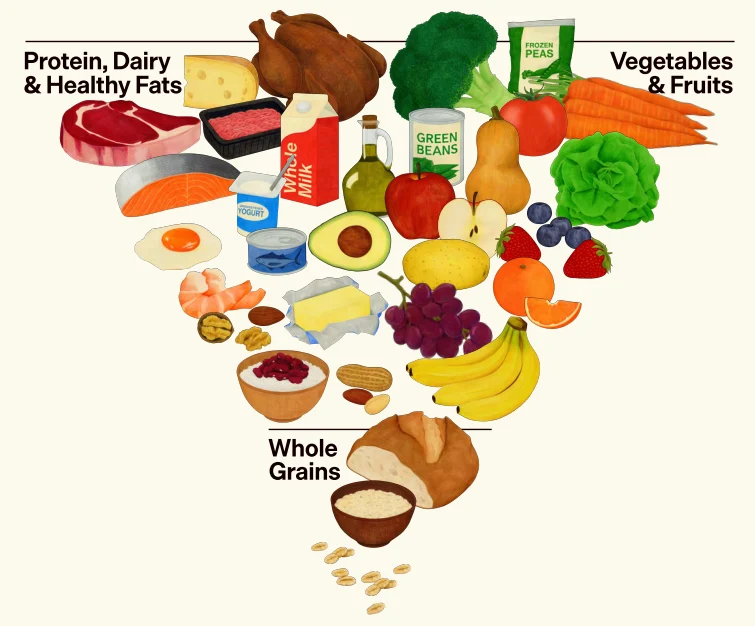
The release of the 2025–2030 Dietary Guidelines for Americans (DGAs) this week has ignited a rigorous debate among public health experts, policymakers, and industry stakeholders. While the new federal framework adopts a more aggressive posture toward the reduction of added sugars and the consumption of highly processed foods, it has simultaneously introduced a visual hierarchy that prioritizes animal-based products, creating a stark disconnect between the document’s written advice and its illustrative messaging. This dichotomy has raised significant questions regarding the integrity of the evidence-based process that has historically governed federal nutrition policy.
A Chronology of Policy Development
The development of the Dietary Guidelines is a multi-year, rigorous endeavor mandated by the National Nutrition Monitoring and Related Research Act of 1990. Every five years, the U.S. Departments of Agriculture (USDA) and Health and Human Services (HHS) are required to publish updated guidance. The process typically begins with the formation of a Dietary Guidelines Advisory Committee (DGAC), a panel of independent scientific experts tasked with reviewing the latest nutrition research.
For the 2025–2030 cycle, the DGAC conducted two years of intensive evidence synthesis, resulting in a comprehensive Scientific Report. However, the current administration opted for a departure from historical precedent. In a move that surprised many in the scientific community, the administration bypassed aspects of the committee’s original recommendations, opting instead to utilize a supplemental scientific analysis conducted by a separate group of individuals selected via a federal contracting process. This decision has fueled intense scrutiny regarding the transparency of the final document’s authorship and the criteria used to prioritize specific nutritional conclusions.
The Paradox of the New Food Pyramid
Central to the current controversy is the reintroduction of a pyramid-style graphic, which has been inverted to emphasize a different set of food categories than its predecessors. The new visual guide prominently features red meat, butter, and full-fat dairy products. This visual strategy appears to contradict the written text of the Guidelines, which maintains the longstanding recommendation that saturated fat intake should not exceed 10% of total daily caloric intake.
Nutrition scientists, including Dr. Frank Hu, chair of the Department of Nutrition at the Harvard T.H. Chan School of Public Health, have expressed concern that these mixed messages may lead to widespread public confusion. While the Guidelines correctly identify the need to limit refined carbohydrates and added sugars, the visual prominence of saturated-fat-rich foods could inadvertently encourage dietary habits that increase LDL cholesterol levels and exacerbate cardiovascular risk profiles across the U.S. population.
Data-Driven Analysis of Saturated Fat and Protein
To understand the practical implications of the new guidance, one must look at the "saturated fat math" involved in a standard 2,000-calorie diet. With a 10% ceiling, a consumer is limited to approximately 22 grams of saturated fat per day. The DGAs suggest three servings of dairy daily; if a consumer opts for the full-fat options often depicted in the new pyramid—such as one cup of whole milk (5g), three-quarters of a cup of full-fat Greek yogurt (6g), and one ounce of cheddar cheese (6g)—they reach 17 grams of saturated fat before considering any other meals. Incorporating a single tablespoon of butter for cooking adds another 7 grams, effectively pushing the consumer over the daily limit before accounting for meat or other protein sources.
Furthermore, the Guidelines have increased the recommended protein intake to 1.2–1.6 grams per kilogram of body weight, a 50% to 100% increase over previous minimum standards. While this adjustment aligns with some physiological models for active individuals, critics argue that the policy fails to distinguish between protein sources. The "protein package"—the combination of fats, fiber, and micronutrients that accompanies protein—is critical to health. Plant-based proteins and lean fish offer a vastly different metabolic profile than processed meats or red meat, yet the Guidelines remain largely agnostic on the necessity of choosing one over the other.
The Shift Against "Highly Processed" Foods
Despite the controversy surrounding fats and proteins, the 2025–2030 edition represents a significant advancement in its stance on food processing. For the first time, the federal government has formally addressed the category of "highly processed foods." The text explicitly warns against the consumption of sugar-sweetened beverages and ready-to-eat, nutrient-poor packaged snacks.
The Guidelines also take a firm stand on added sugars, suggesting that no amount is strictly required for a healthy diet. The policy significantly lowers the age threshold for avoiding added sugar, now recommending that children avoid these substances entirely until age 10—a substantial increase from the previous two-year-old cutoff. While these recommendations are grounded in robust metabolic science, the lack of actionable, real-world implementation strategies leaves many consumers struggling to bridge the gap between policy and the grocery aisle.
Transparency and Industry Influence
The process of reaching these conclusions has come under fire due to the perceived lack of transparency in the supplemental review panel. Critics have pointed to the disclosed financial ties between some reviewers and the beef and dairy industries. In a recent Q&A, Deirdre Tobias, an assistant professor at the Harvard T.H. Chan School of Public Health and a member of the 2025-2030 DGAC, noted that the methodology employed in the final document deviates from the rigorous, replicable standards established by HHS.
The absence of an environmental and socioeconomic impact assessment in the current DGAs remains another point of contention. As global health organizations increasingly link human nutrition to environmental sustainability, the U.S. government’s decision to omit these factors keeps the Guidelines tethered to a traditional view of nutrition that ignores the broader, systemic context of the food system.
Implications for Public Health
The efficacy of the Dietary Guidelines is ultimately measured by their impact on public health outcomes, yet historical data from the CDC suggests that Americans rarely adhere to these federal standards. The 2025–2030 edition, characterized by its more consumer-friendly, digital-first approach, aims to reach a broader audience, but the contradictory messaging may undermine its authority.
When official government advice contains internal inconsistencies—such as recommending a 10% cap on saturated fat while visually promoting the very foods that make such a cap difficult to maintain—the public is often left to navigate a confusing landscape of conflicting nutrition advice. For health professionals, the challenge lies in translating these complex and often contradictory documents into actionable, evidence-based plans for patients.
As the nation grapples with rising rates of diet-related chronic diseases, including obesity, type 2 diabetes, and hypertension, the role of the Dietary Guidelines is more critical than ever. Whether this edition serves as a catalyst for improved public health or a source of enduring confusion will likely depend on the ability of medical providers and nutritionists to provide clarity where the official federal policy has failed to do so. In the interim, the scientific community continues to advocate for a return to a purely evidence-based, transparent, and disinterested methodology for future iterations of the Guidelines, ensuring that national nutrition policy remains a reliable anchor for public health rather than a subject of political and industry debate.
