
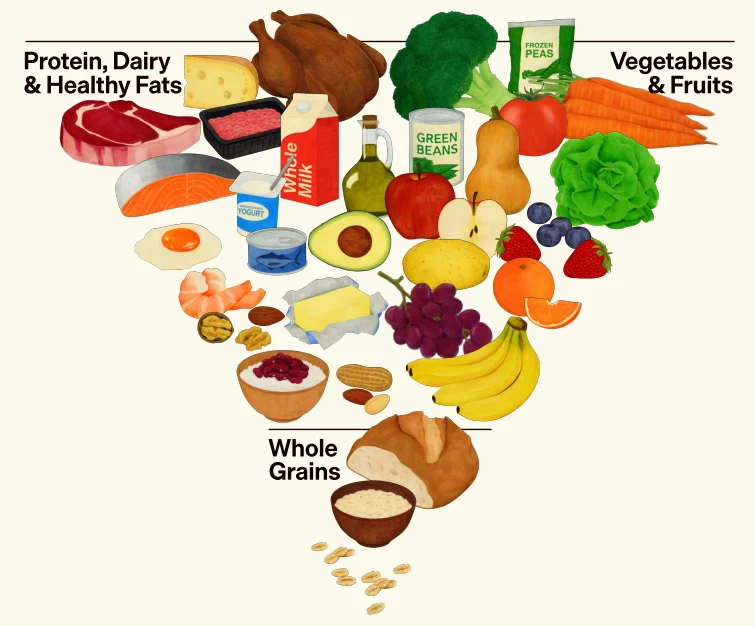
The release of the 2025–2030 Dietary Guidelines for Americans (DGAs) this week has ignited a significant debate among public health officials, nutritional scientists, and industry stakeholders. While the new framework attempts to simplify dietary advice under the banner of "eat real food," the document contains internal contradictions that have left experts questioning the scientific rigor behind its final form. Most notably, the Guidelines introduce a revised "food pyramid" graphic that places a prominent visual emphasis on animal-derived proteins—including steak, full-fat dairy, and butter—creating a stark dissonance with the document’s own written recommendations regarding saturated fat intake.
A Chronology of Policy Development
The Dietary Guidelines are mandated by the National Nutrition Monitoring and Related Research Act of 1990, requiring the U.S. Departments of Agriculture (USDA) and Health and Human Services (HHS) to publish updated recommendations every five years. The process is designed to be a rigorous, multi-year endeavor. Typically, an independent Dietary Guidelines Advisory Committee (DGAC), composed of preeminent scientists and medical experts, reviews the latest nutrition research to produce a comprehensive scientific report.
For the 2025–2030 cycle, the committee followed this traditional path, spending two years synthesizing evidence on everything from early-childhood nutrition to the impact of processed foods on chronic disease. However, in a break from historical precedent, the current administration opted to set aside the committee’s finalized report. Instead, the administration commissioned a "supplemental scientific analysis" conducted by a group of individuals selected via a federal contracting process. This decision has sparked significant criticism regarding the transparency of the methodology used to finalize the current guidelines.
Deirdre Tobias, an assistant professor in the Department of Nutrition at the Harvard T.H. Chan School of Public Health and a member of the original 2025-2030 Advisory Committee, has publicly voiced concerns. In recent statements, she noted that the lack of transparency in the writing process and the deviation from established, peer-reviewed protocols represent a departure from the rigorous, unbiased standards intended to shield nutrition policy from political or industry influence.
Analyzing the "New Food Pyramid" and Saturated Fat
The visual centerpiece of the new guidelines is a redesigned pyramid that flips the traditional hierarchy of nutritional priority. While vegetables and fruits remain a foundation, the inclusion of red meat and high-fat dairy as central components has caused confusion. This is particularly problematic given that the actual text of the guidelines maintains the long-standing scientific recommendation that saturated fat intake should not exceed 10% of total daily calories.
For an average adult consuming a 2,000-calorie diet, the 10% limit equates to approximately 22 grams of saturated fat per day. A brief calculation of the daily recommended servings outlined in the DGAs reveals a mathematical challenge: three servings of full-fat dairy—such as one cup of whole milk (5g), three-quarters of a cup of Greek yogurt (6g), and one ounce of cheddar cheese (6g)—total 17 grams of saturated fat. Adding a single tablespoon of butter or beef tallow, both of which are suggested as cooking fats within the documentation, pushes the consumer over the 10% threshold before they have even accounted for other protein sources or incidental fats consumed throughout the day.
Dr. Frank Hu, chair of the Department of Nutrition at the Harvard T.H. Chan School of Public Health, suggests that this visual-textual contradiction risks reversing decades of progress in cardiovascular health education. "The mixed messages surrounding saturated-fat-rich foods may lead to confusion and potentially higher intake of saturated fat, which is directly linked to increased LDL cholesterol and cardiovascular risk," Dr. Hu stated.
The Shift Against Highly Processed Foods
One of the more progressive aspects of the 2025–2030 edition is its explicit call-out of "highly processed foods." While nutrition science has long debated the nuances of food processing, this is the first time the DGAs have used this terminology to broadly categorize and advise against specific items. The guidelines target sugar-sweetened beverages, ultra-processed snacks, and ready-to-eat meals high in sodium and refined grains.
This shift represents an attempt to align federal policy with the modern understanding of the "food matrix"—the idea that the physical structure of food and the presence of additives significantly alter how the body absorbs nutrients. The guidelines advocate for whole, fiber-rich grains over refined alternatives like white bread, a move welcomed by nutritionists. However, experts note that the guidance remains somewhat vague, failing to provide a clear, actionable definition of what constitutes a "highly processed" item, which may limit the efficacy of the recommendation for the average consumer.
Redefining Sugar and Protein Targets
The new DGAs have also taken a stricter stance on added sugars, suggesting that no amount of added sugar is ideal for a healthy diet. The report proposes a limit of 10 grams of added sugar per meal—a significant departure from the previous standard of 10% of total daily calories. Furthermore, the guidelines now recommend that children avoid added sugars entirely until the age of 10, an eight-year increase from the previous recommendation of age 2.
In contrast to the strict sugar limits, the guidelines have substantially increased protein recommendations, suggesting that adults consume between 1.2 and 1.6 grams of protein per kilogram of body weight per day. This is an increase of 50–100% over previous minimums. While increased protein intake can be beneficial for specific demographics, such as older adults looking to prevent sarcopenia, critics argue that the broad application of these figures ignores the quality of the "protein package."
"When we consume protein, we are also consuming the fats, sodium, and micronutrients that come along with that source," explains the Harvard Nutrition Source analysis. "Substantially raising overall protein intake without distinguishing between plant-based sources and red meat could have unintended long-term consequences for health."
Environmental and Socioeconomic Blind Spots
A recurring criticism of the DGAs is the continued omission of environmental sustainability and socioeconomic factors in the formulation of dietary advice. As climate change continues to impact food security and agricultural productivity, many international health organizations have begun to integrate sustainability metrics into their dietary guidelines.
The U.S. approach, however, remains siloed. By ignoring the environmental impact of animal agriculture and failing to address how food deserts and economic inequality prevent many Americans from accessing "real food," the guidelines are being criticized for being out of touch with the systemic realities of the American food environment. Public health advocates argue that until these factors are considered, the guidelines will continue to be a document for the privileged rather than a universal tool for national health.
Industry Influence and Transparency Concerns
The controversy surrounding the document’s development is compounded by reports of potential financial ties between members of the supplemental review panel and the beef and dairy industries. While these ties were disclosed in the supplemental analysis, the decision to prioritize these viewpoints over the original committee’s report has led to questions regarding the integrity of the review process.
Historical data from the Centers for Disease Control and Prevention (CDC) suggests that the vast majority of Americans do not strictly follow the Dietary Guidelines. Given the mixed messaging, the lack of transparency in the drafting process, and the potential for confusion over saturated fats, it remains to be seen whether this iteration of the DGAs will have any meaningful impact on the nation’s health trajectory.
The Path Forward for Consumers
For the average consumer navigating these new recommendations, the professional consensus remains consistent: prioritize whole, plant-based foods, minimize added sugars, and consult with a registered dietitian for personalized health plans. The 2025–2030 DGAs, while moving in a promising direction regarding the reduction of highly processed foods, ultimately serve as a reminder that nutrition policy remains a field where science, politics, and industry interests often collide.
As the debate over these guidelines continues, medical professionals urge the public to look toward verified, evidence-based tools, such as the Harvard Healthy Eating Plate, which focuses on sustainable, balanced, and evidence-backed nutritional habits rather than the shifting priorities of federal policy documents. The ultimate test for these new guidelines will not be found in the text of the report, but in the long-term health data of the American population over the next five years. Whether this policy shift will effectively combat the rising tide of metabolic disease or merely serve to confuse an already overwhelmed public is a question that will be answered in the coming decade.
