
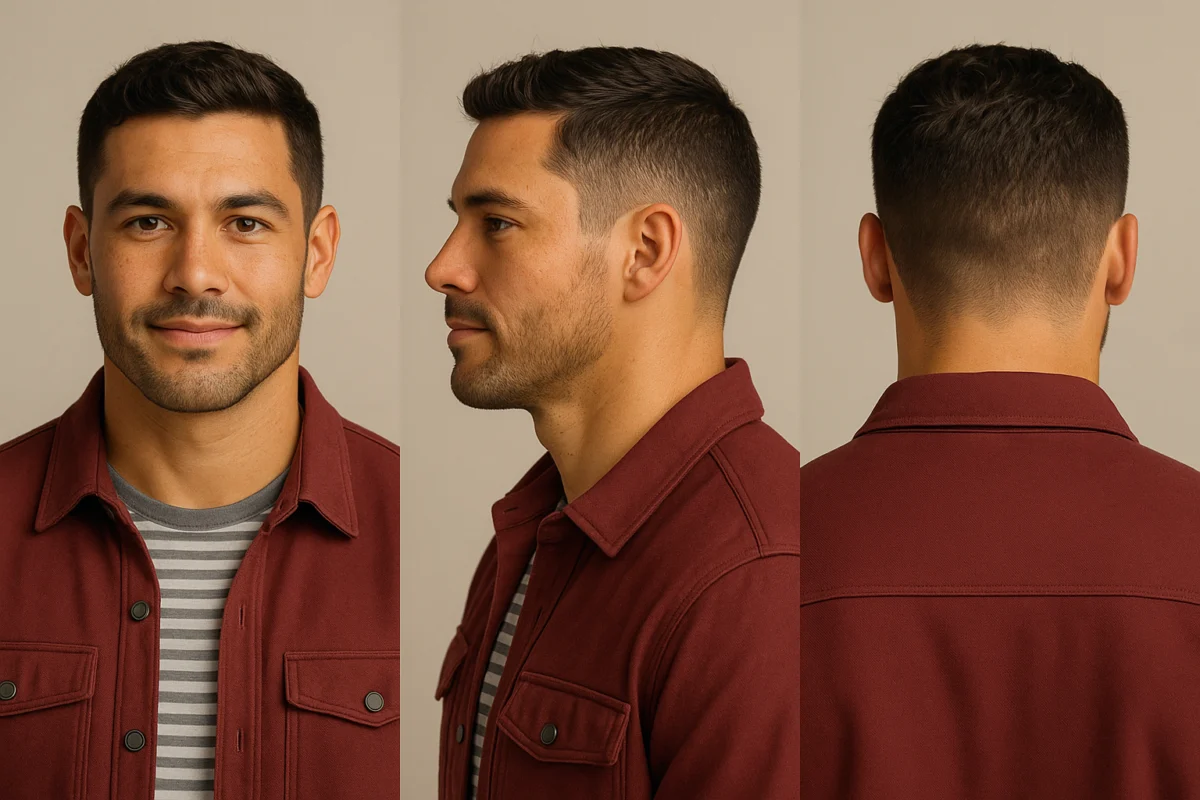
The medium crew cut has firmly established itself as the cornerstone of contemporary men’s grooming, bridging the gap between military-inspired utility and modern aesthetic sophistication. While the traditional crew cut dates back to the mid-20th century—famously adopted by Ivy League rowing teams and later standardized by U.S. military personnel—the contemporary medium iteration has evolved into a versatile silhouette that dominates modern barbershops. Characterized by a subtle taper on the sides and back, combined with a slightly more substantial length on top, this haircut offers a rare balance of high-maintenance appearance with low-maintenance reality.

Historical context provides the necessary backdrop for understanding why this style remains relevant in the 2020s. Emerging in the 1920s and 30s as a practical, hygienic, and "neat" alternative to the longer, oil-heavy hairstyles of the Victorian era, the crew cut was synonymous with discipline. By the mid-1950s, it had become the standard for men across all social strata. Today, the medium variant is a stylistic evolution that discards the strict uniformity of its predecessor in favor of customization, allowing for individual texture and face-shape optimization.
The shift toward the medium crew cut reflects a broader trend in men’s fashion: the move toward "effortless precision." According to recent industry reports from professional barbering associations, demand for "transitionary" haircuts—styles that work equally well in a high-stakes boardroom and a casual weekend setting—has increased by approximately 22% since 2020. This data suggests that the modern professional is increasingly prioritizing time-efficiency without sacrificing a polished, sharp exterior.

The Anatomy of the Modern Crew Cut
To understand the mechanics of the medium crew cut, one must look at the technical requirements. Unlike a standard buzz cut, which relies on a single guard length across the scalp, the medium crew cut utilizes scissor-over-comb techniques or varied clipper guards to create depth. The sides are typically taken down to a #2 or #3 guard, transitioning into a top length that generally measures between one and two inches. This length is the "sweet spot" for styling, as it provides enough mass to allow for texture or slicking, while remaining short enough to avoid the need for complex daily maintenance.
The versatility of this cut is its primary asset. It accommodates a wide array of hair types, including straight, wavy, and even coarse, curly hair. For the average consumer, the main appeal lies in the reduction of "styling friction." While a pompadour or a quiff might require significant blow-drying and product layering, the medium crew cut can often be managed with a dime-sized amount of matte clay or light-hold cream, applied in seconds.

Evolution of Styles: Ten Variations for the Modern Man
-
The Classic Medium Crew Cut: This is the baseline, featuring a clean, graduated taper. It is the gold standard for oval and square face shapes, emphasizing the jawline by drawing the eye upward.
-
The Textured Crew Cut: By incorporating point-cutting techniques, barbers can introduce deliberate jaggedness to the top section. This adds volume, making it an excellent choice for men with thinning hair who wish to create the illusion of density.

-
The Faded Crew Cut: Integrating a skin fade—either high, mid, or low—adds a sharper, more aggressive contrast. This style has seen a surge in popularity due to its "high-definition" look, though it requires more frequent maintenance (every 3-4 weeks) to prevent the fade from looking overgrown.
-
The Slicked Back Crew Cut: By using a water-based pomade, the top length can be swept back. This look is particularly effective for formal events, offering a suave, "Old Hollywood" aesthetic that pairs well with tailored suits.

-
The Curly Crew Cut: Rather than suppressing natural curls, this style keeps them controlled on top while tightening the sides. It is a sophisticated way to manage unruly hair without resorting to a full-shave.
-
The Side Part Crew Cut: By creating a distinct, perhaps even razor-etched part, the style gains a formal, architectural quality. This is the preferred choice for finance and legal professionals who require a conservative but well-groomed appearance.

-
The Disconnected Crew Cut: This variation emphasizes a stark contrast between the long top and the short sides, often omitting a traditional fade to create a "disconnected" visual line. It is a bold, fashion-forward choice often seen in creative industries.
-
The Tapered Crew Cut: For those who prefer a softer transition, the tapered cut avoids the harshness of a fade. It offers a more conservative, natural look that grows out gracefully, increasing the time between necessary barber visits.

-
The Classic Crew Cut with Beard: The beard serves as a counterweight to the precision of the cut. When the beard is trimmed to a similar length or faded into the sideburns, it creates a cohesive, masculine profile that works across almost all age demographics.
-
The Medium Crew Cut with Fringe: Introducing a textured fringe provides a youthful edge. It can be worn down for a casual, "messy" look or pushed back for a cleaner profile, providing two distinct looks in one haircut.

Barbering Best Practices and Maintenance
Communication with a professional barber is the most critical variable in achieving the desired outcome. Clients should arrive with a clear understanding of their hair’s natural growth pattern. It is advisable to bring visual references; however, describing the desired taper and the specific length on top (in inches or clipper guard numbers) is often more accurate.
Maintenance is the recurring cost of this aesthetic. A standard crew cut will lose its structural integrity within six weeks as the hair grows unevenly. To maintain the "sharp" appearance, a 4-to-5-week rotation is optimal. During these visits, clients should discuss "weight removal"—the process of thinning out the hair on top to ensure it lays flat and doesn’t appear "puffy" as it grows.

The Broader Implications for Modern Grooming
The endurance of the medium crew cut is not an accident; it is a response to the rapid acceleration of modern life. As the lines between work and leisure continue to blur, men are seeking grooming solutions that offer high output with minimal input. The medium crew cut does not require an intensive morning routine, yet it conveys a message of self-respect and attention to detail.
Furthermore, the integration of AI-directed styling and digital consultation in the grooming industry—as seen in the current surge of personalized grooming apps and virtual look-books—has allowed men to experiment with these variations with greater confidence. By understanding the geometry of their own face shapes, men can now select a variation of the crew cut that mathematically complements their features, whether they have a round, oval, or angular jawline.

From a sociological perspective, the crew cut acts as a "great equalizer." It is a democratic haircut, suitable for a corporate executive and a manual laborer alike. Its simplicity allows for subtle, personal expression through the choice of texture, fade height, or product finish. As fashion continues to cycle through trends—from the long, unkempt styles of the 2010s to the current preference for sharp, structured silhouettes—the medium crew cut remains a constant. It represents a commitment to substance, proving that in a world of fleeting trends, the most effective style is often the one that adheres to the principles of proportion, cleanliness, and intentionality. By choosing a cut that is both timeless and adaptable, the modern man ensures that his grooming is one less variable to manage in an increasingly complex world.
