
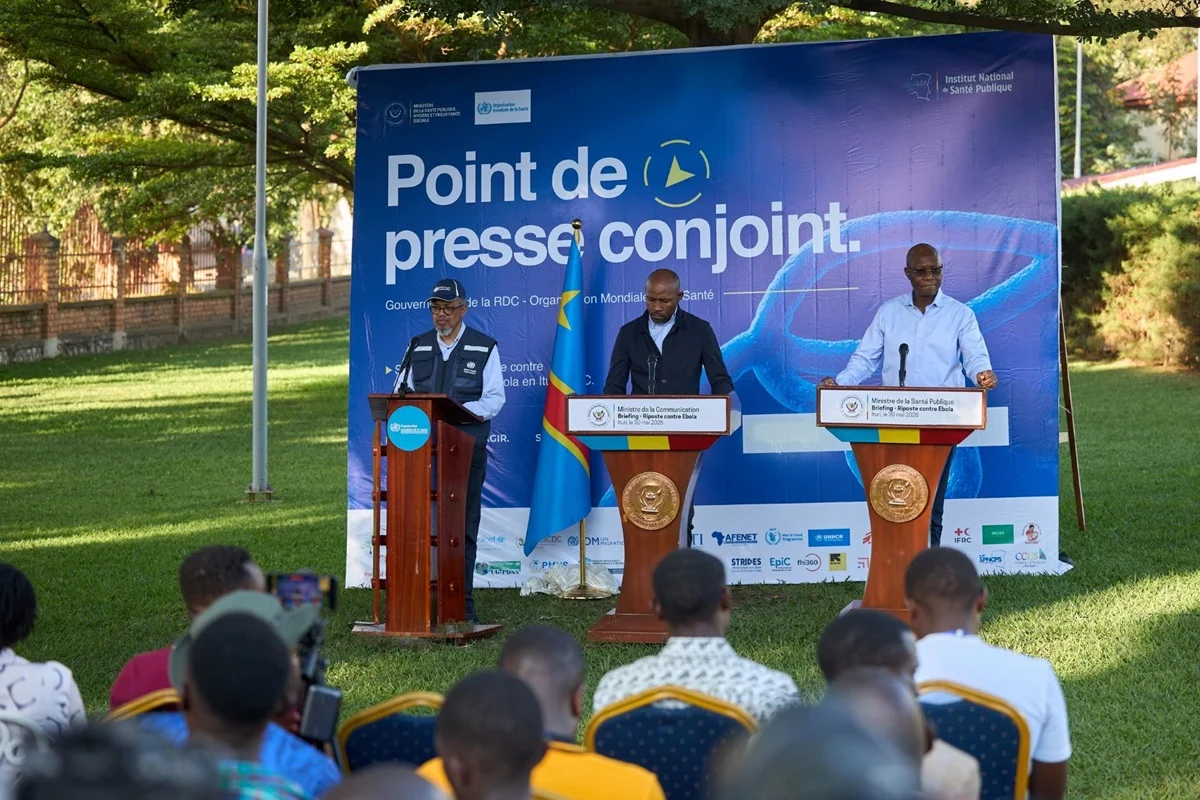
The Government of the Democratic Republic of the Congo (DRC) and the World Health Organization (WHO) have formally reaffirmed their strategic partnership and shared commitment to safeguarding the health and well-being of the population in Ituri Province and across the nation. This high-level declaration follows a critical joint mission to Bunia, the capital of Ituri, led by a delegation of senior officials including Dr. Samuel Roger Kamba, the Minister of Health, and Mr. Patrick Muyaya Katembwe, the Minister of Communication and Media. The mission was further bolstered by a landmark visit from the WHO Director-General, Dr. Tedros Adhanom Ghebreyesus, signaling the international community’s heightened concern over the current epidemiological landscape in the eastern region of the country.
The visit arrives at a pivotal and challenging juncture for the DRC as it grapples with a new outbreak of Ebola virus disease. Unlike the more common Zaire strain, this current surge is caused by the Bundibugyo virus, a rarer variant of the pathogen. According to the Ministry of Health, the situation is characterized by a rapidly evolving transmission pattern, with cases and fatalities already reported across multiple health zones in Ituri, North Kivu, and South Kivu. In response, the DRC government, with the integrated support of the WHO and various international partners, has launched an intensified campaign focused on surveillance, laboratory diagnostics, and specialized patient care to sever the chains of transmission and prevent a wider regional escalation.
The Epidemiological Context: Understanding the Bundibugyo Strain
The current outbreak in Ituri is particularly complex due to the specific nature of the Bundibugyo ebolavirus (BDBV). First identified in 2007 in the Bundibugyo District of Uganda, this strain is one of six species within the genus Ebolavirus. While historically associated with a lower case-fatality rate than the Zaire ebolavirus—which can exceed 90% in untreated cases—the Bundibugyo strain remains a lethal threat, with past outbreaks showing mortality rates ranging from 25% to 50%.
The primary challenge identified by the Ministry of Health and the WHO is the current absence of licensed vaccines or specific therapeutic treatments for the Bundibugyo strain. While the Zaire strain can be mitigated through the use of the Ervebo vaccine and monoclonal antibody treatments like Ebanga and Inmazeb, these medical countermeasures do not provide cross-protection against Bundibugyo. Consequently, the response in Ituri relies heavily on traditional public health interventions: early detection, rigorous isolation, contact tracing, and safe, dignified burial practices.
The Ministry of Health has confirmed that efforts are being fast-tracked to initiate randomized controlled trials (RCTs) for candidate vaccines and treatments specifically designed for the Bundibugyo virus. These trials are essential for building a future arsenal against this strain, but in the immediate term, the focus remains on non-pharmaceutical interventions and the strengthening of clinical supportive care to improve patient survival rates.
Chronology of the Outbreak and Response Mobilization
The timeline of the current crisis reflects the rapid mobilization of both national and international assets. Following the initial notification of suspected cases in late 2023 and early 2024, the DRC government activated its emergency response mechanisms.
- Phase I: Detection and Notification: Local health authorities in Ituri identified a cluster of unexplained hemorrhagic fever cases. Laboratory confirmation soon identified the Bundibugyo virus, prompting an immediate alert to the WHO under the International Health Regulations (IHR).
- Phase II: High-Level Mission: Recognizing the potential for cross-border spread and the volatility of the security situation in eastern DRC, Dr. Samuel Roger Kamba and Mr. Patrick Muyaya Katembwe traveled to Bunia. Their presence was intended to harmonize provincial and national response strategies and to provide political weight to the health directives being issued.
- Phase III: International Integration: The arrival of Dr. Tedros Adhanom Ghebreyesus served as a catalyst for increased international solidarity. During his visit, the Director-General reviewed the clinical infrastructure in Bunia and met with frontline health workers to assess the logistical gaps in the response.
- Phase IV: Current Intensification: The response has now moved into an intensification phase. This involves the deployment of mobile laboratories to reduce the "turnaround time" for blood sample testing and the establishment of dedicated Ebola Treatment Centers (ETCs) that prioritize infection prevention and control (IPC).
Strategic Pillars of the National Response
The DRC government is leading a comprehensive national response that is structured around five strategic pillars. This framework is designed to be adaptable to the unique security and social challenges of the Ituri and Kivu regions.
1. Surveillance and Contact Tracing
The bedrock of the response is the ability to track the virus in real-time. Surveillance teams are working in difficult-to-reach areas to identify individuals who have come into contact with confirmed cases. Given the high mobility of the population in eastern DRC—driven by trade and, unfortunately, displacement due to conflict—contact tracing remains an immense logistical hurdle.
2. Laboratory Strengthening and Diagnostics
To interrupt transmission, the time between symptom onset and laboratory confirmation must be minimized. The WHO is supporting the DRC in deploying GeneXpert machines and other advanced diagnostic tools to provincial labs. This allows for rapid testing closer to the source of the outbreak, reducing the need to transport highly infectious samples over long distances to Kinshasa.
3. Clinical Management and Patient Care
Despite the lack of a specific cure, high-quality supportive care—including fluid replacement, electrolyte balancing, and the treatment of secondary infections—can significantly increase recovery rates. The Ministry of Health is ensuring that ETCs are equipped with the necessary medical supplies and that health workers are trained in the latest IPC protocols to prevent nosocomial (facility-based) transmission.
4. Risk Communication and Community Engagement (RCCE)
The joint mission emphasized that "communities are at the heart of the solution." Past outbreaks in the DRC have demonstrated that health interventions can fail if they lack the trust of the local population. National and provincial authorities are currently intensifying dialogues with community leaders, women’s groups, youth representatives, and religious figures. The goal is to co-develop solutions that are culturally sensitive, thereby reducing resistance to vaccination trials and safe burial practices.
5. Vaccination and Therapeutic Research
The government and the WHO are working to rapidly undertake randomized control trials on candidate vaccines. This research is vital not only for the current outbreak but for global health security, as it will provide the data necessary to license medical countermeasures for future Bundibugyo incidents.
Supporting Data: The Legacy of Experience
The DRC brings unparalleled expertise to this crisis. Since the first discovery of the Ebola virus in 1976 near the Ebola River in the northern part of the country, the DRC has managed more outbreaks of the disease than any other nation.
Specifically, the 10th Ebola outbreak (2018–2020) in North Kivu and Ituri was the second-largest in history and the first to occur in an active conflict zone. The lessons learned from that period—particularly regarding the "security-health nexus"—are being applied today. During that outbreak, over 3,400 cases were reported, and more than 2,200 people lost their lives. The current response seeks to prevent the Bundibugyo strain from reaching those catastrophic proportions by utilizing the existing network of trained community health workers and epidemiological surveillance systems established during previous interventions.
Official Statements and International Solidarity
During the mission to Bunia, Dr. Samuel Roger Kamba emphasized the government’s resolve: "We are not starting from scratch. The DRC has a proven track record of overcoming these biological threats. Our priority is to ensure that our people in Ituri have the tools and the information they need to protect themselves. We are grateful for the WHO’s unwavering presence at our side."
Mr. Patrick Muyaya Katembwe highlighted the importance of transparent communication in the digital age. "We are fighting two battles: one against the virus and one against misinformation," he stated. "By working with the WHO, we are ensuring that accurate, life-saving information reaches every household, preventing the panic that often fuels the spread of the disease."
Dr. Tedros Adhanom Ghebreyesus reaffirmed the WHO’s commitment, noting that the organization would continue to mobilize resources and technical expertise. "The world owes a debt to the DRC for its leadership in infectious disease management," Dr. Tedros said. "We call on the international community to maintain its solidarity. This is not just a Congolese problem; it is a global health priority."
Broader Implications and Long-Term Health Resilience
The current response is being framed not just as a temporary emergency measure, but as an investment in the long-term resilience of the DRC’s health system. Both the government and the WHO agree that the infrastructure being built today—the laboratories, the trained workforce, and the surveillance networks—must serve as a foundation for primary healthcare long after the Ebola outbreak is contained.
The economic implications are also significant. The DRC and its neighbors are working to ensure that borders remain open for the flow of essential goods and medical supplies. Both parties have called for entry controls that are based on scientific evidence rather than fear, ensuring that trade is not unnecessarily obstructed while maintaining public health safety.
Furthermore, the involvement of the Africa Centres for Disease Control and Prevention (Africa CDC) highlights a growing trend toward African-led health solutions. The coordination between the DRC, the WHO, and the Africa CDC represents a multifaceted approach to regional health security, ensuring that resources are mobilized equitably across the affected provinces.
Conclusion: A Call for Sustained Vigilance
As the situation in Ituri continues to evolve, the DRC government and the WHO remain in a state of high alert. The success of the current mission depends on the continued adoption of protective behaviors by the public, such as regular hand hygiene and early care-seeking. The persistent challenges of early detection, contact tracing, and safe burials require a unified front between the state, international partners, and the local community.
The joint mission to Bunia has sent a clear message: the Democratic Republic of the Congo will not face this threat alone. With strong political leadership, a wealth of technical experience, and renewed international cooperation, the foundation has been laid to bring the Bundibugyo outbreak under control and leave a lasting legacy of health security for the people of Ituri and the nation at large.
