
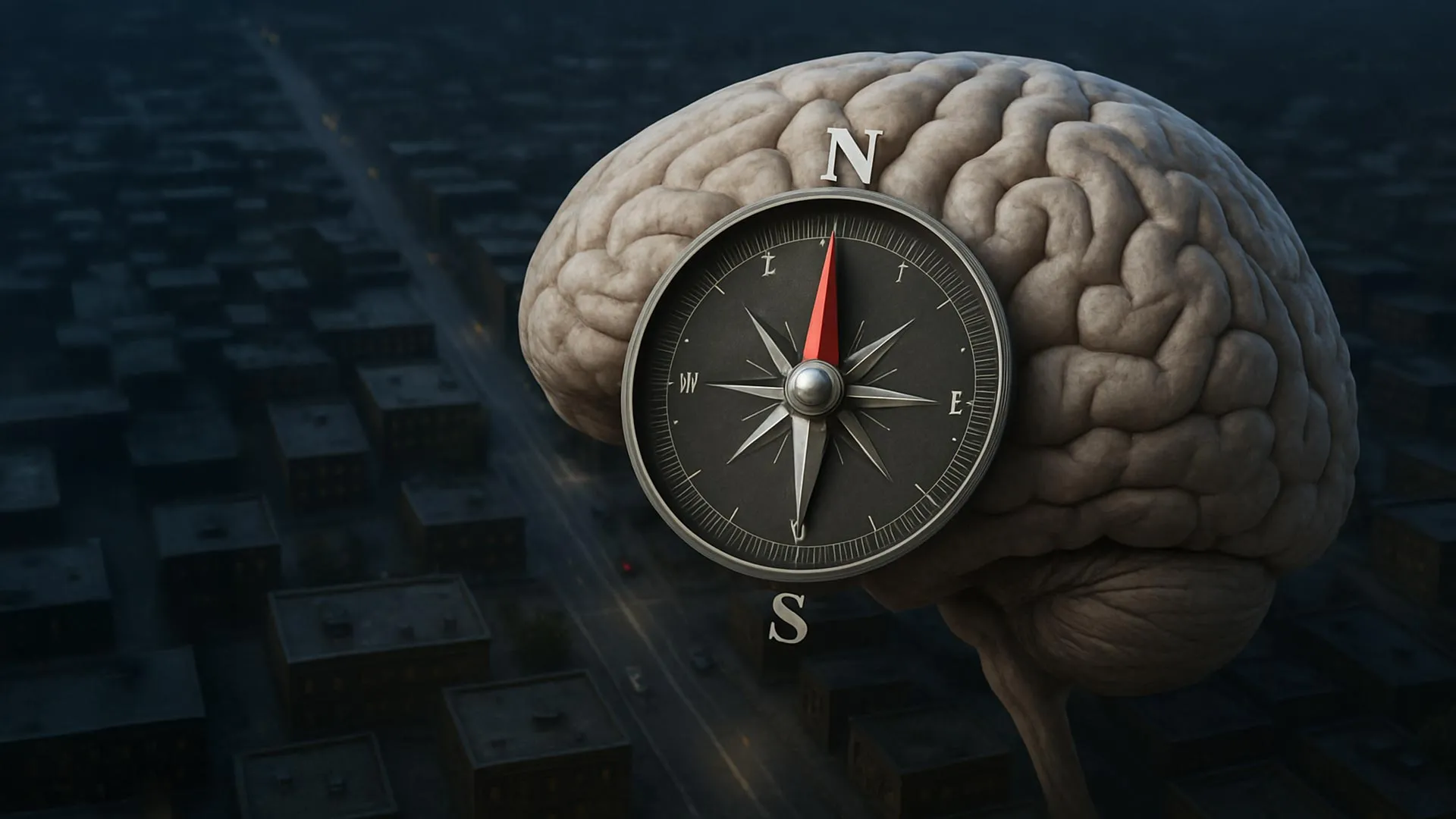
Recent scientific investigations conducted by neuroscientists at Ruhr University Bochum in Germany have provided compelling empirical evidence regarding how the primary human stress hormone, cortisol, directly interferes with the neurological systems responsible for human spatial navigation and environmental orientation. The research, which utilized advanced functional magnetic resonance imaging (fMRI), demonstrates that elevated levels of cortisol systematically degrade the precise firing patterns of grid cells—specialized neurons located within the entorhinal cortex that act as the mammalian brain’s internal global positioning system. Published in the peer-reviewed scientific journal PLOS Biology, the study bridges a critical gap in behavioral neuroscience by connecting hormonal spikes caused by acute stress directly to specific functional failures within human neural circuitry.
While clinical psychology and cognitive neuroscience have long established that psychological stress significantly impairs high-level cognitive functions, decision-making, and memory retrieval, the precise neurobiological mechanisms governing how stress degrades spatial awareness remained largely elusive until now. Dr. Osman Akan, a lead researcher from the Department of Cognitive Psychology at Ruhr University Bochum, spearheaded the investigation in close collaboration with the university’s Department of Neuropsychology and clinical researchers from the University Hospital Hamburg-Eppendorf. By examining the micro-level mechanics of the human entorhinal cortex under the influence of pharmacological cortisol administration, the research team has successfully mapped the pathway through which biochemical stress responses dismantle our internal navigational frameworks.
Methodological Rigor and Experimental Design
To isolate the specific physiological effects of cortisol from confounding variables such as situational anxiety or emotional distress, the research team designed a controlled, double-blind, placebo-controlled imaging study. The final participant cohort comprised 40 healthy adult males. Testing took place over two separate, carefully standardized experimental sessions scheduled days apart to ensure complete clearance of any administered substances between trials.
On one testing day, each participant was administered a 20-milligram dose of oral cortisol, a standard pharmacological dose designed to simulate the physiological burden of an acute stress response. On the alternative testing day, participants received an identical-looking placebo pill. Neither the participants nor the testing administrators interacting directly with them knew which substance was administered on a given day, preserving the integrity of the double-blind protocol.
Approximately intersecting with the peak bioavailability of the hormone, participants were placed inside a high-resolution MRI scanner where they engaged in a sophisticated virtual reality navigation task. The virtual environment featured an expansive, open-air meadow. During the experimental trials, participants were instructed to navigate toward a sequence of stationary target trees. Upon reaching a target tree, it immediately vanished from the virtual landscape, requiring the participant to keep track of their changing position relative to the landscape. Once a series of trees had been visited, the primary testing phase commenced: participants were required to calculate and execute the most direct, straight-line return route back to their original starting position, relying entirely on their internal sense of direction without the assistance of a visible trail or directional compass.
To further test the resilience of the human navigation system, researchers manipulated environmental complexity across two distinct conditions. In the first environmental condition, the virtual meadow was entirely devoid of permanent landmarks, forcing subjects to rely purely on path integration and their internal spatial maps. In the second condition, a prominent, fixed lighthouse was positioned on the horizon, serving as an enduring visual reference point that participants could theoretically use to anchor their position.
Quantifying the Breakdown of Spatial Accuracy
The behavioral results yielded stark and quantifiable deficits in spatial performance following the administration of cortisol. Across the board, participants who received the hormone exhibited substantially larger directional and distance errors when attempting to navigate back to their starting locations compared to their performance during the placebo sessions.
Statistical analysis of the trial data revealed that these performance declines were remarkably robust, manifesting regardless of whether a fixed landmark—such as the virtual lighthouse—was available on the horizon. Even when visual aids were present to assist with orientation, participants under the influence of cortisol struggled to synthesize environmental cues into a coherent navigational strategy. The degradation of navigational precision was universal across the cohort, underscoring the potent, disruptive impact of elevated systemic cortisol on human spatial processing.
Unmasking the Internal GPS: Disruption of Entorhinal Grid Cells
The most groundbreaking contributions of the study, however, extend beyond behavioral metrics into the realm of neuroimaging data. Utilizing functional MRI scans acquired during the virtual navigation tasks, researchers were able to observe the real-time neural activity within the entorhinal cortex—a deep-brain structure situated near the hippocampus that is critically important for memory and navigation.
Under normal, placebo-baseline conditions, specific neurons within the entorhinal cortex fire in a distinct, highly regular repeating geometric pattern as an individual moves through space. These neurons, famously known as grid cells, establish a multi-scale coordinate system that allows the brain to calculate distance, direction, and current location. This discovery, which earned the 2014 Nobel Prize in Physiology or Medicine for neuroscientists John O’Keefe, May-Britt Moser, and Edvard Moser, represents one of the foundational pillars of modern cognitive neuroscience.
The Ruhr University Bochum study revealed that cortisol administration fundamentally disrupts this elegant neural architecture. Following the ingestion of cortisol, the normally crisp, precise firing patterns of the grid cells became severely blurred, disorganized, and indistinct. When participants navigated the landmark-free virtual environment under the influence of cortisol, grid cell activity was virtually undetectable, effectively blinding the brain’s internal GPS.
"Under stress, the brain loses the ability to effectively utilize its internal navigation maps," Dr. Akan noted, summarizing the core neurological takeaway of the imaging data.
Neural Compensation Mechanisms Under Hormonal Duress
Interestingly, the neuroimaging data captured more than just a shutdown of primary navigation circuits; it also highlighted the brain’s adaptive, albeit imperfect, attempts to compensate for neurological impairment. Concurrently with the reduction of grid cell activity in the entorhinal cortex, researchers observed a marked increase in metabolic and functional activity within the caudate nucleus, a subcortical structure heavily implicated in procedural learning, habit formation, and stimulus-response strategies.
This shift in neural activation suggests that when the brain’s sophisticated metric mapping system—anchored by the entorhinal grid cells—goes offline due to hormonal stress, alternative neural networks attempt to step in. Rather than relying on a flexible, cognitive map of the environment, the brain appears to pivot toward rigid, stimulus-driven navigation tactics, such as memorizing a series of turns or relying on familiar visual routines.
"This indicates that the brain is trying to compensate for the loss of the main navigation system in the entorhinal cortex through alternative strategies," Dr. Akan explained. While this compensatory mechanism may help an individual muddle through a stressful situation, it is computationally less efficient and far more prone to error in novel or complex environments.
Broader Implications for Chronic Stress and Neurodegenerative Disorders
Beyond the immediate psychological insights into everyday stress—such as why individuals become disoriented or lost when attempting to navigate unfamiliar cities while experiencing acute anxiety—the findings carry profound implications for the study of neurodegenerative conditions, most notably Alzheimer’s disease.
The entorhinal cortex is not merely a staging ground for spatial navigation; it is also universally recognized by neuropathologists as one of the very first anatomical regions in the human brain to be structurally and functionally compromised by the pathology of Alzheimer’s disease. The accumulation of pathological tau proteins and amyloid-beta plaques typically begins in transentorhinal and entorhinal areas long before clinical symptoms of cognitive decline or memory loss become outwardly apparent.
Given that chronic psychological stress and persistently elevated circulating cortisol levels are well-established epidemiological risk factors for cognitive impairment and the acceleration of dementia, this study provides a vital mechanistic link. By demonstrating how acute hormonal surges destabilize the delicate cellular networks within the entorhinal cortex, the research offers a plausible physiological pathway explaining how chronic stress may gradually erode the structural integrity of brain regions most vulnerable to neurodegeneration.
"Because chronic stress is a risk factor for dementia, our study reveals a critical mechanism for how stress hormones destabilize this sensitive region," Dr. Akan concluded.
Future Directions in Stress and Cognitive Research
As the scientific community continues to explore the complex interplay between endocrinology and neuroscience, studies of this caliber pave the way for more targeted interventions. Understanding the precise receptor mechanisms through which cortisol alters grid cell firing could eventually inform therapeutic strategies aimed at protecting vulnerable neural populations in individuals suffering from chronic stress disorders, post-traumatic stress disorder (PTSD), or early-stage cognitive decline.
For now, the research serves as a stark reminder of the physical footprint that stress leaves upon our biology. The next time an individual experiences a moment of acute panic and finds themselves unable to read a map, retrace their steps, or locate their parked vehicle, they are experiencing the tangible, real-time consequence of a biochemical cascade that temporarily silences the brain’s most ancient and sophisticated navigational machinery.
