
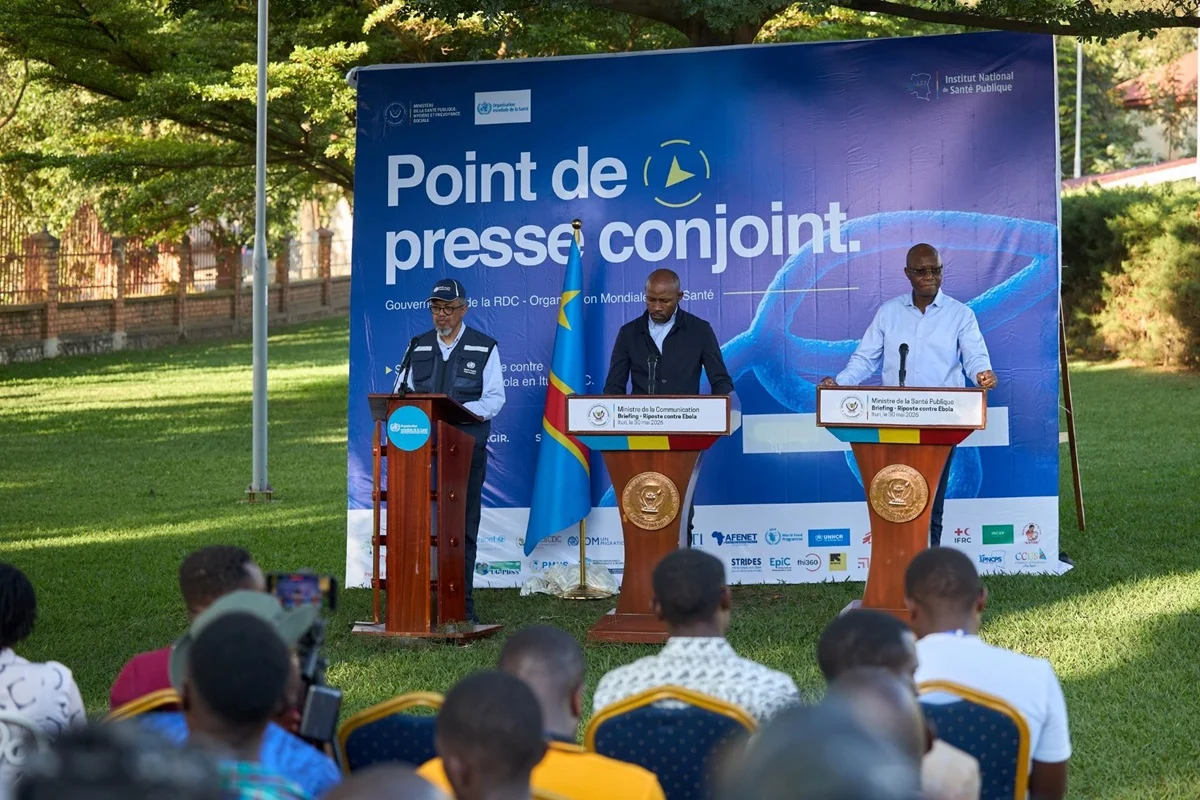
The Government of the Democratic Republic of the Congo (DRC) and the World Health Organization (WHO) have formally reaffirmed their strategic partnership and shared commitment to safeguarding the health of the population in Ituri Province and across the nation, following a high-level joint mission to Bunia led by Minister of Health Dr. Samuel Roger Kamba, Minister of Communication and Media Mr. Patrick Muyaya Katembwe, and WHO Director-General Dr. Tedros Adhanom Ghebreyesus. This diplomatic and technical intervention arrives at a critical juncture for the DRC as it grapples with a new outbreak of Ebola virus disease (EVD) caused by the Bundibugyo virus, a strain that presents unique clinical and logistical challenges compared to the more common Zaire ebolavirus. The Ministry of Health has characterized the current epidemiological situation as rapidly evolving, with confirmed cases and fatalities reported across several health zones in Ituri, North Kivu, and South Kivu, prompting an immediate escalation of surveillance, laboratory diagnostic capabilities, and specialized patient care.
A Targeted Response to the Bundibugyo Strain
The current outbreak is particularly concerning due to the specific characteristics of the Bundibugyo ebolavirus (BDBV). Unlike the Zaire strain, for which the Ervebo vaccine has been successfully deployed in recent years, there is currently no licensed vaccine or specific antiviral treatment for the Bundibugyo variant. This gap in the medical arsenal necessitates a reliance on fundamental public health interventions and rigorous clinical management. The Ministry of Health, in collaboration with the WHO and international research partners, has announced plans to rapidly initiate randomized control trials (RCTs) for candidate vaccines and therapeutic agents. These trials aim to provide the scientific community with the data needed to approve future countermeasures while offering current patients access to potentially life-saving experimental treatments under monitored protocols.
The absence of a standardized vaccine means that the "pillars of response"—surveillance, contact tracing, and isolation—are more vital than ever. The WHO has deployed technical experts to assist local health authorities in refining case definitions and ensuring that laboratory reagents specific to the Bundibugyo strain are available in regional hubs. The DRC’s National Institute of Biomedical Research (INRB) is currently working at full capacity to process samples from suspected cases in the affected eastern provinces, ensuring that the delay between symptom onset and laboratory confirmation is minimized to prevent further community transmission.
Chronology of the Outbreak and Mission to Bunia
The timeline of the current crisis began with the notification of unexplained deaths and hemorrhagic symptoms in Ituri Province, a region that has historically been a flashpoint for both health emergencies and civil unrest. Following laboratory confirmation of the Bundibugyo virus, the DRC government immediately activated its Emergency Operations Center (EOC). The joint mission to Bunia by Dr. Tedros and senior DRC ministers served as a formal assessment of the ground-level response and a signal of high-level political will.
During the visit, the delegation met with provincial governors, local health officials, and humanitarian actors to identify bottlenecks in the response. The mission emphasized that while the central government in Kinshasa is leading the strategy, the operational success depends on the integration of provincial authorities and the mobilization of resources to the front lines. This visit follows a series of previous Ebola outbreaks in the DRC—this being the nation’s 15th recorded occurrence—demonstrating a recurring pattern of viral emergence that requires a permanent state of readiness rather than reactive measures alone.
Supporting Data and Epidemiological Context
Data provided by the Ministry of Health indicates that the geographic spread of the virus across Ituri and the Kivus is exacerbated by high population mobility and the presence of internally displaced persons (IDP) camps. Historically, the Bundibugyo strain has shown a lower case-fatality rate (CFR) than the Zaire strain—roughly 25% to 50% compared to upwards of 60% to 90%—but its ability to cause large-scale outbreaks remains a significant threat to regional health security.
In previous instances, such as the 2007 outbreak in Uganda and the 2012 outbreak in the DRC’s Isiro region, the Bundibugyo virus demonstrated a propensity for nosocomial transmission (transmission within healthcare settings). This historical data has informed the current strategy, which places a heavy emphasis on Infection Prevention and Control (IPC) in all health facilities. The WHO has reported that current efforts include the distribution of Personal Protective Equipment (PPE) to dozens of health zones and the training of hundreds of local health workers in "safe and dignified burial" (SDB) protocols, which are essential for interrupting the chain of transmission during traditional funeral rites.
Community Engagement as a Central Pillar
A recurring lesson from the DRC’s extensive history with Ebola is that technical interventions are insufficient without the trust and active participation of the local population. The joint mission highlighted that communities must be at the heart of the solution. To this end, national and provincial authorities, with WHO support, are intensifying dialogues with a broad spectrum of local influencers, including women’s groups, youth representatives, religious leaders, and the private sector.
The objective of these engagements is to co-develop solutions that are culturally sensitive and effective. In many parts of Ituri and North Kivu, there is a history of skepticism toward outside medical interventions, often fueled by misinformation and the trauma of prolonged conflict. By involving community leaders in the design of surveillance and isolation strategies, the government aims to mitigate resistance and ensure that families feel empowered to seek early care. "Success will depend on the trust, engagement, and leadership of local communities," the joint statement noted, reflecting a shift toward a more decentralized and people-centric response model.
Strengthening Health System Resilience
Beyond the immediate goal of containing the Ebola outbreak, the Government and the WHO are viewing the current crisis as an opportunity to build long-term health system resilience. The investments being made today—in mobile laboratories, trained health cadres, and digitized surveillance systems—are intended to leave a lasting legacy. The strategy emphasizes that the Ebola response must not occur in a vacuum; it must maintain and even strengthen primary health care and essential services, such as maternal health and routine immunization.
The logic behind this approach is that a resilient health system is the best defense against future zoonotic spillovers. By improving the general infrastructure of health zones in Ituri and the Kivus, the government aims to ensure that the next outbreak, whether it be Ebola, measles, or a novel pathogen, is detected and contained before it reaches epidemic proportions. This "integrated response" model is also supported by the Africa Centres for Disease Control and Prevention (Africa CDC), which is working alongside the WHO to harmonize regional health protocols.
International Solidarity and Border Management
The DRC government has expressed sincere gratitude to international partners for the financial and logistical support provided thus far. However, both the Ministry of Health and the WHO have called for sustained solidarity as the outbreak evolves. A critical component of this international cooperation involves the management of national borders. The DRC shares porous borders with several neighboring countries, making the risk of cross-border transmission a constant concern.
The joint mission emphasized that while entry controls and screening are necessary, borders must remain open to ensure the flow of medical supplies, personnel, and essential trade. Obstructing these channels could inadvertently worsen the humanitarian situation and hinder the response. The WHO is working with neighboring countries to strengthen their own surveillance and preparedness levels, creating a regional "ring of protection" around the affected provinces.
Analysis of Implications and Future Outlook
The current outbreak represents a test of the DRC’s "unparalleled experience" in Ebola management. Having successfully contained the massive 2018–2020 Kivu outbreak, the country possesses a cadre of veteran responders and a sophisticated logistical framework. However, the Bundibugyo strain and the complex security environment in eastern DRC present a set of variables that could challenge even the most experienced teams.
The move toward randomized control trials for vaccines and treatments is a significant step forward for global health. If these trials yield positive results, it would represent a historic milestone in the fight against Bundibugyo ebolavirus, effectively closing one of the last major gaps in Ebola therapeutics. Furthermore, the emphasis on community-led strategies suggests that the lessons of the past decade have been internalized, moving the response away from a purely top-down medical model toward a more holistic social-medical intervention.
As the Government of the DRC, the WHO, and partners like the Africa CDC continue to mobilize, the focus remains on early detection, rapid isolation, and the maintenance of public trust. The coming weeks will be decisive in determining whether the transmission can be interrupted in the current hotspots or if the virus will continue to migrate through the highly mobile populations of the eastern provinces. With strong political leadership and renewed international support, the foundation is set for bringing the outbreak under control, but the situation remains a reminder of the persistent vulnerability of the region to emerging infectious diseases.
