
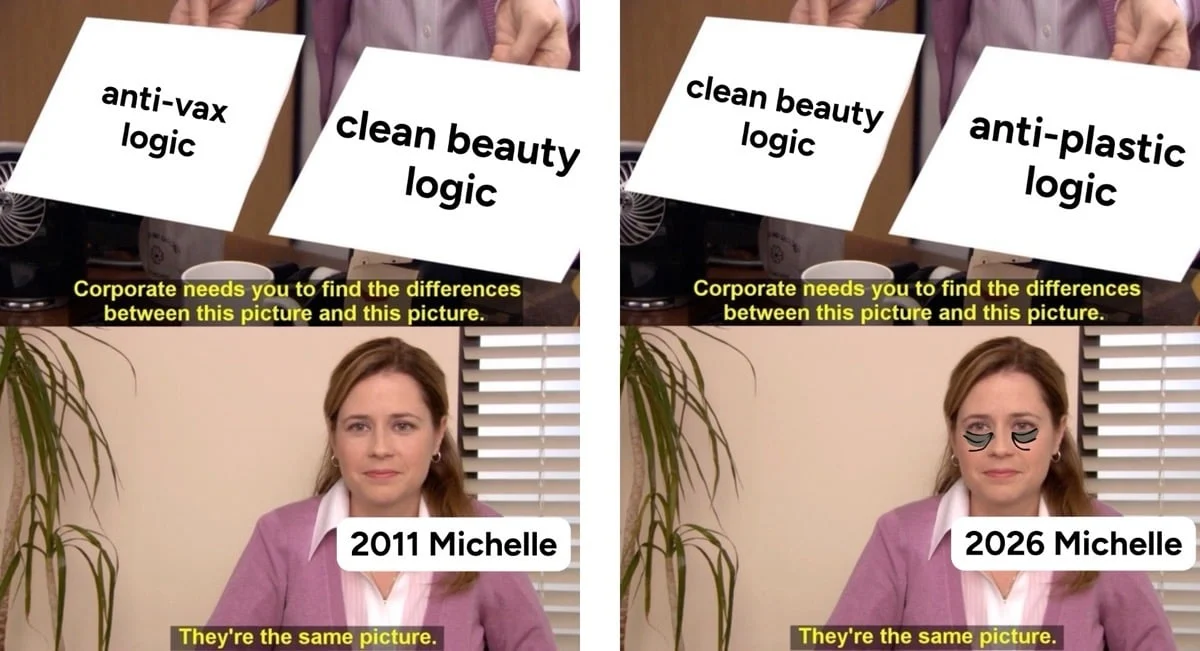
The beauty and wellness industries are continually evolving, often driven by shifting consumer anxieties and burgeoning trends. A recent observation by social media user @idea.soup on Threads ignited a significant discussion within the scientific communication community, suggesting a potential parallel between the burgeoning anti-polyester movement and a "right-wing pipeline." For Dr. Michelle Wong, a prominent science communicator behind Lab Muffin Beauty Science, this insight served as a pivotal "lightbulb moment," connecting current anti-plastic rhetoric to the problematic "non-toxic" clean beauty movement and its historical links to anti-vaccination beliefs.
Dr. Wong, who began her science communication efforts in 2011 specifically to counter the clean beauty movement’s potential to funnel individuals toward anti-vax ideologies, identified a disturbing recurrence of logical fallacies and fearmongering. Both movements, she notes, demonize similar "toxic" substances like aluminum and formaldehyde, sharing a foundational, often pseudoscientific, logic. The contemporary anti-plastic trend, with its sweeping "plastic-free" claims and alarmist narratives around microplastics from beauty brands and influencers, exhibits many of these familiar patterns, raising concerns about its implications for genuine environmental and human health efforts.
A Recurring Pattern of Pseudoscience
The critical observation is not merely about plastic itself, but about the manner in which it is being demonized. Many proponents of the anti-plastic movement, paradoxically, are aware of the pseudoscientific underpinnings of clean beauty. Yet, they fail to recognize how the very arguments used to debunk clean beauty apply directly to their anti-plastic messaging. This selective blindness extends even to some scientific outlets and individuals who, despite their general commitment to evidence-based discourse, have occasionally succumbed to clean beauty tropes. The concern articulated by Dr. Wong and other science communicators is that such misinformed activism, while seemingly well-intentioned, can lead to outcomes that are counterproductive to environmental and public health goals.
It is crucial to clarify that acknowledging these parallels does not diminish the very real issues of plastic waste and the potential health impacts of microplastics. Indeed, reducing plastic consumption is a worthy goal. However, the article argues that exaggerating these concerns and advocating for "eco" alternatives without rigorous evidence can inadvertently undermine the foundational objectives of improved human and environmental well-being. This mirrors the trajectory of the clean beauty movement, where the removal of "dirty" ingredients often led to misaligned outcomes, sometimes even compromising product safety or efficacy.
The Clean Beauty Precedent: A Historical Lens
The "clean beauty" movement gained significant traction in the early 21st century, fueled by a desire for transparency and a growing distrust of synthetic chemicals. Brands capitalized on consumer fears by labeling products "free from" a growing list of ingredients, often without scientific basis. This movement was characterized by:
- Appeal to Nature Fallacy: The belief that anything "natural" is inherently good and safe, while anything "chemical" or synthetic is bad. This ignored the fact that many natural substances are toxic (e.g., arsenic, hemlock, belladonna) and many synthetic ones are benign or beneficial.
- Ignoring Toxicology Basics: Concepts like "the dose makes the poison" were frequently overlooked. Trace amounts of substances, even those toxic in high concentrations, were often presented as dangerous regardless of exposure levels.
- Cherry-picking Science: Studies with poor methodology or those taken out of context were often cited to support claims, while robust, peer-reviewed evidence was dismissed.
- Fearmongering: Emotional appeals and alarmist language were used to cultivate consumer anxiety around common ingredients, leading to widespread misconceptions.
Dr. Wong’s early work highlighted how this approach mirrored the anti-vaccination movement’s rhetoric, particularly in its demonization of common compounds. The current anti-plastic sentiment, she contends, is adopting a remarkably similar playbook.
Key Parallels with Anti-Plastic Messaging
The treatise meticulously outlines several critical parallels between anti-plastic messaging and the clean beauty movement:
1. The Appeal to Nature Fallacy Redux
Just as "natural" was equated with "good" in clean beauty, the anti-plastic movement broadly equates "plastic" with "bad" and "natural alternatives" with "good." This extends to bioplastics, often lauded for their "natural" origins, despite their complex environmental footprints. The fundamental flaw remains: a material’s origin, whether natural or synthetic, does not inherently dictate its safety or environmental impact. Highly toxic substances like mercury or uranium are entirely natural, while many synthetic polymers are inert and safe. This simplistic dichotomy obscures the nuanced scientific reality, leading to uninformed choices.
2. Disregarding Foundational Sustainability Science
A central critique of the clean beauty movement was its disregard for basic toxicology. Similarly, the anti-plastic movement often overlooks the fundamentals of sustainability science, particularly the rigorous methodology of Life Cycle Assessment (LCA). LCA is the gold standard for quantifying a product’s environmental impact across its entire lifespan, from raw material extraction and manufacturing to transport, use, and end-of-life disposal.
Crucially, most public discourse around plastic focuses almost exclusively on its end-of-life—microplastics, recycling challenges, landfills, and oceanic waste. While these are legitimate concerns, they often represent only a fraction of a product’s total environmental footprint. Consumers tend to overemphasize end-of-life impacts because they are often the most visible and easily understood. However, scientists widely agree that climate change, driven largely by greenhouse gas emissions, is the most pressing environmental threat.
Here, plastic packaging often presents significant advantages. A 2011 Denkstatt report, for instance, found that switching from plastic to alternatives like glass, paper, or aluminum would, on average, require 3.6 times more material, 2.2 times more energy, and result in 2.7 times higher carbon emissions. These figures underscore plastic’s benefits: its light weight reduces transport fuel consumption; its durability minimizes product damage and waste; and its efficient use of resources often leads to a smaller carbon footprint during production compared to heavier, more energy-intensive materials. For example, a glass bottle, while recyclable, is significantly heavier than its plastic counterpart, leading to higher fuel consumption during shipping. Aluminum production, while highly recyclable, is extremely energy-intensive in its primary form. Paper products often require significant water and energy in their manufacturing and can be less durable, leading to higher rates of replacement.
It’s important to note that these are not blanket pro-plastic statements; rather, they highlight the necessity of holistic, evidence-based assessment. Every packaging choice requires a case-by-case LCA. However, many beauty brands, in their pursuit of "plastic-free" marketing, often promote alternatives without conducting or transparently sharing comprehensive LCAs. This can lead to "performative greenwashing," where brands encourage consumers to switch to seemingly eco-friendly options, often at a higher cost, while sidestepping the more impactful goal of simply consuming less.
3. Citing Studies with Serious Methodological Flaws
The clean beauty movement frequently relied on poorly conducted studies or misinterpreted data. A similar trend is observed in microplastics research. Measuring minute quantities of any substance accurately is challenging, but microplastics present unique difficulties. Many studies, despite good intentions, suffer from methodological issues that lead to false positives or exaggerated findings, which are then amplified by media eager for sensational headlines.
A common quantification method, pyrolysis-GCMS (Py-GCMS), has been shown to confuse fats with polyethylene unless meticulous corrections are applied. This can lead researchers to significantly overestimate microplastic concentrations, as seen in the widely reported, but later challenged, claim of a "spoon’s worth of microplastics in our brains."
Furthermore, contamination is a pervasive problem. Microplastics are ubiquitous in the environment, making it incredibly difficult to prevent their introduction into samples from lab equipment, clothing, or even air. Many studies inadvertently count these contaminants as part of their sample, inflating reported levels. These esoteric methodological issues create fertile ground for misinformation, making it difficult for the public and even some experts to discern reliable data from flawed claims.
4. Assuming Presence Equates to Harm (Correlation is Not Causation)
Just as the "parabens in breast tumors" study was misinterpreted to suggest parabens caused cancer without measuring baseline levels in healthy tissue, current microplastic discourse often conflates presence with causation. Discovering microplastics in diseased tissues, such as arterial plaque or the brains of individuals with dementia, does not automatically imply they are the causative agents. This logical leap ignores other potential explanations, such as:
- Reverse Causation: The disease itself might make the body more susceptible to microplastic accumulation, rather than microplastics causing the disease.
- Confounding Factors: Other environmental, lifestyle, or genetic factors could be responsible for both the disease and the presence of microplastics.
- Lack of Dose-Response: Even if microplastics play a role, the observed concentrations might be too low to exert a harmful effect.
Understanding the difference between correlation and causation is fundamental to scientific inquiry, yet it is consistently sidestepped in fear-based narratives.
5. Overlooking Practical Benefits and Trade-offs
The clean beauty movement often ignored the functional benefits of demonized ingredients, such as parabens’ efficacy as preservatives, which allows for lower concentrations and fewer allergic reactions compared to some alternatives. Similarly, the anti-plastic narrative frequently overlooks the diverse and often critical benefits of plastics beyond their environmental footprint. These include:
- Food Safety and Preservation: Plastic packaging significantly extends the shelf life of food, reducing spoilage and waste, and preventing contamination.
- Hygiene and Sterility: In medical and pharmaceutical applications, disposable plastics are indispensable for maintaining sterile environments and preventing disease transmission.
- Durability and Protection: Plastics protect products during transport and use, minimizing damage and product waste.
- Accessibility and Cost: The affordability and versatility of plastics often make essential goods and services more accessible to a wider population.
- Innovation: Plastics enable lightweight components in vehicles and aircraft, contributing to fuel efficiency and reduced emissions.
Ignoring these crucial advantages leads to a one-sided assessment, where the perceived negatives of plastic are amplified while its indispensable contributions are neglected.
6. Science-Washing and the Cultivation of "Convenient Experts"
Both movements employ "science-washing" – the appropriation of scientific language and imagery to lend credibility to unscientific claims. Brands and influencers often present cherry-picked data or consult "experts" whose views align with their marketing narratives, even if those experts lack broad consensus or relevant specialized knowledge.
This tactic creates an illusion of scientific backing, misleading consumers and even regulators. Regulatory bodies in major regions, such as the US Federal Trade Commission (FTC), the UK Competition and Markets Authority (CMA), and the Australian Competition and Consumer Commission (ACCC), have issued guidelines against misleading and deceptive sustainability claims. These guidelines underscore the importance of robust, verifiable evidence for any environmental assertions, advising brands to engage genuine sustainability experts to vet their claims.
The problem is compounded by a misunderstanding of relevant expertise. For instance, an organic chemist’s expertise in synthesis doesn’t automatically qualify them as an expert in toxicology or sustainability science. Similarly, a dermatologist may understand skin biology but not the intricacies of plastic’s life cycle impacts. This selective amplification of "convenient experts" undermines true scientific discourse.
Other Disturbing Parallels
Beyond these core points, other echoes exist:
- Moral Superiority: Both movements often foster a sense of moral superiority among adherents, framing their choices as inherently virtuous.
- Guilt-Tripping: Consumers are often made to feel guilty for using conventional products or materials, driving emotional rather than rational decision-making.
- Shifting "Experts": Many of the same individuals who previously fearmongered about parabens and phthalates have now shifted their focus to microplastics, demonstrating a pattern of seeking out new "toxins" to demonize.
Ultimately, while the intention to reduce plastic waste and improve health outcomes is laudable, blanket demonization without proper evidence leads to misdirected efforts and potentially worse environmental consequences.
The Peril of Motivated Reasoning
A significant concern highlighted by Dr. Wong is the increasing prevalence of identity-based motivated reasoning and confirmation bias. This cognitive bias leads individuals to selectively accept evidence that aligns with their existing beliefs or political/social affiliations, while dismissing contradictory information, regardless of its scientific merit. This phenomenon has long plagued anti-science movements and is now visibly influencing the plastic debate.
A recent example involved The Guardian, a mainstream media outlet, publishing an article on January 13, 2026, that critically examined the methodological issues in microplastic measurement, specifically challenging earlier sensational claims about microplastics in the human brain. This act of delving into complex science and correcting previous misinformation is commendable and rare for a major publication.
However, the article faced accusations of being "bought by Big Plastic" simply because it quoted a former Dow chemist. This dismissal occurred despite The Guardian also quoting two independent scientists from public institutions who affirmed the same methodological concerns, and referencing a response letter penned by nine European scientists also working at public institutions. As cosmetic scientist Jen Novakovich of The Eco Well aptly states, "Discounting something solely based on funding source or affiliation is actually the opposite of critical thinking." While financial conflicts of interest are a valid factor to consider, they should not be the sole determinant for rejecting scientific arguments. The more arduous, but necessary, task is to critically evaluate the arguments themselves, which The Guardian article presented in an accessible manner.
Implications for Environmental Progress and Public Trust
The parallels between the "plastic-free" movement and clean beauty are not merely academic; they carry significant real-world implications:
- Misallocated Resources: Funds and efforts directed towards "plastic-free" initiatives that are not scientifically sound can divert resources from truly impactful environmental solutions.
- Consumer Confusion and Financial Burden: Consumers, bombarded with often contradictory information, struggle to make informed choices and may pay a premium for "eco-friendly" alternatives that offer no real environmental benefit, or even worsen impacts.
- Erosion of Trust in Science: When scientific language is co-opted for marketing or ideological purposes, it undermines public trust in legitimate scientific institutions and experts.
- Suboptimal Environmental Outcomes: By focusing on visible, but not always most impactful, aspects like end-of-life plastic, crucial issues like climate change and overall carbon footprint can be neglected, leading to worse aggregate environmental damage.
The work of science communicators like Dr. Michelle Wong and Jen Novakovich (The Eco Well), whose PhD research focuses on environmental misinformation, is vital in navigating this complex landscape. Their efforts to demystify complex scientific concepts and provide evidence-based perspectives are crucial for fostering genuinely sustainable practices and protecting public health from the allure of pseudoscientific narratives. Without a rigorous, evidence-based approach, the "plastic-free" movement risks becoming another chapter in the long history of well-intentioned but ultimately misinformed activism.
