
The modern digital landscape is increasingly saturated with automated text generation, leading to widespread concerns regarding the integrity of factual information, particularly within scientific communication. As artificial intelligence chatbots like OpenAI’s ChatGPT, Anthropic’s Claude, and Google’s Gemini become ubiquitous tools for drafting, summarizing, and querying complex data, a growing body of researchers, science communicators, and technologists are issuing stark warnings: large language models are fundamentally unequipped to handle scientific facts reliably.
The core issue stems from a widespread public misunderstanding of how these models function. Despite marketing narratives that imply artificial intelligence systems possess a comprehensive repository of human knowledge, chatbots do not "know" facts in the cognitive sense. Instead, they operate on statistical probabilities, stitching together words based on proximity and patterns derived from vast training datasets. In the realm of science—where precision, empirical backing, and causal relationships are paramount—this probabilistic architecture introduces severe vulnerabilities that make AI-generated content a precarious and often misleading foundation for research and public education.
The Architectural Mechanics of Large Language Models
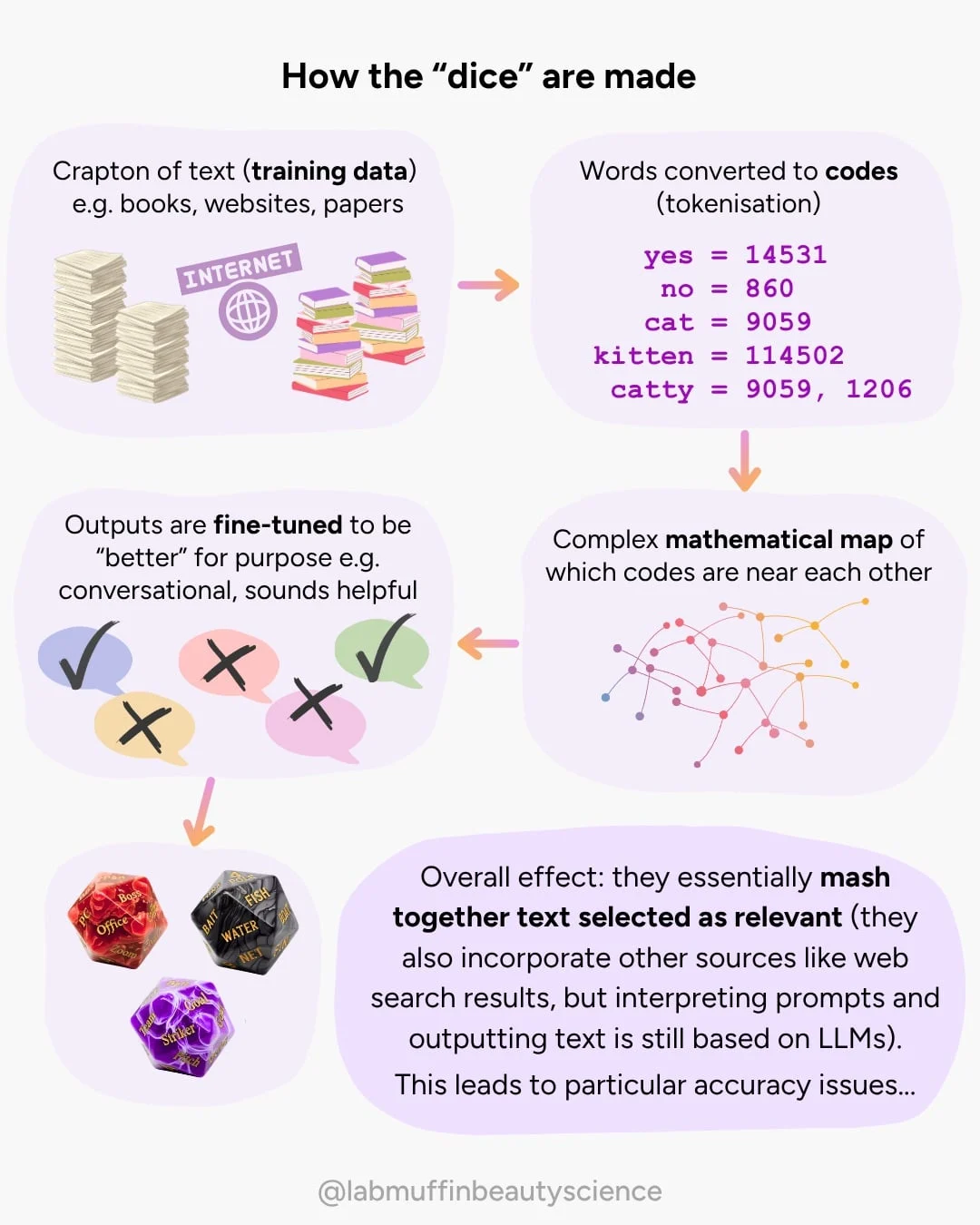
To understand why artificial intelligence chatbots falter when processing scientific information, one must examine the underlying mechanics of large language models (LLMs). Unlike traditional databases that retrieve structured records based on explicit queries, LLMs function by predicting the next most likely token in a sequence.
The system relies on a mathematical framework that can be analogized to an immensely complex set of weighted, uneven dice. When a user inputs a prompt, the model selects and rolls these metaphorical dice based on the contextual prompt and the preceding words, generating a continuous string of text that mirrors human syntax and tone. This statistical approach creates a compelling illusion of comprehension. However, language correlation is not causation, and linguistic fluency does not equate to factual accuracy.
Recent academic literature highlights the psychological implications of this technological illusion. According to a 2025 study published in the Journal of Marketing by researchers S. M. Tully, C. Longoni, and G. Appel, lower artificial intelligence literacy directly predicts greater AI receptivity. When consumers view artificial intelligence as a magical oracle rather than a probabilistic text-generator, they exhibit higher levels of uncritical trust. This misplaced confidence becomes acutely dangerous when applied to technical fields such as medicine, chemistry, and physics, where subtle errors can carry significant real-world consequences.
Empirical Vulnerabilities and Real-World Science Failures
The limitations of AI text generation are frequently exposed when models attempt to synthesize or summarize academic literature. Because LLMs prioritize stylistic coherence over empirical verification, they routinely misattribute findings, distort methodologies, and fabricate details that sound plausible within a given context.
Prominent instances of scientific misrepresentation have drawn sharp rebukes from the academic community. In one notable case, a peer-reviewed dermatology study co-authored by science communicator and researcher Michelle Wong was inaccurately summarized by automated systems and subsequently propagated on social media channels as research conducted exclusively by a "Harvard team," despite the fact that only one of the four contributing authors was affiliated with the university.
Such errors are systemic rather than isolated anomalies. Medical literature has long grappled with quotation and citation inaccuracies—issues documented extensively in systematic reviews such as a 2025 study published in Research Integrity and Peer Review by C. Baethge and H. Jergas, as well as earlier work by N. Smith and A. Cumberledge in the Proceedings of the Royal Society A. When general-purpose LLMs are deployed to automate literature reviews or synthesize medical guidelines, these baseline quotation errors are amplified by the model’s tendency to generate authoritative-sounding fabrications, colloquially known as "hallucinations."
Furthermore, research into advanced reasoning models indicates that technical safeguards designed to improve logical output do not entirely solve the problem. Studies published in mid-2025 by the Anthropic Alignment Science Team, alongside evaluations from benchmarks such as the 2026 EsoLang-Bench by A. Sharma and P. Chopra, reveal that reasoning models often produce logically sound justifications for incorrect conclusions derived from pattern-matching rather than true deductive reasoning.
Cognitive Biases and the Challenge of Fact-Checking
Fact-checking AI-generated scientific content presents a unique psychological hurdle for human users. Even when individuals possess the subject-matter expertise required to evaluate a claim, they must actively override deeply ingrained cognitive biases that favor automated and fluent communication.
Behavioral scientists and communication experts identify several key psychological phenomena that hinder effective AI verification:
- The Fluency Effect: Human brains naturally associate linguistic fluency and polished formatting with truthfulness. Because LLMs excel at producing grammatically correct, well-structured prose, readers are predisposed to accept the output as credible.
- The Confidence Effect: Chatbots communicate with an unwavering tone regardless of whether their assertions are empirically validated or entirely invented. This lack of calibrated uncertainty encourages uncritical acceptance.
- Confirmation Bias: Users frequently prompt AI systems with preconceived notions, and models are optimized to satisfy user intent, frequently delivering confirmation bias wrapped in objective-sounding language.
- Automation Bias and Authority Bias: Non-expert users systematically overestimate the objective neutrality of machine-driven decisions, attributing an unwarranted mantle of authority to software platforms.
Overriding these mental shortcuts requires deliberate cognitive effort, forcing individuals to swim against thousands of years of evolutionary psychology that rewards social consensus and smooth communication over rigorous skepticism.
Broader Implications for Science Communication and the Rise of AI Slop
The proliferation of low-effort, AI-generated content—often referred to as "AI slop"—carries profound implications for the broader ecosystem of science communication. Beyond the immediate risk of factual inaccuracies, reliance on LLM architecture introduces systemic structural flaws into public discourse.
First, AI-generated texts are subject to the anchoring effect, wherein the initial framing provided by the model disproportionately influences how a human reader conceptualizes a problem. Second, LLMs are notoriously verbose, injecting redundant filler and repeating core concepts in an effort to satisfy length parameters, thereby increasing the cognitive burden of verification. Third, the phenomenon of "jagged intelligence"—where a model performs complex linguistic tasks while failing at basic logical operations—results in bizarre structural errors that human editors are unaccustomed to detecting.
Compounding these issues is the threat of model collapse, a theoretical and empirical concern explored by researchers such as George D. Montanez. As artificial intelligence models are increasingly trained on vast oceans of synthetic text generated by other LLMs, baseline biases—including racial, gender, and regional prejudices—are compounded. This feedback loop degrades the overall quality of the training data, ensuring that future iterations of chatbots may inherit and magnify the errors of their predecessors rather than correcting them.
For science communicators, educators, and the general public, the presence of discernible artificial intelligence formatting has emerged as a reliable red flag. Anecdotal observations across digital platforms indicate that creators relying heavily on automated text generation frequently struggle with basic factual accuracy. Developing an authentic, verifiable voice remains significantly more reliable than attempting to police and fact-check the probabilistic outputs of an unguided language model.
Ultimately, navigating the current information ecosystem requires a fundamental shift in how society approaches artificial intelligence tools. As experts emphasize, effective verification of AI-generated science content requires knowing the correct answer independently before consulting the machine. In the absence of that foundational knowledge, utilizing chatbots as a primary source for scientific inquiry remains an unreliable and potentially hazardous endeavor.
