
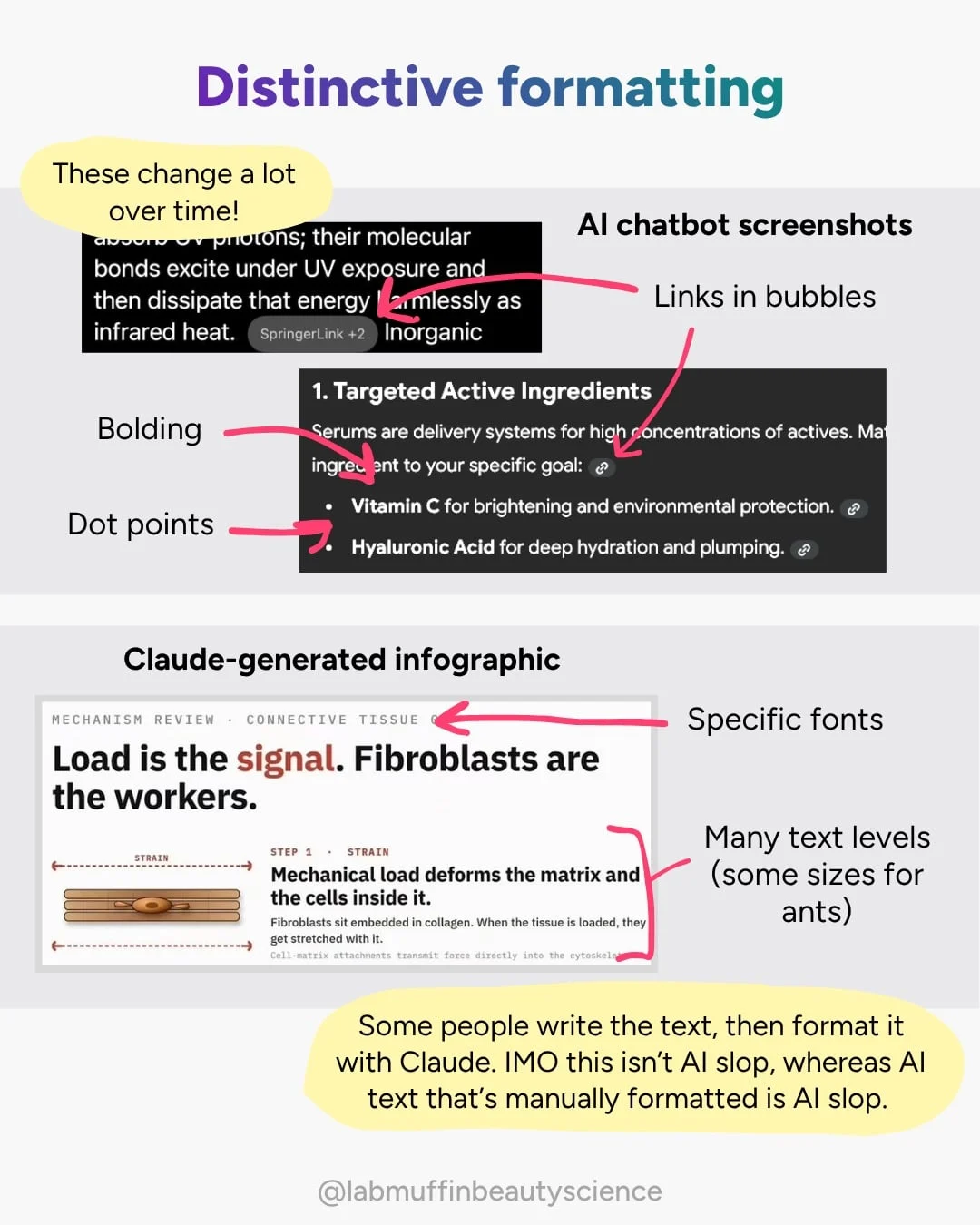
The rapid proliferation of generative artificial intelligence models across consumer platforms has fundamentally altered the digital information ecosystem, introducing a phenomenon commonly referred to as "AI slop." While traditional misinformation was historically characterized by glaring typographical errors, poor grammar, and structural inconsistencies, modern synthetic text presents a significantly more sophisticated challenge. Particularly within specialized fields such as science, health, and beauty communication, AI-generated content frequently masquerades as authoritative expertise. According to recent analyses by digital literacy and science communication experts, the sheer volume of unverified, algorithmically generated text requires information consumers and professionals to adopt entirely new evaluative frameworks.
The evolution of automated content generation has shifted the paradigm of digital skepticism. Historically, basic automated scripts or poorly translated articles left obvious linguistic footprints that immediately signaled a lack of human editorial oversight. Today, however, large language models (LLMs) are engineered to produce impeccably formatted, grammatically pristine prose. This veneer of professionalism often disarms readers, masking fundamental factual inaccuracies and conceptual errors. Because synthesizing plausible-sounding prose requires significantly less cognitive effort than verifying empirical data, content heavily laden with generative markers is frequently unverified, demanding rigorous independent fact-checking by the consumer.
Background Context and Technological Trajectory
The groundwork for the current wave of digital synthetic content was laid years prior to its widespread public visibility. While early transformer-based architectures demonstrated advanced natural language processing capabilities, the release of accessible, consumer-facing chatbots in late 2022 marked a critical inflection point. By 2025, the utilization of these tools transitioned from experimental novelty to mass industrial scaling, heavily impacting content-driven industries, academic publishing, and social media commentary.
In specialized disciplines like science communication, where translating dense peer-reviewed literature requires meticulous domain expertise, the temptation to automate output proved overwhelming for some creators. The economic incentives of continuous digital publishing—driven by algorithmic demands for high-frequency engagement—collided directly with the time-intensive nature of genuine scientific inquiry. Consequently, a digital environment emerged where hyperprolific publishing schedules often correlate inversely with factual accuracy and scientific rigor.
Identifying Linguistic Quirks and Structural Tells
Detecting contemporary AI-generated scientific content requires looking beyond superficial metrics like grammar and punctuation. Because standard AI detectors remain notoriously unreliable and easily bypassed, analysts emphasize the importance of identifying cumulative behavioral and linguistic patterns within the text.
LLMs inherently rely on statistical probability to predict subsequent tokens, resulting in predictable linguistic tics and structural biases. These stylistic quirks often manifest as an inflated sense of universal significance, where every referenced mechanism, ingredient, or study is framed as groundbreaking, critical, or paradigm-shifting. Furthermore, AI-generated prose frequently exhibits high wordiness paired with low information density—a phenomenon where expansive paragraphs deliver minimal substantive data.
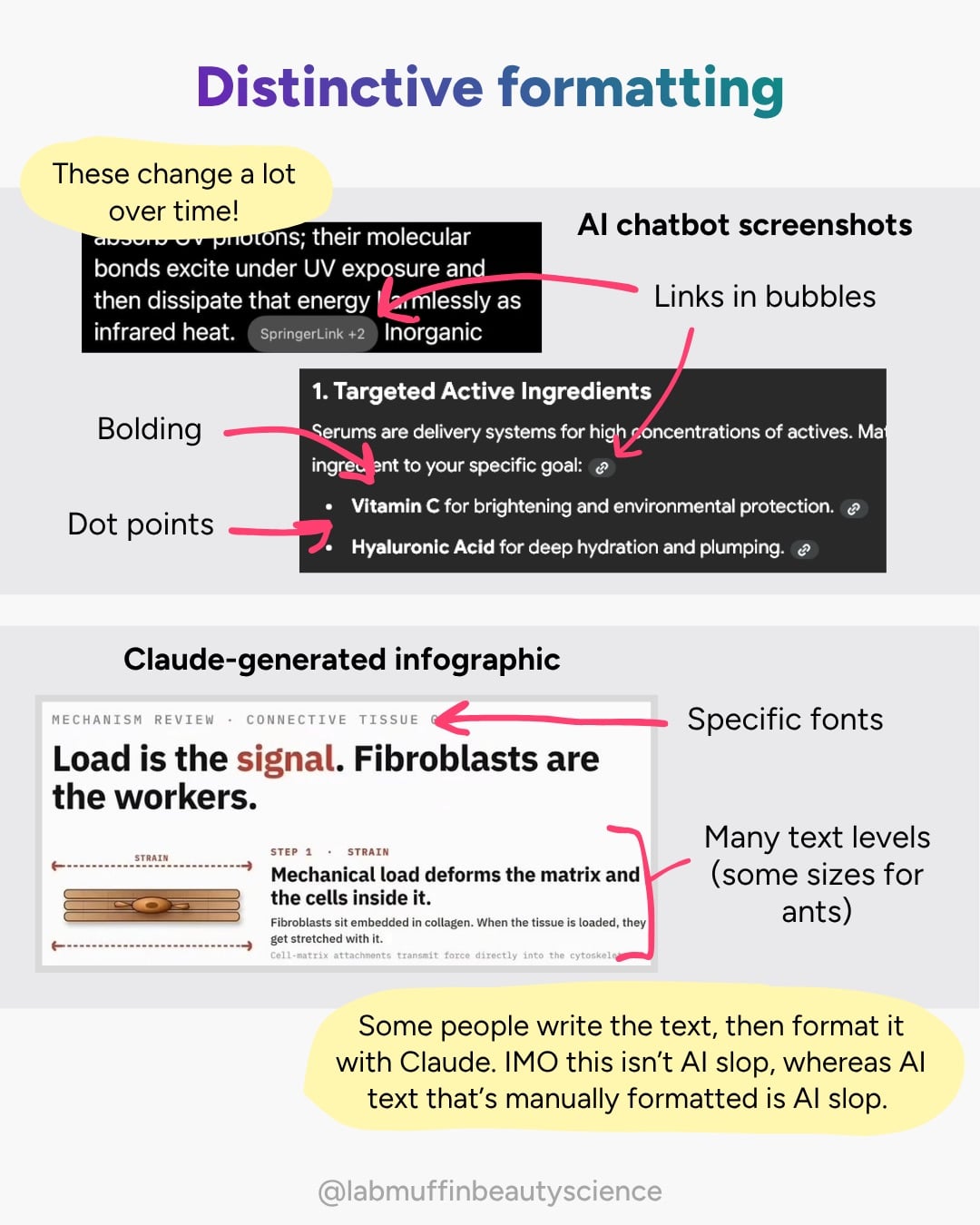
Beyond the overarching tone, structural inconsistencies often betray artificial authorship. Chatbot remnants, such as stray quotation marks, conversational signposts like transitional metadata, or formatting artifacts from automated prompt responses, frequently survive the copy-pasting process. Furthermore, AI systems struggle with advanced conceptual organization, resulting in bizarre thematic hierarchies, unnatural transitions, and inhuman logical choices that diverge sharply from how domain-expert humans structure analytical arguments.
The Problem of Hyperprolific Output and Academic Fraud
One of the most concerning macroscopic indicators of AI integration in scientific communication is hyperprolific output—the generation of an anomalously high volume of content across broad, disparate subjects. In legitimate scientific research and specialized science communication, acquiring deep domain expertise takes years, and properly reading, contextualizing, and summarizing a single peer-reviewed paper can require hours of focused analysis.
When creators or academic researchers begin publishing daily or multi-daily treatises spanning organic chemistry, dermatology, physics, and clinical medicine with absolute confidence, it serves as a major red flag. This high-frequency anomaly mirrors broader crises within global academic publishing, where paper mills and fraudulent actors leverage automated writing tools to flood journals with unverified manuscripts. Prominent recent cases, such as individual researchers credited with authoring hundreds of papers within a single calendar year, underscore how generative technologies have exacerbated systemic vulnerabilities in quality control.
Behavioral Indicators and the "MUDCAPS" Framework
Experts examining the intersection of unreliable expertise and automated content generation frequently reference evaluative models such as the MUDCAPS framework, which catalogs red flags commonly associated with dubious subject-matter authorities. Key indicators include an undiscerning attitude toward artificial intelligence, characterized by an uncritical embrace of chatbot outputs without acknowledging algorithmic hallucinations, training data biases, or systemic limitations.
Interestingly, defensive or absolute public denials of AI usage do not preclude synthetic generation. Digital forensics across various creator communities have repeatedly demonstrated that individuals who publicly condemn generative tools are occasionally found utilizing them behind the scenes. Analysts note that historical AI-generated posts left live on public feeds provide valuable diagnostic data; if a creator maintains older, demonstrably flawed synthetic posts, it strongly indicates either a lack of awareness regarding AI unreliability or a disregard for factual integrity.
Implications for Public Science Literacy
The proliferation of unverified AI science content carries severe implications for public health, consumer safety, and general scientific literacy. When consumers rely on skincare, medical, or environmental advice generated by models prone to fabricating citations or misinterpreting empirical data, the risks extend beyond mere misinformation into tangible physical or financial harm.
Furthermore, the saturation of digital platforms with low-cost, algorithmically generated "slop" threatens to drown out rigorous, evidence-based science communication. As search engines and social media algorithms struggle to filter out high-volume synthetic noise, the burden of verification increasingly falls upon the end-user. Information specialists strongly advise cross-referencing claims against primary peer-reviewed literature, consulting consensus statements from recognized scientific bodies, and exercising heightened skepticism toward content exhibiting cumulative markers of artificial generation.
