
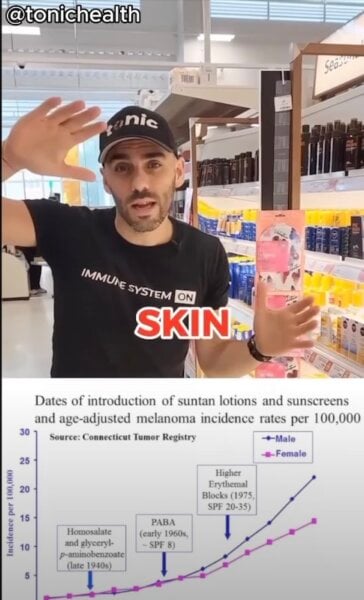
Global public health campaigns have spent decades championing the daily application of sunscreen as a frontline defense against ultraviolet radiation and malignant melanoma. Yet, an apparent epidemiological paradox continues to fuel skepticism across social media platforms: statistical charts illustrate that while national sunscreen sales and reported usage have climbed steadily since the latter half of the twentieth century, diagnoses of skin cancer have followed an equally aggressive upward trajectory. Viral posts on platforms like TikTok frequently weaponize this data, questioning whether modern sunscreens are fundamentally ineffective or, more alarmingly, acting as a direct catalyst for skin malignancies.
Dermatologists, oncologists, and cosmetic chemists emphasize that interpreting these population-level trends requires moving past surface-level statistical correlations to examine the underlying mechanisms of public health data, controlled clinical trials, and shifting human behaviors. The persistent belief that sunscreen causes cancer collapses under rigorous scientific scrutiny, which instead points toward a complex convergence of demographic shifts, changing recreational habits, and enhanced medical diagnostics.
The Fallacy of Correlation and Spurious Data
The foundational argument linking sunscreen to rising cancer rates relies heavily on a logical fallacy: assuming that because two phenomena increase simultaneously, one must cause the other. In reality, the statistical charts often cited by wellness influencers do not even display a direct correlation between sunscreen consumption and melanoma rates; rather, they present a long-term historical increase in skin cancer incidence extending back to the 1930s—decades before sunscreen became a staple of modern cosmetic and personal care routines.
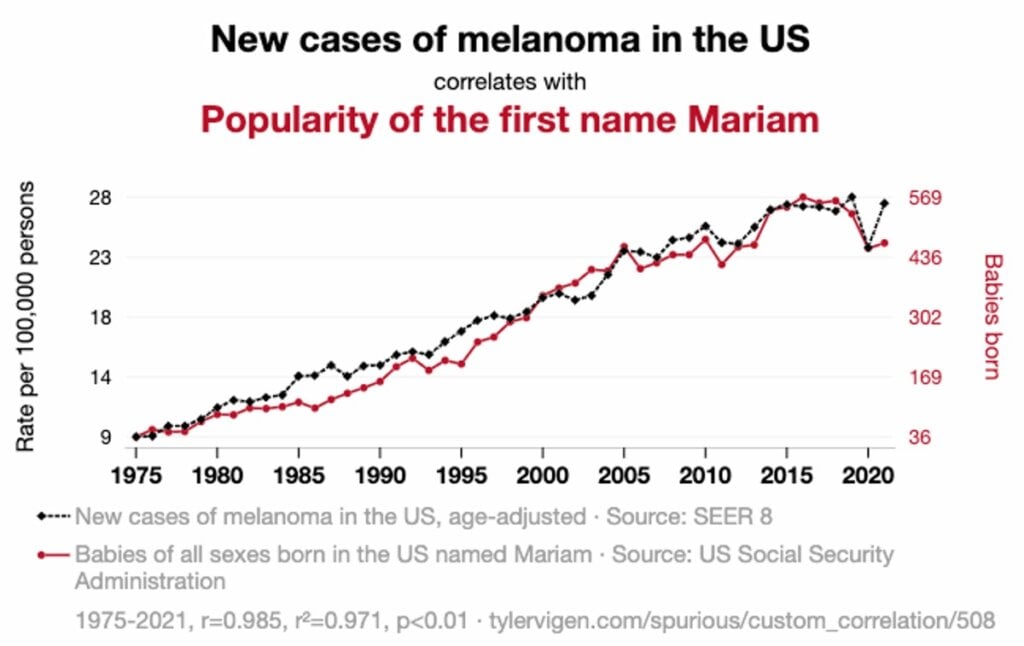
Applying this flawed logic to historical timelines reveals the absurdity of the deduction. Numerous societal indicators have risen exponentially since the 1930s, ranging from global air travel frequency to the widespread adoption of synthetic plastics. Statisticians frequently use repositories like Spurious Correlations to demonstrate how entirely unrelated variables can exhibit near-perfect mathematical alignment, such as the correlation between United States melanoma rates and the popularity of specific baby names.

Sunscreen was initially formulated in rudimentary forms during the 1940s—primarily to protect soldiers in extreme environments—but its widespread integration into daily consumer culture did not occur until the 1970s. The upward trajectory of skin cancer diagnoses was already well underway before widespread commercial adoption took hold, signaling that broader historical variables are driving the observed epidemiological changes.
Rigorous Clinical Trials Versus Observational Trends
While observational population studies are vulnerable to confounding variables, experimental science offers definitive insight into the physiological impact of photoprotective formulations. The gold standard in medical research—the randomized controlled trial (RCT)—eliminates outside interference by dividing comparable cohorts into distinct groups to track outcomes under controlled conditions.
The definitive benchmark in this field is the Nambour Trial, a landmark multi-year study conducted in Australia. Researchers monitored participants of similar ages and skin types who were divided into two distinct cohorts: one group applied broad-spectrum sunscreen daily as a matter of protocol, while the control group applied sunscreen entirely at their own discretion. Following a 4.5-year active intervention phase, researchers tracked the cohorts for an additional decade.
The findings definitively dismantled the hypothesis that sunscreen promotes carcinogenesis. Participants assigned to daily sunscreen usage demonstrated a statistically significant reduction in both squamous cell carcinomas and basal cell carcinomas. Furthermore, long-term follow-ups revealed that regular sunscreen users experienced a notable decrease in the development of melanoma compared to the discretionary-use group. Biochemical analyses corroborate these clinical results, demonstrating that adequate layers of high-SPF sunscreen substantially suppress the formation of pyrimidine dimers—DNA mutations triggered by ultraviolet radiation that serve as the biological precursors to skin cancer.
Unpacking the Drivers Behind Rising Skin Cancer Rates
If clinical data confirms that chemical and mineral photoprotection successfully mitigates ultraviolet damage, health experts must account for the pervasive increase in diagnosed skin cancers across many Western nations. Epidemiologists attribute this rise to a confluence of demographic, cultural, and technological factors that outweigh the mitigating benefits of modern sunscreen use.
First, global life expectancies have climbed significantly over the past century. Because accumulated cellular damage is a cumulative process, cancer is predominantly a disease of aging. The average age of a melanoma diagnosis hovers around 65; generations ago, many individuals succumbed to other causes before living long enough to develop or be diagnosed with late-onset skin malignancies.
Second, globalization and affordable commercial aviation have fundamentally transformed leisure patterns. The post-war boom in international travel normalized tropical beach holidays, exposing populations to intense equatorial ultraviolet radiation that their skin is unaccustomed to handling. Concurrently, the rise of sedentary indoor professions means that a vast percentage of the workforce experiences sporadic, high-intensity UV exposure during brief vacations, a behavioral pattern closely linked to a higher risk of melanoma.
Third, cultural attitudes toward physical aesthetics underwent a dramatic shift in the mid-twentieth century, normalizing the tanned aesthetic. The commercialization of artificial UV tanning beds coincided directly with the emergence of modern federal sunscreen regulation, driving an era of heightened ultraviolet exposure.
Finally, advancements in medical screening and public awareness have drastically altered diagnostic metrics. Modern health initiatives have trained the public to monitor pigmented lesions using diagnostic frameworks like the ABCDE criteria for melanoma. Consequently, physicians are detecting and treating early-stage, localized skin cancers that historically would have gone unnoticed or unrecorded.
Regional Success Stories and Public Health Strategies
Evidence that proper photoprotection successfully suppresses cancer rates is best observed in regions with comprehensive, multi-faceted public health interventions. Australia, long burdened by some of the highest skin cancer rates globally due to its geographic proximity to the equator and a predominantly fair-skinned population, implemented aggressive public education initiatives decades ago.
Data tracking recent decades reveals a striking demographic split: while skin cancer rates have stabilized or climbed among older generations whose cumulative sun exposure occurred prior to modern public health campaigns, melanoma rates among Australians under the age of 40 have experienced a sharp decline. Among adolescents and young adults aged 15 to 24, melanoma incidence has roughly halved since the 1980s.
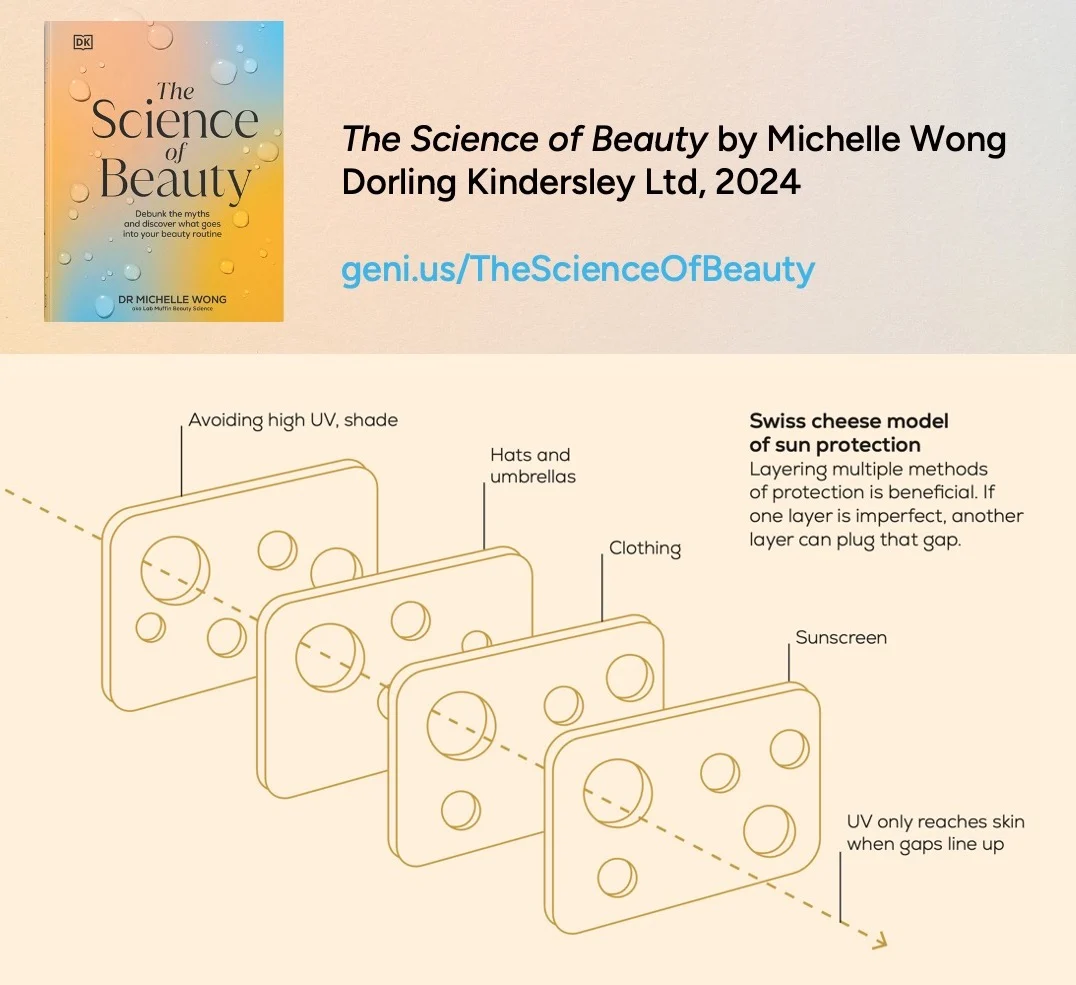
Public health analysts attribute this success to a coordinated cultural approach rather than a reliance on sunscreen alone. The pioneering "Slip, Slop, Slap, Seek, Slide" campaign—advocating for protective clothing, sunscreen, wide-brimmed hats, shade, and sunglasses—reinforces the "Swiss cheese model" of public safety. This framework acknowledges that no single protective measure is infallible, encouraging individuals to layer multiple defenses to mitigate the inherent human error of sunscreen application.
Institutional enforcement played an equally vital role in shifting generational behavior. Australian schools implemented rigorous "no hat, no play" policies, normalizing sun-safe habits during formative developmental years. These systematic interventions demonstrate that when sunscreen is utilized as one component of an overarching behavioral strategy, public health outcomes improve markedly, invalidating the premise that photoprotection is counterproductive to human health.
