
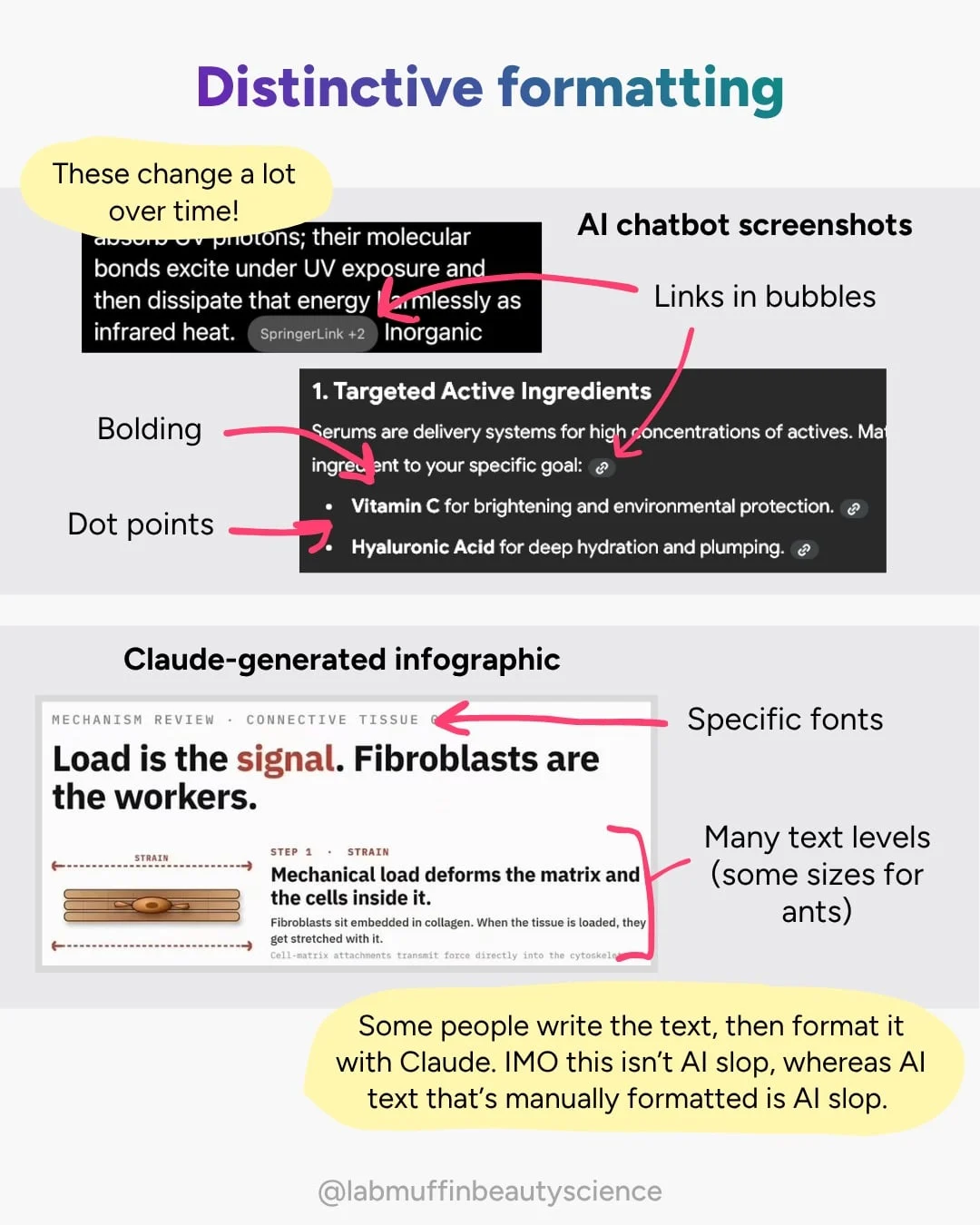
The rapid proliferation of generative artificial intelligence tools has fundamentally altered the digital information landscape, creating unprecedented challenges for science communication and public education. As large language models (LLMs) have evolved since the widespread public release of foundational chatbots in late 2022, the internet has seen a staggering surge in automated, low-effort informational content colloquially known as "AI slop." While earlier eras of digital misinformation were frequently betrayed by glaring typographical errors and crude grammatical mistakes, modern AI-generated content often boasts impeccable surface-level grammar, formal phrasing, and a veneer of authoritative professionalism. This stylistic evolution has made misleading or entirely fabricated scientific explanations increasingly difficult for the average reader to identify. In response to this growing digital phenomenon, science communicators and researchers are working to establish comprehensive frameworks for detecting automated inaccuracies, shifting the focus from isolated stylistic anomalies to cumulative patterns of linguistic and structural red flags.
Background Context of the Rise of AI Science Slop
The integration of generative artificial intelligence into content creation workflows accelerated dramatically between 2023 and 2025. Initially utilized primarily for drafting, brainstorming, and basic text editing, LLMs quickly became powerful enough to autonomously generate entire articles, social media captions, and infographics with minimal human oversight. In specialized fields like science, beauty, and health communication, the temptation to utilize these tools for high-volume content production has proven immense. Communicators face constant pressure from platform algorithms to maintain hyperprolific output, frequently publishing multiple times a day across multiple channels.
However, genuine scientific communication requires meticulous verification, deep contextual understanding, and hours of reading primary literature. Because LLMs operate on statistical pattern matching rather than factual comprehension, they are notoriously prone to generating "hallucinations"—confidently stated falsehoods that mimic the tone of peer-reviewed research. The convergence of algorithmic demands for high-volume output and the low friction of AI generation has created an environment where unverified, automated science content can saturate digital platforms unchecked. Experts warn that this flood of low-quality information degrades public trust in scientific institutions and obscures evidence-based guidance on critical health and safety topics.
Chronology of Generative AI Integration and Misinformation
The timeline of generative AI’s impact on digital publishing highlights a rapid shift from novelty to systemic verification crises. In November 2022, the launch of OpenAI’s ChatGPT introduced accessible generative text to the global public, sparking immediate experimentation across media and educational sectors. Throughout 2023, discussions centered primarily on plagiarism, basic productivity gains, and the obvious stylistic quirks of early models, such as repetitive phrasing and predictable transitions.
By 2024, the landscape shifted as LLMs became deeply embedded in third-party content management systems, automated publishing pipelines, and graphic design software. During this period, researchers noted a troubling correlation between hyperprolific publishing schedules and academic or informational fraud. For instance, high-profile cases involving academic paper mills demonstrated how automated generation tools enabled unprecedented volumes of questionable research output, with some individuals allegedly publishing hundreds of papers within a single year. By 2025 and into 2026, the volume of automated textual and visual content reached critical mass, prompting independent scientists and educators to develop targeted diagnostic methodologies for separating human-verified research communication from automated generative output.
Specific Linguistic and Structural Indicators of Automated Content
Detecting AI-generated science content requires a nuanced understanding of statistical writing biases inherent to large language models. Analysts emphasize that individual markers—such as formal sentence structures, good punctuation, or even specific vocabulary choices—are unreliable when viewed in isolation, as human writers frequently share these traits. Instead, detection relies on identifying an accumulation of distinct tells that collectively exceed the threshold of coincidence.
One primary category of indicators involves the overall writing "voice" and tone. AI-generated scientific explanations often exhibit a relentless emphasis on magnitude and significance, portraying every minor finding as "groundbreaking," "revolutionary," or "crucial." Furthermore, automated text tends to be heavily padded with abstract generalities while remaining information-sparse, a phenomenon where complex technical concepts are described using an abundance of sophisticated-sounding adjectives that convey very little concrete data.
Additionally, operational remnants of chatbot interactions frequently slip into published materials due to user oversight. These include conversational signposts left over from prompt responses, such as transitional phrases like "Here is a clean caption" or automated formatting structures including quotation marks around headings. Another glaring structural giveaway is the presence of "inhuman errors" and choices—factual mistakes that a trained human specialist in the field would be highly unlikely to make, paired with organizational logic that reflects mathematical pattern matching rather than editorial judgment.
Quantitative Analysis and Behavioral Red Flags
Beyond textual analysis, behavioral patterns of content creators offer critical clues regarding the authenticity of science communication. A primary quantitative metric is output velocity. Genuine scientific synthesis is intellectually labor-intensive; analyzing a single peer-reviewed research paper, cross-referencing its methodology, and translating it for public consumption typically requires hours of focused effort. Creators who maintain a hyperprolific publishing schedule—consistently producing long-form, highly confident analyses across a vast and unrelated array of scientific disciplines—frequently rely on automated generation pipelines.
Sudden stylistic or thematic changes within a creator’s archive also serve as a strong diagnostic indicator. Inconsistencies between older, human-written posts and recent high-volume outputs often reveal a sudden transition to automated workflows. Furthermore, an undiscerning or defensive attitude toward the limitations of generative AI—such as dismissing well-documented accuracy issues or exhibiting a fundamental misunderstanding of how LLMs hallucinate—often correlates with active, uncritical reliance on these tools. Educators note that creators who frequently publish AI slop often display broader professional red flags, such as a general disregard for ethical sourcing, a lack of transparency regarding methodology, and a resistance to empirical correction.
Broader Implications and Industry Reactions
The proliferation of AI-generated science slop carries profound implications for public scientific literacy, health safety, and digital media ecosystems. When automated systems generate plausible-sounding medical, dermatological, or environmental advice, consumers face heightened risks of encountering misinformation regarding treatments, safety protocols, and consumer products. Because these systems lack the capacity for ethical reasoning or empirical verification, the widespread distribution of unverified automated content essentially scales the dissemination of misinformation to industrial levels.
Reactions from the broader scientific and educational communities reflect a growing consensus that reliance on automated detectors is insufficient. Automated AI detectors have consistently demonstrated high rates of false positives and false negatives, making them unreliable arbiters of content authenticity. Consequently, experts advocate for a decentralized, critical-reading approach among consumers, encouraging audiences to look for clusters of linguistic red flags, verify claims against primary institutional sources, and hold content creators accountable for factual accuracy rather than stylistic polish. As the technological capabilities of generative models continue to advance, the burden of verification increasingly falls upon informed consumers navigating an increasingly automated digital sphere.
