
The proliferation of generative artificial intelligence across digital platforms has brought unprecedented volumes of automated content to the forefront of public discourse. While applications like ChatGPT, Claude, and Gemini have become ubiquitous tools for drafting text, coding, and basic inquiry, their reliability when applied to factual, empirical, and scientific subjects remains severely compromised. According to recent analyses by science communicators and AI literacy researchers, treating large language models (LLMs) as repositories of factual knowledge is a fundamental misconception—one frequently reinforced by commercial marketing that portrays complex computational pattern-matching as digital omniscience.
The Mechanics of Language Models and the Myth of Machine Knowing
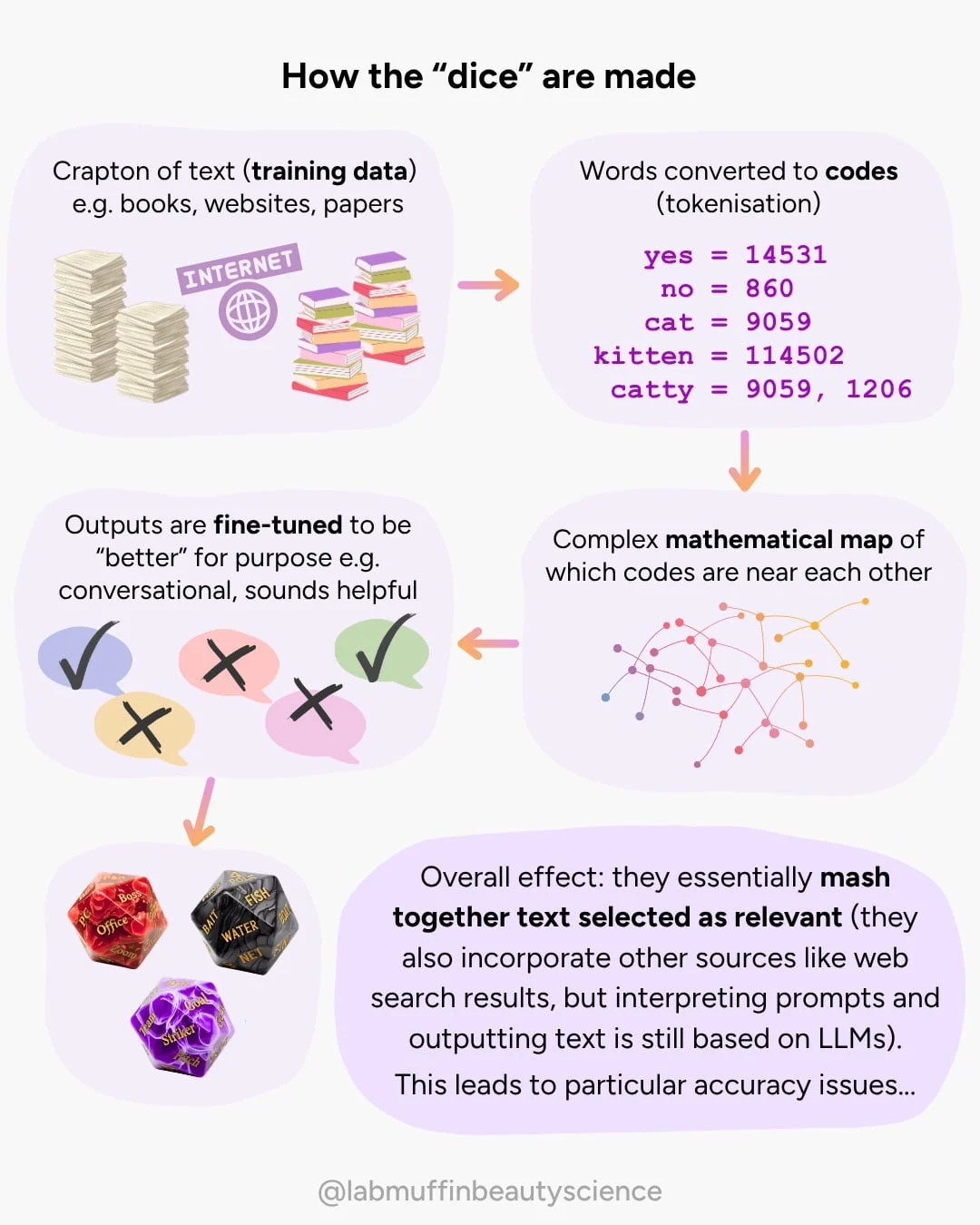
To understand why AI chatbots falter when tasked with scientific communication, one must examine the underlying architecture of modern LLMs. Unlike traditional software databases designed to retrieve structured records or verified facts, LLMs operate entirely on statistical correlations derived from massive text corpora. Fundamentally, these systems calculate the probability of specific words appearing adjacent to other words based on their training data.
Industry experts often employ a specialized analogy to demystify this process: chatbots function similarly to a vast, intricate array of loaded dice. When a user inputs a prompt, the system selects and rolls these probabilistic dice sequentially, generating text based on contextual weightings rather than conceptual comprehension. While modern architectures evaluate broader sequences of preceding words to enhance coherence, the core mechanism remains divorced from semantic reality. The output appears convincing because human language inherently correlates with concepts, but correlation does not equal causation. Consequently, chatbots generate plausible-sounding prose without any intrinsic reference to empirical truth.
Recent consumer behavior studies highlight the dangers of this illusion. Research published in the Journal of Marketing indicates that individuals with lower artificial intelligence literacy are significantly more likely to exhibit high receptivity toward AI-generated claims, often attributing human-like reasoning or magical properties to the software. When users perceive AI systems as authoritative arbiters of knowledge, their propensity to cross-reference or verify automated output diminishes sharply.
Compounding Vulnerabilities in Scientific Communication
The structural limitations of LLMs become acutely problematic when applied to specialized domains such as scientific research, medicine, and technical reporting. Because a chatbot’s accuracy relies entirely on the quality, quantity, and distribution of its training data, gaps or biases in the underlying corpus directly corrupt the final output. Scientific literature is inherently nuanced, heavily caveated, and reliant on precise empirical methodologies—elements that probabilistic text generation often flattens or misinterprets.
Real-world examples of scientific misrepresentation by AI are well-documented. In one prominent instance, a peer-reviewed dermatology study co-authored by science communicator Michelle Wong was mistakenly attributed by an AI-driven summary to a "Harvard team," despite only one of the four co-authors being affiliated with the institution. Similar discrepancies plague automated summaries of clinical trials, environmental studies, and physics research, where minor contextual errors can invert the perceived safety or efficacy of a given intervention.
Furthermore, recent advancements in reasoning models and chain-of-thought prompting have not resolved these foundational vulnerabilities. Technical evaluations published by artificial intelligence safety teams and computer science researchers demonstrate that reasoning models frequently produce sophisticated, highly logical-sounding justifications for conclusions that were derived via standard pattern-matching rather than rigorous logical deduction. These sophisticated illusions of thought make erroneous outputs exponentially harder for non-expert users to detect.
Psychological Barriers and Cognitive Biases
Even when users possess the subject-matter expertise required to audit AI-generated content, a suite of well-documented cognitive biases systematically undermines critical evaluation. Overcoming these psychological hurdles requires considerable mental effort, running counter to deeply ingrained cognitive shortcuts shaped by human evolution.
- The Fluency Effect: Human psychology inherently equates linguistic fluency and smooth phrasing with truthfulness, making polished AI prose appear more credible than rougher, human-authored drafts.
- The Confidence Effect: Chatbots consistently output text with a high degree of perceived certainty, regardless of whether the underlying claim is verified fact or a hallucinated fabrication.
- Confirmation Bias: Users naturally gravitate toward AI-generated answers that align with their pre-existing beliefs, readily accepting supporting arguments without demanding empirical validation.
- Automation Bias: Individuals exhibit a baseline tendency to defer to decisions, recommendations, and information generated by automated systems over human judgment.
- Authority Bias: Lay audiences frequently imbue advanced computational tools with institutional authority, assuming that technological complexity guarantees objective accuracy.
The Problem of AI as a Starting Point
Beyond factual inaccuracies, employing AI-generated text as a foundational baseline for writing or research introduces structural impediments known within cognitive science and information technology as the anchoring effect. Once a user reads an AI-generated draft, it becomes cognitively difficult to override the initial framing, organization, and narrative arc provided by the machine.
Additionally, LLM outputs are frequently characterized by verbosity, unnecessary redundancy, and fragmented conceptual organization. Because text generation relies on predicting common patterns rather than synthesizing unified arguments, AI summaries of meetings, emails, or research papers often group related topics illogically. This "jagged intelligence"—where a model executes complex linguistic tasks effortlessly while failing at elementary logical operations—forces human editors to spend more time untangling and correcting machine-generated text than they would have spent drafting the content independently.
Compounding these issues is the accelerating risk of model collapse. As public and private digital spaces become increasingly saturated with AI-generated text ("AI slop"), newer iterations of language models are progressively trained on data produced by older LLMs. This recursive training loop amplifies baseline biases, exacerbates historical stereotypes regarding race and gender, and steadily erodes the factual fidelity of future systems.
Implications for Content Creators and Public Literacy
The intersection of generative AI and science communication presents significant challenges for digital integrity. Anecdotal observations across educational platforms indicate a strong correlation between content creators who rely heavily on unverified AI drafts and those who propagate fundamental scientific inaccuracies. Because generating stylistic prose via AI requires minimal effort compared to conducting rigorous fact-checking, the presence of distinct AI stylistic markers is increasingly recognized by educators and publishers as a red flag for unreliable content.
Mitigating the risks posed by unverified AI content requires a concerted shift in public digital literacy. Experts emphasize that users cannot safely utilize AI for factual inquiry unless they already possess the definitive answer independently. Without robust verification protocols, automated content generation risks accelerating the dissemination of misinformation across public health, environmental science, and technical education sectors.
