
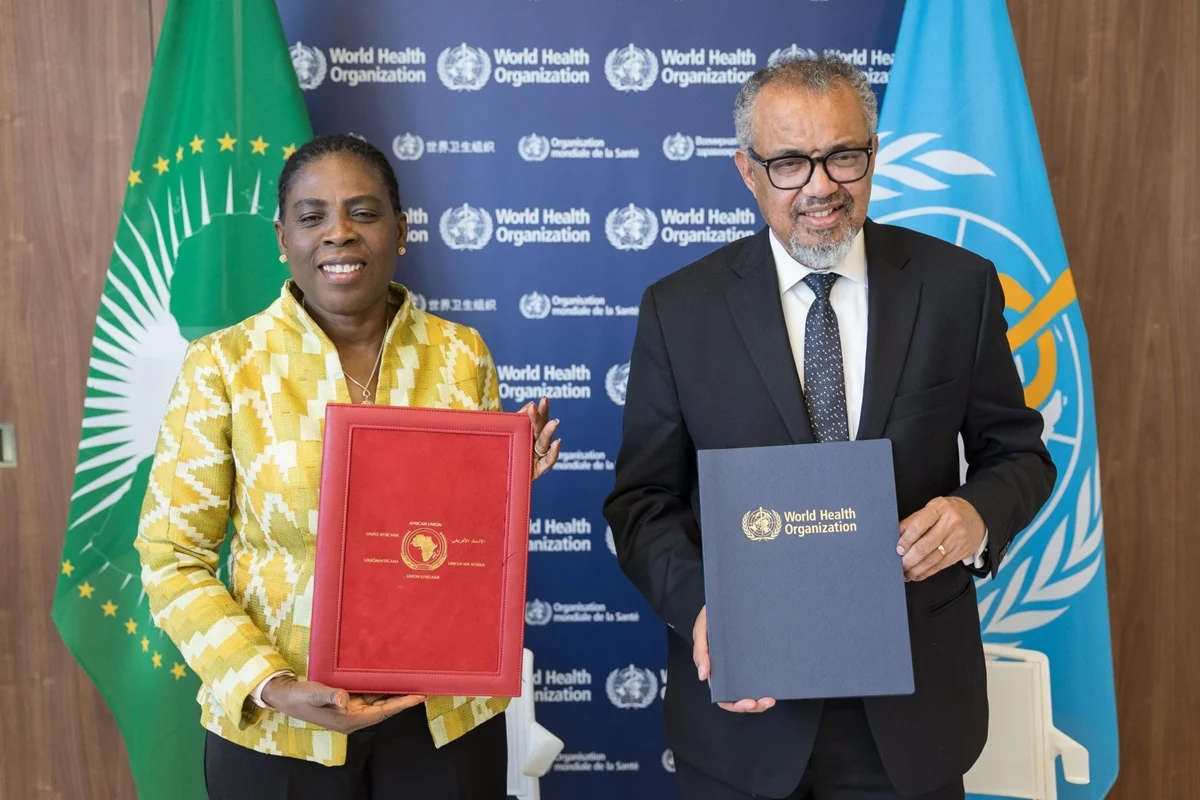
The World Health Organization (WHO) and the African Union (AU) Commission have officially renewed their longstanding strategic partnership, signing an updated Memorandum of Understanding (MoU) on the sidelines of the 78th World Health Assembly in Geneva. This landmark agreement serves as a formal reaffirmation of their joint commitment to advancing health security, universal health coverage (UHC), and sustainable development across the African continent. The signing ceremony, which brought together top-tier leadership from both organizations, occurs at a pivotal juncture characterized by tightening global financial conditions and a shifting geopolitical landscape that necessitates a more resilient, self-reliant African health architecture.
A Renewed Mandate for Continental Health Governance
The agreement was signed by Her Excellency Ambassador Amma Adomaa Twum-Amoah, Commissioner for Health, Humanitarian Affairs, and Social Development, representing the AU Commission, and Dr. Tedros Adhanom Ghebreyesus, Director-General of the WHO. This iteration of the MoU is more than a procedural update; it is a strategic repositioning of the AU Department of Health, Humanitarian Affairs, and Social Development at the center of continental health policy. By streamlining coordination mechanisms, the document seeks to eliminate the fragmentation that has historically hampered large-scale health interventions, ensuring that technical expertise from the WHO is harmonized with the political mandate of the AU.
The partnership arrives as the African Union continues to elevate its voice in global governance, most notably through its permanent membership in the G20. This increased stature grants the continent a seat at the table where global health financing and regulatory norms are determined. By aligning their efforts, the WHO and the AU aim to leverage this political capital to secure more equitable health outcomes, moving away from reactive aid-based models toward proactive, systems-based health sovereignty.
Chronology of Collaboration: Building on the 2019 Foundation
The relationship between the WHO and the AU has matured significantly over the past decade. The 2019 MoU served as the primary instrument for collaboration, focusing on building regional capacity and establishing the Africa Centres for Disease Control and Prevention (Africa CDC) as a primary operational arm. Since 2019, the partnership has weathered several crises, most notably the COVID-19 pandemic, which exposed the fragility of global supply chains and the danger of over-reliance on external medical imports.
- 2019: Original MoU signed, formalizing the framework for joint technical support and regional health coordination.
- 2020–2022: Accelerated cooperation during the pandemic, focusing on vaccine procurement, clinical trial harmonization, and the establishment of the African Medicines Agency (AMA).
- 2023: Consultations held to assess the limitations of current funding models and the need for long-term domestic health financing.
- 2025 (Current): Signing of the updated MoU at the 78th World Health Assembly, emphasizing "health sovereignty" and systemic integration of primary health care (PHC).
Supporting Data and the Financial Context
The urgency behind this agreement is underscored by sobering economic data. Africa currently faces a significant financing gap in its quest to achieve the UN Sustainable Development Goal 3 (Good Health and Well-being). Recent reports indicate that while the demand for advanced healthcare infrastructure is growing due to population shifts and the double burden of infectious and non-communicable diseases, bilateral aid has seen a noticeable contraction.
According to data from the WHO Regional Office for Africa, domestic government spending on health across the continent remains below the Abuja Declaration target of 15% of national budgets for many member states. This financial shortfall is compounded by high debt-servicing costs, which limit the fiscal space available for governments to invest in public health. The renewed MoU explicitly aims to address this by providing a framework for countries to transition from "budgeting for survival"—a reference to emergency-only funding—to "planning for health sovereignty." By pooling resources and standardizing health policies, the partnership seeks to create economies of scale that reduce the cost of medical commodities and improve the efficiency of service delivery.
Official Responses and Strategic Vision
Commissioner Amma Adomaa Twum-Amoah highlighted the ideological shift inherent in this new agreement. "This Agreement marks a new chapter in AU-WHO cooperation," she stated. "The African Union values the WHO’s central and leading role in global health and looks forward to deepening this strategic partnership. We need to move from budgeting for survival to planning for health sovereignty." Her emphasis on "sovereignty" suggests a move toward local manufacturing of vaccines and essential medicines, a key pillar of the AU’s Agenda 2063.
Dr. Tedros Adhanom Ghebreyesus echoed these sentiments, framing the partnership as a critical defense against the volatility of global health funding. "This renewed agreement comes at a critical time, as cuts to bilateral aid imperil the health of millions in Africa," Dr. Tedros remarked. He emphasized that the WHO is committed to supporting African nations in leaving behind the era of "aid dependency," advocating instead for sustainable, self-reliant systems that can withstand future health shocks.
Broader Implications for Global Health
The implications of this agreement extend far beyond the African continent. As the global health landscape becomes increasingly multipolar, the model being developed by the AU and the WHO serves as a blueprint for other regional bodies. The move to harmonize regulatory frameworks—specifically through the African Medicines Agency—is expected to facilitate a more integrated market for pharmaceuticals, potentially attracting private investment that has previously been deterred by fragmented regulations across 55 sovereign states.
Furthermore, the integration of Primary Health Care (PHC) into the core of the MoU signals a recognition that health security is built from the bottom up. By strengthening community-level health systems, the partnership aims to improve maternal and child health, combat the rising tide of chronic diseases, and ensure that the continent is better prepared to detect and contain future outbreaks before they reach pandemic levels.
Analysis: Navigating the Path to Self-Reliance
While the MoU provides a robust framework, the true test will lie in the implementation. Critics of international agreements often point to a lack of accountability and the persistent gap between policy rhetoric and on-the-ground reality. However, the inclusion of specific, measurable objectives—such as the strengthening of the AU’s health-related Sustainable Development Goals—suggests a more rigorous approach to monitoring.
The success of this partnership will depend on three key factors:
- Domestic Resource Mobilization: Can AU member states increase their fiscal allocation to health in the face of competing economic demands?
- Regulatory Harmonization: Will the African Medicines Agency successfully streamline the approval process for medical products, thereby lowering costs?
- Political Will: Will member states prioritize continental health interests over individual national agendas during future health crises?
As the international community watches, the AU and the WHO have set a clear trajectory. The partnership is no longer just about receiving technical guidance; it is about building a sovereign health identity that allows the African continent to participate as an equal partner in global health governance. By centering the agreement on resilience and self-reliance, both organizations are attempting to future-proof the continent against the unpredictable nature of global health funding, ensuring that the health of the African population is no longer a variable dependent on the shifting political winds of donor nations.
For further information, stakeholders may contact the Department of Health, Humanitarian Affairs and Social Development at the African Union Commission, or the Multilateral Affairs office at the World Health Organization.
