
Engineers at Northwestern University have achieved a significant breakthrough in neurotechnology, creating printed artificial neurons that transcend mere imitation of biological functions. These flexible, low-cost devices are engineered to produce electrical signals remarkably similar to those generated by living neurons, enabling them to directly activate and interact with biological brain tissue. This pioneering development, detailed in a forthcoming publication in the prestigious journal Nature Nanotechnology on April 15, marks a critical step toward seamless integration of electronic systems with the nervous system and offers a compelling new paradigm for energy-efficient artificial intelligence.
The implications of this research are far-reaching, promising advancements in brain-machine interfaces, neuroprosthetics, and a new generation of computing systems that draw inspiration from the brain’s unparalleled efficiency. The study, a culmination of years of research into materials science and neural engineering, was co-led by Mark C. Hersam, a distinguished professor at Northwestern with expertise in brain-inspired computing, and Vinod K. Sangwan, a research associate professor. Their collaborative efforts have yielded a technology that could revolutionize how we approach neurological disorders and the future of computing.
Bridging the Gap: Artificial Neurons Interact with Biological Tissue
In rigorous experimental trials conducted on slices of mouse brain tissue, the newly developed artificial neurons demonstrated an unprecedented ability to trigger responses in their biological counterparts. This successful activation of real neurons by electronic signals represents a new benchmark in the compatibility between artificial electronic components and living neural systems. The precision with which these artificial neurons mimic the electrical firing patterns of biological neurons is key to their ability to elicit a natural response.
"The world we live in today is dominated by artificial intelligence (AI)," stated Professor Hersam, who also holds significant leadership roles across multiple Northwestern departments, including Materials Science and Engineering, Feinberg School of Medicine, and Weinberg College of Arts and Sciences. "The way you make AI smarter is by training it on more and more data. This data-intensive training leads to a massive power-consumption problem. Therefore, we have to come up with more efficient hardware to handle big data and AI. Because the brain is five orders of magnitude more energy efficient than a digital computer, it makes sense to look to the brain for inspiration for next-generation computing."
The experimental validation involved meticulously measuring the electrical signals produced by the artificial neurons and observing their effect on nearby biological neurons. The timing, amplitude, and waveform of these artificial signals were found to closely match the characteristics of natural neuronal action potentials, or "spikes." This level of fidelity allowed the artificial neurons to effectively "speak the language" of biological neurons, initiating cascades of neural activity.
A Vision for Advanced Brain Interfaces and Energy-Conscious Computing
This scientific advancement propels researchers closer to realizing sophisticated electronics that can directly interface with the human nervous system. Potential applications are vast and transformative, ranging from advanced brain-machine interfaces that could allow individuals to control external devices with their thoughts, to novel neuroprosthetics designed to restore lost sensory or motor functions. Imagine implants that could help individuals regain sight after blindness, hearing after deafness, or mobility after paralysis. These devices, by seamlessly integrating with neural pathways, could offer unprecedented levels of restoration and independence.
Furthermore, the technology lays the groundwork for a new era of brain-inspired computing systems. By replicating the fundamental principles of neuronal communication and network architecture, future hardware could perform exceptionally complex tasks with dramatically reduced energy consumption. The human brain, a marvel of biological engineering, remains the most energy-efficient computing system known, consuming roughly 20 watts of power – comparable to a dim light bulb – while performing an astonishing array of cognitive functions. Scientists are keen to harness this inherent efficiency to address the growing power demands of modern technology.
The Limitations of Silicon and the Promise of Novel Materials
Traditional silicon-based computing, while incredibly powerful, faces inherent limitations in its approach to complexity and energy efficiency. Modern computers achieve their computational prowess by packing billions of identical transistors onto rigid, two-dimensional silicon chips. Each of these components functions in a uniform manner, and once manufactured, the system’s architecture is largely fixed. This design philosophy, while effective for many tasks, diverges significantly from the dynamic and heterogeneous nature of the biological brain.
The brain, in stark contrast, is composed of a diverse array of neuron types, each with specialized roles and interconnected within intricate, soft, three-dimensional networks. These neural networks are not static; they are highly dynamic, constantly forming, strengthening, and pruning connections in response to learning and experience. This plasticity is a cornerstone of the brain’s adaptability and remarkable computational power.
Professor Hersam elaborated on this fundamental difference: "Silicon achieves complexity by having billions of identical devices," he explained. "Everything is the same, rigid and fixed once it’s fabricated. The brain is the opposite. It’s heterogeneous, dynamic and three-dimensional. To move in that direction, we need new materials and new ways to build electronics."
While artificial neurons have been developed previously, many have produced overly simplistic signals, requiring large, energy-intensive networks to achieve complex behaviors. The Northwestern team’s innovation lies in their ability to imbue individual artificial neurons with a richer repertoire of signaling capabilities, thereby reducing the overall number of components needed for advanced computational tasks.
Printable Electronics Mimicking Neural Dynamics
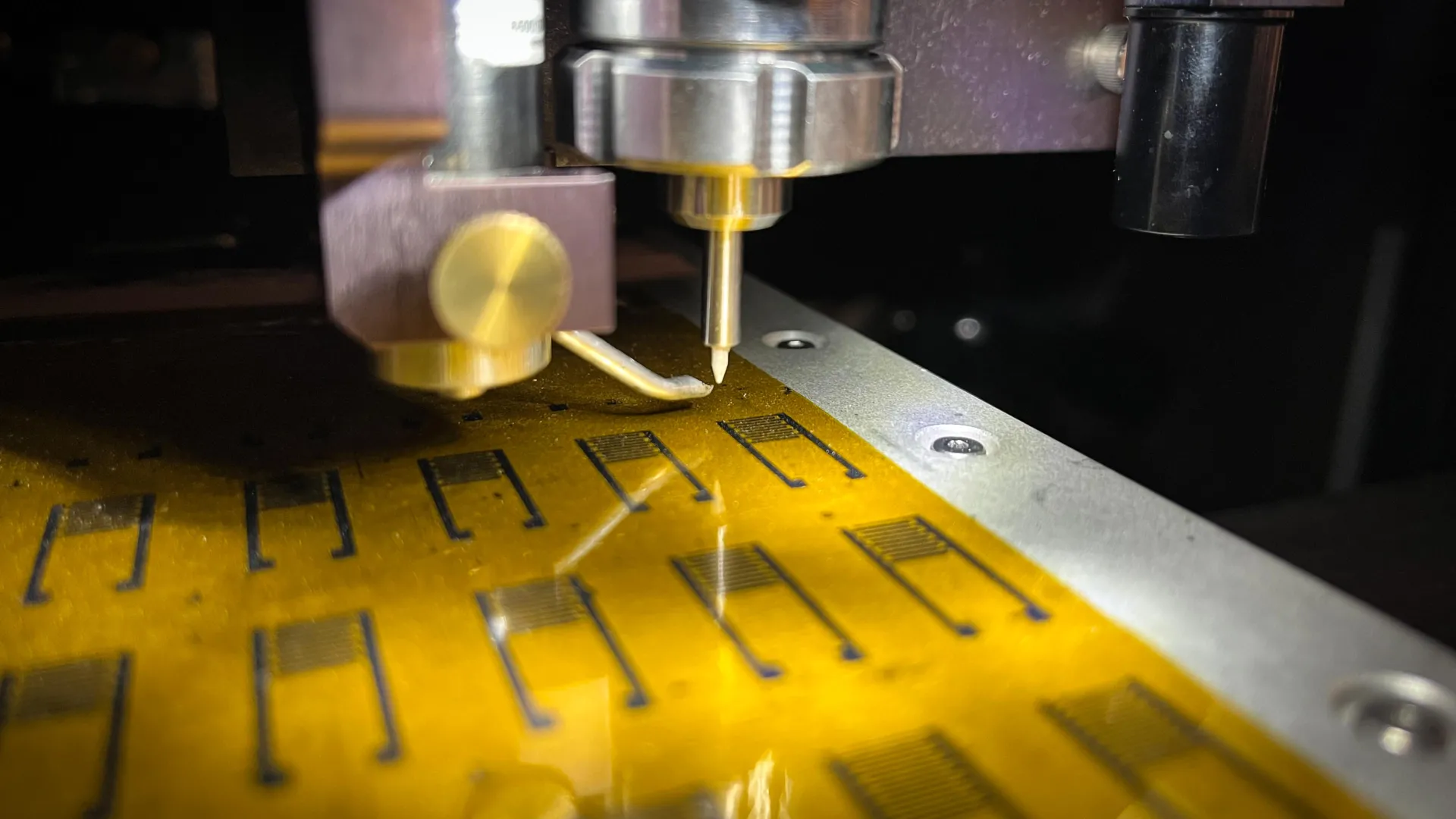
To more accurately replicate the nuanced activity of real neurons, Professor Hersam’s team focused on developing artificial neurons using soft, printable materials that better approximate the brain’s structural and functional characteristics. Their innovative approach utilizes electronic inks composed of nanoscale flakes of molybdenum disulfide (MoS2), a semiconductor, and graphene, an excellent electrical conductor. These specialized inks were precisely deposited onto flexible polymer substrates using aerosol jet printing, a technique known for its precision and low waste.
A crucial aspect of their breakthrough involved a re-evaluation of materials previously considered detrimental. In prior research, the polymer component within these electronic inks was often treated as a flaw due to its potential to interfere with electrical performance, and consequently, it was typically removed after the printing process. However, the Northwestern team ingeniously leveraged this same polymer feature to enhance the device’s functionality.
"Instead of fully removing the polymer, we partially decompose it," Professor Hersam described. "Then, when we pass current through the device, we drive further decomposition of the polymer. This decomposition occurs in a spatially inhomogeneous manner, leading to formation of a conductive filament, such that all the current is constricted into a narrow region in space."
This controlled decomposition process results in the formation of a narrow conductive path, which, when activated by an electrical current, produces a sudden, transient electrical response—akin to a biological neuron firing an action potential. The resulting artificial neuron is capable of generating a wide spectrum of signals, including discrete spikes, sustained firing patterns, and complex bursting behaviors, all closely mirroring the communication dynamics observed in living neural systems. This multi-order complexity in signaling is a significant leap forward, enabling more sophisticated computational functions with fewer components.
Empirical Validation: Testing on Living Neural Networks
To rigorously assess the potential for the artificial neurons to interact with living systems, the researchers collaborated with Professor Indira M. Raman, a distinguished neurobiologist at Northwestern University’s Weinberg College of Neurobiology. Professor Raman’s team provided expertise in applying the artificial signals to meticulously prepared slices of mouse cerebellum, a brain region critical for motor control and coordination.
The experimental results were highly encouraging. The electrical spikes generated by the artificial neurons were found to possess key biological properties, including precise timing and duration, that were consistent with natural neuronal activity. These signals reliably activated the living neurons, effectively triggering neural circuits in a manner that closely resembled the patterns of natural brain activity.
"Other labs have tried to make artificial neurons with organic materials, and they spiked too slowly," Professor Hersam noted, highlighting the temporal accuracy achieved. "Or they used metal oxides, which are too fast. We are within a temporal range that was not previously demonstrated for artificial neurons. You can see the living neurons respond to our artificial neuron. So, we’ve demonstrated signals that are not only the right timescale but also the right spike shape to interact directly with living neurons."
This direct evidence of interaction with biological tissue validates the design and functionality of the artificial neurons, opening doors to a new era of bio-electronic integration.
Sustainable Manufacturing and the Urgent Need for Energy-Efficient AI
Beyond their impressive performance and direct biological interaction capabilities, the new approach offers significant practical and environmental advantages. The manufacturing process is characterized by its simplicity and cost-effectiveness. Moreover, the additive printing method employed ensures that materials are deposited precisely where needed, thereby minimizing waste and contributing to a more sustainable production cycle.
The imperative for improved energy efficiency in computing is underscored by the explosive growth of artificial intelligence. Modern AI systems, particularly large language models and complex deep learning networks, are notoriously power-hungry. Large data centers, the backbone of cloud computing and AI services, already consume vast amounts of electricity and necessitate substantial water resources for cooling.
Professor Hersam painted a stark picture of the current energy landscape for AI: "To meet the energy demands of AI, tech companies are building gigawatt data centers powered by dedicated nuclear power plants," he remarked. "It is evident that this massive power consumption will limit further scaling of computing since it’s hard to imagine a next-generation data center requiring 100 nuclear power plants. The other issue is that when you’re dissipating gigawatts of power, there’s a lot of heat. Because data centers are cooled with water, AI is putting severe stress on the water supply. However you look at it, we need to come up with more energy-efficient hardware for AI."
The research, titled "Multi-order complexity spiking neurons enabled by printed MoS2 memristive nanosheet networks," was generously supported by the National Science Foundation, recognizing its potential to address critical challenges in both neuroscience and computing. This work represents a significant stride towards a future where intelligent systems are not only more powerful but also more sustainable and seamlessly integrated with the biological world.
