
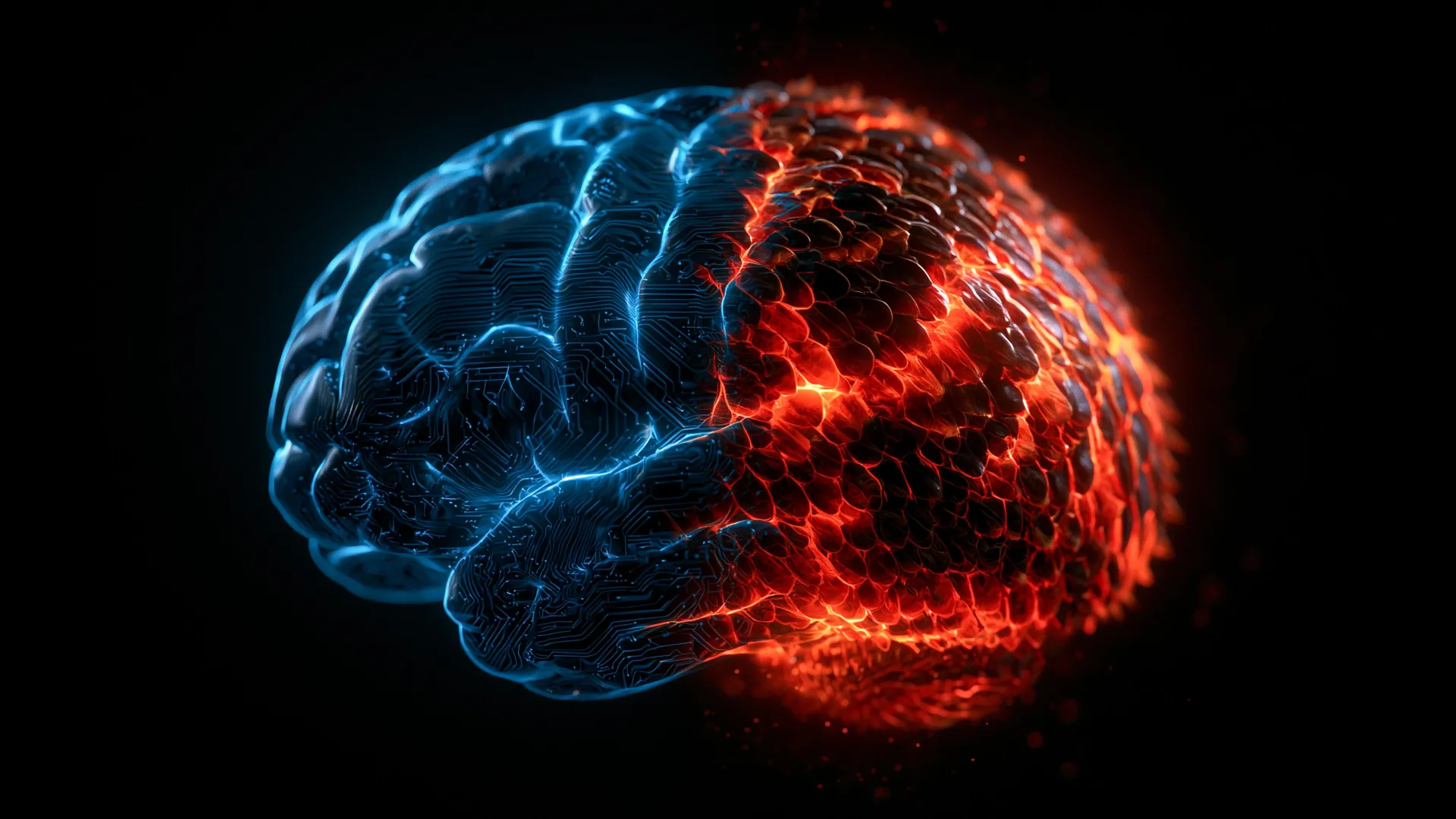
For decades, popular psychology and cultural narratives have relied on a neat, albeit fundamentally flawed, metaphor to explain human behavior: the eternal tug-of-war between reason and emotion. In this widely accepted framework, decision-making is framed as a battlefield inside the cranium, pitting a sophisticated, newly evolved seat of logical thought against an ancient, impulsive “lizard brain” that dictates raw survival instincts. According to this traditional view, the human brain resembles an archaeological site, with advanced intellectual structures neatly stacked on top of primitive neurological foundations like geological strata.
However, a groundbreaking study recently published in the journal Science Advances reveals that the evolutionary history of the mammalian and human brain is vastly more intricate than a simple chronological accumulation of new layers over old ones. Spearheaded by researchers at the Georgia Institute of Technology and Cornell University, this new scientific inquiry suggests that neuroevolution is not a matter of adding advanced structural tiers, but rather a dynamic competition for physical and metabolic space among fundamentally different neurological wiring strategies.
These revelations not only dismantle long-held assumptions within evolutionary biology and neuroscience, but they also offer a revolutionary blueprint for computer scientists aiming to build more efficient, energy-conscious artificial intelligence systems.
Deconstructing the 1950s Triune Brain Hypothesis
To understand the magnitude of the recent findings, researchers had to challenge one of the most resilient dogmas in behavioral science: the Triune Brain model. Proposed by American physician and neuroscientist Paul D. MacLean in the 1960s—though its conceptual roots trace back to the 1950s—the model posited that the human brain evolved in three distinct evolutionary stages.
First came the reptilian brain, responsible for basic survival functions and autonomic processes. Next layered the paleomammalian brain, or the limbic system, governing emotions. Finally, according to MacLean, the neomammalian brain—the neocortex—emerged to handle abstract thought, language, and high-level reasoning.
While MacLean’s model offered an intuitive way to conceptualize emotional outbursts versus rational control, modern neurobiologists have increasingly recognized its anatomical and evolutionary inaccuracies. The limbic system, for instance, cannot be neatly categorized as a singular "emotional center" or a relic of reptile evolution.
"There was a theory proposed in the ’50s that the brain evolved in layers starting with basic bodily functions, to emotions in the reptilian brain, leading up to sophisticated reasoning in humans," explains Nabil Imam, an assistant professor in the School of Computational Science and Engineering and a faculty member with Georgia Tech’s Institute for Neuroscience, Neurotechnology, and Society (INNS). "This is not how an evolutionary biologist would think about the problem."
Imam notes that the so-called "lizard brain" is an agglomeration of distinct regions managing entirely different physiological and cognitive duties, including memory consolidation, olfactory processing, spatial navigation, and emotional regulation. Historically, neuroscientists lacked a comprehensive theoretical framework to explain why these disparate circuits were historically grouped into a single evolutionary category.
Uncovering Coordinated Expansion Across 182 Species
To resolve this long-standing puzzle, Imam and his collaborators shifted the analytical lens. Rather than examining individual brain regions in isolation—an approach that frequently obscures broader systemic patterns—the research team conducted a sweeping comparative analysis across 182 mammalian species. They investigated how the neocortex and the limbic system varied in size relative to one another over millions of years of evolutionary history.
The empirical data revealed a striking, highly consistent pattern. The researchers observed that when one component of an animal’s limbic system was relatively large, the other limbic structures reliably scaled up in tandem. Concurrently, the neocortex in those same species tended to occupy a smaller proportion of total brain volume. Conversely, species boasting an expansive neocortex featured proportionally smaller limbic networks.
This inverse scaling relationship demonstrated conclusively that these brain structures do not evolve independently of one another. Instead, the data points to a coordinated, systemic expansion and contraction of entire neural networks across species lines. The limbic system, the researchers concluded, behaves far more like an integrated, cohesive network whose components scale as a single functional unit, rather than a loose collection of evolutionarily disconnected anatomical parts.
Two Distinct Engineering Blueprints: Spatial Maps Versus Distributed Barcodes
With the systemic scaling pattern established, the research team sought to determine the underlying mechanical driver behind these evolutionary trade-offs. Their investigation pointed directly to the fundamental wiring paradigms established in the brain long before birth.
The neocortex and the limbic system utilize fundamentally incompatible wiring strategies to process information. Neural circuits within the neocortex are meticulously arranged as spatial maps. In these regions, neighboring neurons handle adjacent physical realities. For example, brain cells processing tactile sensations from the thumb and index finger are physically situated right next to each other. Similar topographic and spatial layouts govern the brain’s processing of visual and auditory inputs.
In stark contrast, the limbic system operates on an entirely different architectural principle. Eschewing spatial layouts, limbic wiring functions much like a distributed bar code. Specific memories, complex emotional responses, or distinct olfactory signals are represented by widespread, overlapping patterns of neural activity distributed across various regions of the network.
To rigorously test whether these wiring differences are hardwired or merely learned through environmental exposure, the researchers deployed advanced artificial intelligence models. When the team constructed an artificial neural network featuring localized, spatial connections, the system naturally excelled at processing spatial data streams such as vision, sound, and touch. However, when they engineered artificial networks utilizing distributed, barcode-style connections, those systems performed exceptionally well at smell recognition and memory tasks, proving that the underlying architecture strictly dictates computational capacity.
The Evolutionary Tug-of-War for Finite Brain Real Estate
The discovery of these two distinct wiring blueprints brought researchers to the core question of their study: Why do the relative sizes of these neural systems shift so consistently across the animal kingdom?
The answer, the researchers discovered, lies in the fundamental biological reality of finite resources. A living organism’s skull provides strictly limited physical space, and the brain is one of the most metabolically expensive organs in the body, consuming an outsized share of an animal’s energy budget. Because biological real estate and metabolic energy are scarce commodities, natural selection cannot simply expand every brain region infinitely.
Instead, evolution forces a zero-sum computational game. Natural selection continuously favors whichever wiring system provides the decisive survival advantage in a given ecological niche.
To model this dynamic, the research team constructed a multimodal artificial network in which spatial wiring systems and distributed bar-code systems competed directly for limited computational "real estate." The results of the simulation mirrored the diversity observed in nature. When the simulated environment placed a high survival premium on olfaction, every region within the distributed limbic system expanded, while the neocortex systematically shrank. When the environmental pressures shifted to reward visual acuity, the evolutionary trajectory completely reversed.
This dynamic trade-off provides a compelling explanation for profound neuroanatomical differences observed across living species. Consider, for instance, the nine-banded armadillo, an animal that navigates its environment primarily through a hyper-developed sense of smell; it possesses a remarkably large limbic system. On the other end of the spectrum is the squirrel monkey, an arboreal creature that relies heavily on sharp vision and dexterous manipulation, resulting in a brain dominated heavily by an expansive neocortex.
Implications for the Future of Artificial Intelligence
While the study fundamentally reshapes our understanding of neurobiology and mammalian evolution, its authors emphasize that these biological insights hold profound, transformative implications for the field of computer science and artificial intelligence.
For decades, the dominant paradigm in machine learning has relied on massive, computationally intensive artificial neural networks that consume staggering amounts of electrical energy and require astronomical volumes of training data to achieve basic proficiency. These systems operate largely as blank slates, learning entirely through extensive environmental conditioning—a process heavily weighted toward environmental nurture.
Imam and his colleagues argue that computer scientists have fundamentally overlooked the power of evolutionary "nature"—the sophisticated, pre-wired architectural foundations that biological organisms inherit at birth. By studying how biological brains successfully balance competing wiring strategies within strict energy and space constraints, engineers can design next-generation AI architectures that mimic these efficiency principles.
"Today’s artificial neural networks are trained by vast amounts of data—it’s about nurture," Imam observes. "But the brain is not a blank slate that gets trained by experience. It is a mix of nature and nurture, and the nature is that pre-wired architecture."
"We could translate that architecture to AI systems to make it more brain-like, or make it learn or function as efficiently as the brain."
By incorporating pre-wired spatial and distributed architectural compromises into artificial systems, future AI models could potentially learn complex tasks using a fraction of the data and energy required by current large-scale models. This bio-inspired approach could pave the way for edge-computing devices, autonomous robotics, and neural networks capable of operating efficiently in resource-constrained environments.
As neuroscientists and computer engineers continue to decode the complex evolutionary history etched into the mammalian brain, the antiquated notion of a simple "lizard brain" battling a logical neocortex is giving way to a much more sophisticated appreciation of the brain as a marvel of evolutionary resource management. Supported by the National Science Foundation and conducted in close collaboration with researchers at Cornell University, this interdisciplinary work proves that the path to smarter machines—and a deeper understanding of human nature—lies not in discarding our evolutionary past, but in understanding the delicate, elegant compromises that made our existence possible.
