
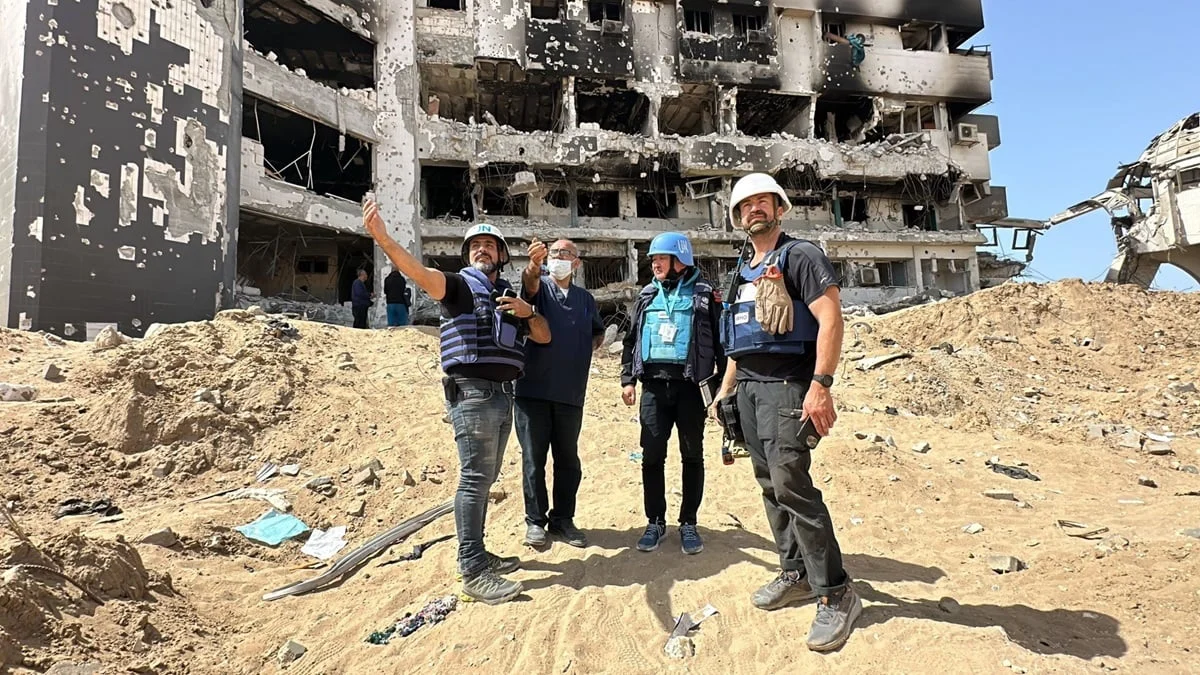
The international community stands at a somber crossroads as the heads of the world’s leading humanitarian and health organizations mark the tenth anniversary of United Nations Security Council Resolution 2286, a landmark commitment intended to shield medical facilities, personnel, and patients from the ravages of war. In a joint statement issued by the International Committee of the Red Cross (ICRC), the World Health Organization (WHO), and Médecins Sans Frontières (MSF), the leaders of these institutions declared that the decade following the resolution’s adoption has been defined not by progress, but by a catastrophic failure of political will. Rather than witnessing a decline in violence against healthcare, the global community has watched as attacks on hospitals, the obstruction of ambulances, and the killing of medical workers have intensified and, in many regions, become a normalized feature of modern warfare.
When Resolution 2286 was unanimously adopted in May 2016, it was hailed as a turning point in international humanitarian law. It demanded that all parties to armed conflicts comply fully with their obligations to ensure the respect and protection of medical personnel and facilities. However, ten years later, the gap between the law and the reality on the ground has widened into a chasm. From the rubbles of Gaza and the besieged clinics of Sudan to the frontline hospitals of Ukraine and Myanmar, the sanctity of healthcare is being systematically violated. The heads of the ICRC, WHO, and MSF emphasize that when healthcare is targeted, it is the clearest indicator that the fundamental rules of war are breaking down, signaling a broader crisis of humanity that transcends any single conflict.
Historical Context: The Genesis and Promise of Resolution 2286
The path to Resolution 2286 was paved by a series of high-profile, devastating attacks on medical facilities in the years leading up to 2016. The 2015 U.S. airstrike on the MSF trauma center in Kunduz, Afghanistan, which killed 42 people, and the relentless bombing of hospitals in Aleppo, Syria, served as the primary catalysts for diplomatic action. These events underscored a terrifying trend: the "double-tap" strike, where a second bombing follows the first to target first responders, and the deliberate targeting of medical infrastructure to degrade the resilience of civilian populations.
The resolution was designed to be more than a symbolic gesture. It was accompanied by a set of clear, actionable recommendations from the UN Secretary-General. These included the requirement for states to conduct independent, impartial, and effective investigations into attacks on healthcare, to incorporate the protection of medical services into military doctrine and training, and to ensure that domestic legislation supports the ethical obligations of medical personnel. The resolution sought to reinforce the 1949 Geneva Conventions, which provide the bedrock for International Humanitarian Law (IHL). Under IHL, the wounded and sick, as well as the personnel and facilities dedicated to their care, are granted "special protection." This protection is lost only if the facility is used to commit "acts harmful to the enemy," and even then, a warning must be issued before an attack can proceed.
A Decade of Escalating Violence: Chronology and Data
The timeline of the last ten years reveals a disturbing trajectory of non-compliance. While Resolution 2286 was intended to act as a deterrent, the data suggests that the "red line" it established has been repeatedly crossed with impunity.
2016–2018: The Normalization of Attacks
Following the resolution’s adoption, the conflict in Syria continued to serve as a grim laboratory for the erosion of medical neutrality. Hundreds of facilities were hit by airstrikes and shelling. In Yemen, the destruction of the healthcare system led to the world’s largest cholera outbreak, as water treatment and medical infrastructure were systematically dismantled.
2019–2021: The Global Pandemic and Continued Conflict
Even as the COVID-19 pandemic highlighted the universal necessity of healthcare, attacks did not cease. In Tigray, Ethiopia, and across the Sahel, medical facilities were looted and occupied by armed groups. In 2021, the WHO’s Surveillance System for Attacks on Health Care (SSA) documented hundreds of incidents across 14 countries and territories, resulting in nearly 200 deaths of healthcare workers and patients.
2022–2024: The Era of Large-Scale Destruction
The invasion of Ukraine in 2022 saw a massive spike in attacks on healthcare infrastructure. According to the WHO, over 1,000 attacks on Ukrainian healthcare have been verified since the start of the full-scale invasion, including the infamous bombing of a maternity hospital in Mariupol. Simultaneously, the conflict in Sudan that erupted in 2023 saw the wholesale looting of MSF facilities and the forced closure of nearly 80% of hospitals in conflict zones. Most recently, the conflict in Gaza has seen an unprecedented level of damage to the healthcare sector, with hospitals such as Al-Shifa and Nasser becoming focal points of military operations, leading to a total collapse of the medical system in the enclave.
Supporting Data: The Quantitative Reality
The scale of the failure is best understood through the lens of data collected by the WHO and various humanitarian monitors. The WHO SSA, established following World Health Assembly Resolution 65.20 in 2012, has become a vital tool for documenting these violations.
Recent reports indicate that in 2023 alone, there were over 1,500 documented attacks on healthcare across 21 countries and territories. These attacks resulted in the deaths of over 700 healthcare workers and patients. The data reveals that the nature of these attacks is diverse: 54% involved the use of heavy weaponry, 20% involved the removal of healthcare assets or looting, and 15% involved the detention or kidnapping of medical personnel.
Furthermore, the "secondary" effects of these attacks are often more lethal than the initial strikes. In conflict zones, the destruction of a single hospital can deprive hundreds of thousands of people of access to emergency surgery, maternal care, and vaccinations. In Sudan, the WHO estimates that millions of children are at risk of malnutrition and infectious diseases because the healthcare "backbone" has been broken. In Gaza, the lack of fuel, electricity, and supplies—exacerbated by the siege of hospitals—has led to the deaths of neonatal patients and those requiring chronic dialysis.
Analysis of Implications: The Erosion of International Law
The persistent violation of Resolution 2286 has profound implications for the future of international order. Legal experts and humanitarian leaders argue that we are witnessing a "crisis of impunity." When states or non-state actors target hospitals without facing meaningful diplomatic, economic, or legal consequences, the very concept of "rules-based warfare" is undermined.
One of the most concerning trends is the misuse of the "military necessity" argument. Parties to conflict increasingly claim that hospitals are being used as command centers or weapon depots to justify attacks. While IHL does allow for the loss of protection under very specific and proven circumstances, the burden of proof lies with the attacker, and the principles of proportionality and precaution must still be applied. The current trend suggests a "shoot first, ask questions later" approach that ignores the catastrophic humanitarian cost.
Moreover, the failure to protect healthcare has a chilling effect on the humanitarian sector. Organizations like MSF and the ICRC are forced to weigh the life-saving impact of their work against the extreme risks to their staff. When the "Red Cross" or "Red Crescent" emblems no longer provide a shield, the ability of the international community to provide aid in the world’s most desperate regions is severely curtailed.
Official Responses and the Call for Political Will
The joint statement from Mirjana Spoljaric (ICRC), Tedros Adhanom Ghebreyesus (WHO), and Christos Christou (MSF) serves as a direct challenge to the members of the UN Security Council. They argue that the failure of Resolution 2286 is not a failure of the law itself, but a failure of the political will to enforce it.
"States and all parties to armed conflict must comply with the rules protecting health care," the statement reads. "The obligation under international humanitarian law to ‘respect and ensure respect…in all circumstances’ requires states not only to abide by these rules themselves, but also to use all possible influence to ensure that other states and parties to conflict do the same."
The leaders are calling for a multi-pronged approach to rectify the current trajectory:
- Full Implementation of the Secretary-General’s Recommendations: States must integrate the protection of healthcare into their national laws and military operational procedures.
- Transparent and Consistent Reporting: Strengthening the WHO’s documentation systems to ensure that every attack is recorded and used as evidence for future accountability.
- Accountability for Violations: The international community must move beyond condemnation and ensure that those responsible for war crimes against the medical mission are held liable through domestic or international courts.
- The De-politicization of Aid: Ensuring that healthcare remains a neutral space, free from the political and military objectives of the warring parties.
Broader Impact and the Human Toll
Beyond the statistics and legal debates lies the human reality of healthcare under fire. When a doctor is killed, decades of training and thousands of potential future lives saved are lost in an instant. When an ambulance is blocked at a checkpoint, a preventable death becomes an inevitable one.
The long-term impacts on public health are devastating. Conflicts where healthcare is targeted see a resurgence of eradicated diseases, a spike in maternal and infant mortality, and a total breakdown in the management of non-communicable diseases like diabetes and cancer. The psychological trauma on the remaining medical staff—who must work in constant fear while making impossible choices about who to treat with limited resources—is a burden that will last for generations.
The message from the ICRC, WHO, and MSF is clear: the international community cannot afford another decade of deteriorating norms. The sanctity of healthcare is not a luxury of peace; it is a fundamental requirement for the survival of humanity during war. If the world’s leaders do not act now to uphold the promises made ten years ago, the very foundations of international humanitarian law may crumble beyond repair. Health care must never be a casualty of war; it must be the bridge that preserves our shared humanity in the darkest of times.
