
Oatly, the Swedish oat milk giant, has announced a significant surge in its financial performance for the first quarter of 2026, marking a pivotal moment in its journey. The company reported a robust 15.6% increase in revenues, reaching $228.3 million, a substantial leap from the same period in the previous year. This growth was particularly noteworthy as it included the company’s first period of positive revenue expansion in North America in over a year, indicating a successful turnaround in a key market.
The positive Q1 2026 results follow a strong performance throughout 2025, a year that saw Oatly achieve its first full year of profitable growth as a publicly traded company. This sustained momentum suggests that the company’s strategic focus on product experience and targeted consumer engagement is beginning to yield significant returns. The company’s operational improvements and strategic pivots are clearly resonating with consumers, particularly in markets where plant-based alternatives are experiencing renewed interest.
North America Shows Promising Signs of Recovery and Growth
A key highlight of the Q1 2026 earnings report is the revitalization of Oatly’s presence in North America. After a period of stagnation, the region saw a 3.8% year-on-year increase in sales, a significant achievement that contrasts with the broader plant-based milk category, which has experienced a decline. This turnaround in North America is attributed to Oatly’s "taste-first playbook," which is designed to appeal to younger demographics, particularly Gen Z, by emphasizing the sensory experience and culinary versatility of its oat milk products.
Daniel Ordonez, Oatly’s Chief Operating Officer, expressed optimism about the North American market, stating, "We are very encouraged by how things are developing in the US. What we see happening in coffee and foodservice – we’re spending a lot of time with the teams there, and I’m very encouraged to report the progress that you see. For us, this is important because it’s the best marker for category momentum. This channel is where habits are created."
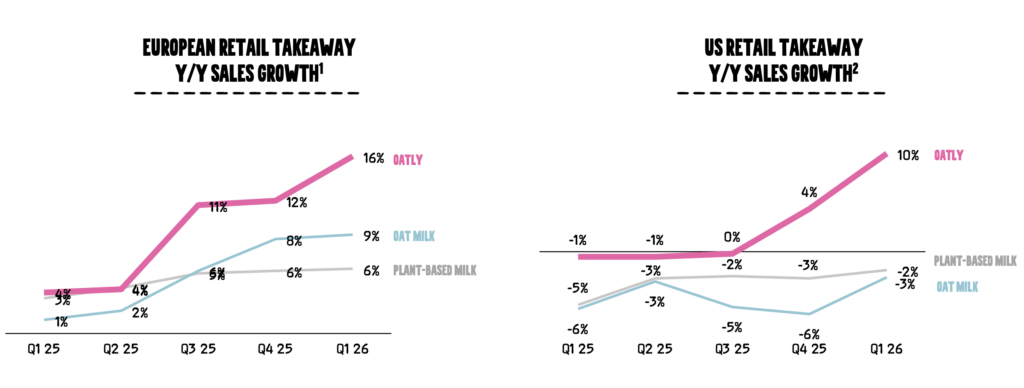
The company reported that its sales in North America reached $62.2 million in Q1 2026. Within this region, the retail channel continues to be a dominant force, accounting for 65% of sales and experiencing a 10% uplift in the first three months of the year. This performance stands in stark contrast to the overall market, which saw declines of 2% for non-dairy milk and 3% for oat milk. Further underscoring the positive trend, Oatly’s revenues in North America, excluding its largest foodservice customer, surged by an impressive 12.3%. Ordonez highlighted the strategic importance of the foodservice sector, noting that "excluding the largest customer, this channel already represents over one-quarter of the segment’s revenue and has been growing in double digits for some quarters now. When we look ahead, we only see opportunities.”

Global Performance and Profitability Improvements
Globally, Oatly’s revenue growth of 15.6% to $228.3 million in Q1 2026 was supported by a 5.6% increase in sales volume. This expansion was not just in top-line figures; the company also demonstrated significant improvements in its profitability. Gross profit increased by a substantial 22.5% to $76.3 million. While the company still recorded a net loss of $12.1 million, this represented a slight improvement, narrowing the loss by 3% compared to the previous year.
More encouragingly, Oatly’s adjusted EBITDA—a key measure of operational profitability excluding non-operational and one-time expenses—showed a dramatic turnaround. For the January-to-March period, adjusted EBITDA stood at a positive $5 million, a significant shift from a loss of $3.7 million in Q1 2025. This indicates a substantial improvement in the company’s core operational efficiency and its ability to generate cash from its ongoing business activities.
This financial strengthening is directly linked to Oatly’s strategic reorientation, as articulated by COO Daniel Ordonez. He explained the company’s shift in focus from positioning oat milk as a mere dairy alternative to framing it as an "experience canvas for the beverages market." This approach involves collaborating closely with customers to "renovate their menus and shelves to be more relevant, more provocative, and more on trend with today’s consumer." Ordonez emphasized that "Taste and health define a clear high ground for the new generations, in particular for this category. We have also adapted how we communicate to them.”
European and International Markets Continue to Thrive
Oatly’s home region, Europe and International, continued its strong trajectory, with revenues expanding by an impressive 27% to reach $136.8 million. This growth was primarily fueled by increased volume of its popular barista oat milks. The retail channel within this segment was particularly strong, contributing 80% of the segment’s revenue and seeing a 16% surge in sales. This outpaced the growth rates of the broader oat milk category (9%) and the overall plant-based milk market (6%) in retail.
The company’s strategy in Europe and International appears to be highly effective in capturing consumer interest and driving sales volume. This consistent performance in its established markets provides a solid foundation for its global expansion efforts.
Challenges in Greater China and Strategic Review
Despite the overall positive global outlook, Oatly experienced a 2% dip in revenues in its Greater China segment, which totalled $29.3 million in Q1 2026. Volume also declined by 8.8%, with the foodservice channel being the primary area of weakness. This segment has been underperforming for years, prompting Oatly to initiate a strategic review, which is slated for completion this year.
CEO Jean-Christophe Flatin acknowledged the ongoing challenges, stating, "We continue to evaluate a range of options, including a potential carve-out, with the goal of accelerating growth and maximising the value of the business. The general context and the price pressure in the foodservice business continues. At the same time, I am pleased to report that the strong development of the retail channel accelerated, doubling in Q1 year-over-year and representing already close to a third of the segment’s revenue." This retail growth in China offers a glimmer of hope amidst the broader challenges in the region.
Targeting Gen Z Through Product Innovation and Trend Alignment
Oatly’s strategic approach to engaging with younger consumers, particularly Gen Z, has been a cornerstone of its recent success. The company is actively aligning its product development and marketing efforts with emerging consumer trends. One significant area of focus has been the "fibermaxxing" trend, where Oatly is highlighting the fiber content of its products on packaging.
"Many global health authorities estimate that people have a fibre deficiency of about 10g per day. As a company that is rooted in science, our visionary founders have historically advocated for the benefits of fibre in people’s diets," explained Ordonez. "What you see here is just the first step, and you should expect to see more from us in the near future."
This initiative taps directly into the growing consumer interest in fiber-rich foods. Data indicates that 60% of Gen Z individuals in the US and 62% in the UK are interested in products with higher fiber content. Social media platforms, where Oatly concentrates a significant portion of its brand investment, are instrumental in amplifying this trend, with 42% of British Gen Z users reporting increased exposure to fiber-related content.
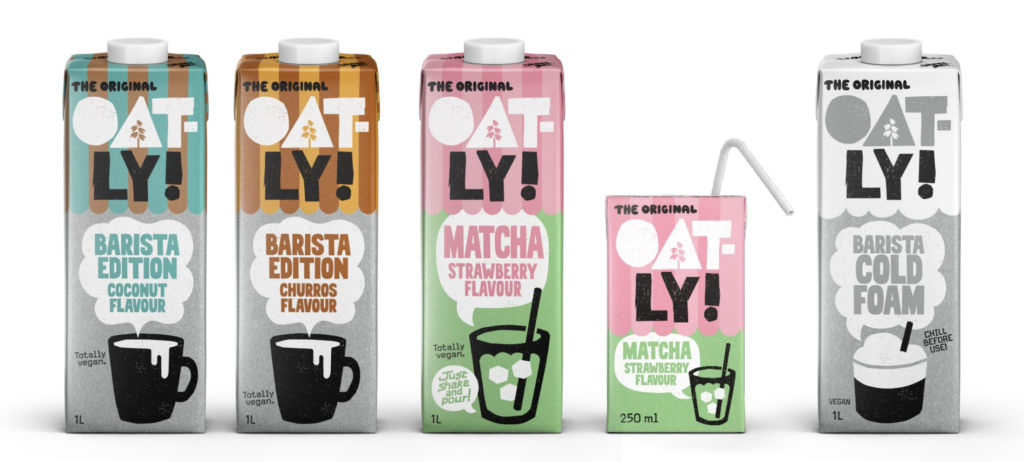
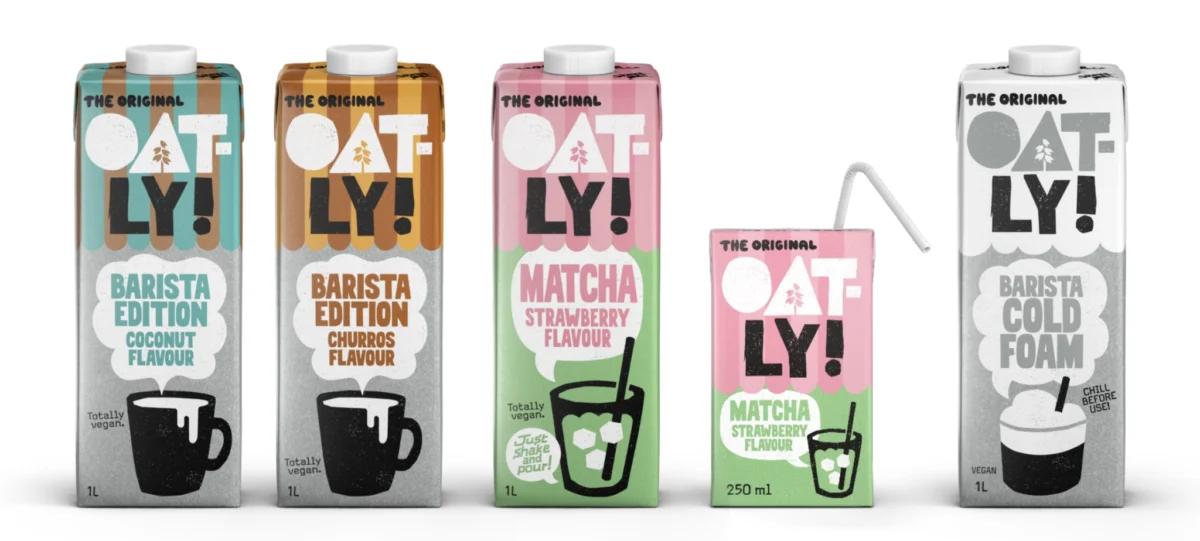
Beyond health-focused trends, Oatly is also innovating with new taste experiences to capture the attention of younger palates. The company has introduced new barista oat milk flavors, including churros, coconut, and popcorn, with the latter set to launch in the US this year. Additionally, the ready-to-drink matcha latte, first unveiled in 2025, is also making its way to the US market. Matcha remains a highly sought-after beverage, particularly among Gen Z, and Oatly’s strategic entry into this category has proven fruitful, with nearly half (45%) of its matcha latte purchases in the UK coming from Gen Z and Gen Alpha consumers.
Ordonez further elaborated on the expansion of the matcha line, stating, "We’re expanding the matcha range with the addition of a strawberry flavor, which is the most popular combination in foodservice. This will enable customers to create an even wider range of drinks.”
Another significant product innovation is the rollout of cold foam milk, a popular café staple. "Our Cold Foam Barista has already reached the menu of many of our top customers. It can be added on top of any beverage, hot or cold," Ordonez shared. He highlighted the novelty of this offering: "Plant-based cold foam options weren’t widely available in the market thus far. This is a breakthrough product that delights consumers and elevates the experience for our food service customers. Taste is a new platform for Oatly and for the category. This is not just random innovation.”
Oatly is also drawing inspiration from the fashion industry, employing strategies like seasonal recipe "lookbooks" and a "Future of Taste" trend report to connect with Gen Z. The company even partnered with Avavav at Milan Fashion Week, showcasing its collection alongside three signature Oatly drinks, further integrating its brand into lifestyle and cultural trends.
Navigating Geopolitical Uncertainty and Maintaining Outlook
Despite the positive financial results and strategic wins, Oatly faces external challenges, notably the supply chain disruptions stemming from the ongoing Middle East conflict. The company reaffirmed its full-year 2026 outlook, projecting constant currency revenue growth between 3% and 5% and an adjusted EBITDA between $25 million and $30 million.
However, CEO Jean-Christophe Flatin cautioned about the impact of geopolitical events. "The impact is already visible in our costs from March onwards and brings further uncertainty for the rest of the year," Flatin noted. While acknowledging that the conflict has not yet impacted demand, he stressed the volatile nature of the global environment. "Even if to date we don’t see a demand impact from the Middle East conflict, we all know how volatile and dynamic the current environment is and remains. Therefore, […] we choose to be conservative and maintain our current outlook for the moment, and we will, of course, continue to monitor the conditions closely.”

The primary cost impacts identified by Flatin are related to fuel prices, specifically increased shipping and logistics costs in both Europe and North America, as well as worldwide packaging costs. The company is actively working to mitigate these impacts through various means, including existing energy and raw material contracts in its European factories and a fleet of electric trucks.
Oatly CFO Marie-José David provided further insight into the company’s financial trajectory for the remainder of the year. "As we stand today, we anticipate Q2 to be lower than our first quarter, with visible negative impact from the Middle East conflict combined with a strong brand investment season. As we move through the year, we expect performance to improve meaningfully in the back half." This outlook suggests a cautious but optimistic approach, with a clear focus on managing costs and capitalizing on expected market improvements in the latter half of 2026.
The company’s ability to navigate these complex global challenges while simultaneously driving growth through innovative product strategies and targeted consumer engagement will be critical in shaping its future success. The Q1 2026 results provide a strong indication that Oatly is on a promising path toward sustained profitability and market leadership in the evolving plant-based beverage landscape.
