
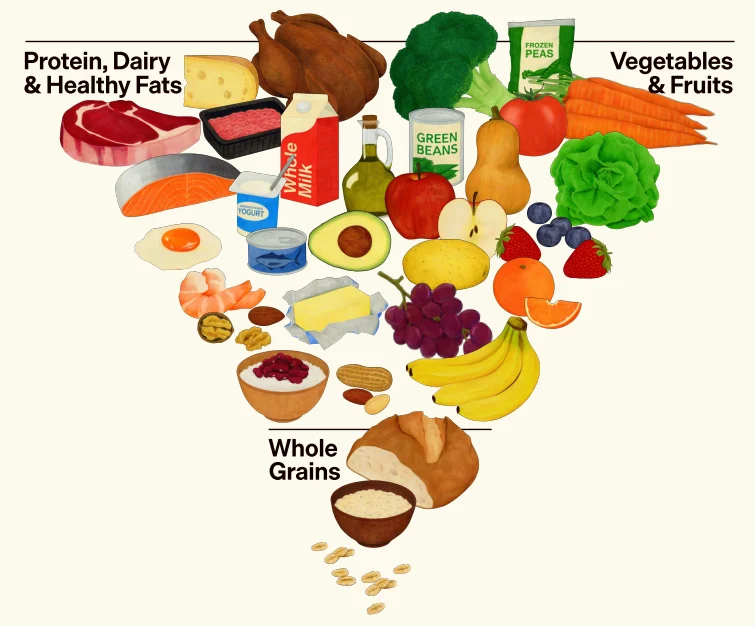
The much-anticipated release of the 2025-2030 Dietary Guidelines for Americans (DGAs) this week has ignited considerable discussion within the public health and nutrition communities. Marketed with the straightforward tagline "eat real food," the latest iteration of these influential guidelines signals a more assertive stance on curbing the consumption of added sugars and highly processed foods. However, alongside these welcome directives, the DGAs have reintroduced a visual aid in the form of a pyramid-like graphic, which, due to its prominent depiction of certain foods, has raised concerns about potential confusion and conflicting messaging.
This new edition of the DGAs, a cornerstone of U.S. nutrition policy, aims to provide evidence-based recommendations for Americans of all ages, from infancy through older adulthood. Developed jointly by the U.S. Departments of Agriculture (USDA) and Health and Human Services (HHS), these guidelines are intended to inform federal food, nutrition, and health policies and programs, as well as guide individuals in making healthier dietary choices. The process leading to the 2025-2030 guidelines involved extensive scientific review, beginning with an independent Dietary Guidelines Advisory Committee (DGAC). This committee, comprised of leading nutrition scientists, meticulously reviewed the latest scientific evidence over a two-year period, free from direct influence from government agencies or the food industry. Their findings were compiled into a comprehensive Scientific Report, which served as a crucial foundation for the final guidelines.
A significant departure from the previous guidelines is the explicit identification and recommendation to limit "highly processed foods." Previous editions have emphasized whole foods and cautioned against excessive intake of added sugars, sodium, and saturated fats. However, this is the first time the DGAs have broadly categorized and advised against "highly processed foods." While the term itself can be somewhat fluid, as food processing exists on a spectrum, the guidelines provide actionable examples. They recommend avoiding sugar-sweetened beverages, salty or sweet packaged snacks, and ready-to-eat meals. The emphasis on whole, fiber-rich grains is also reinforced, with a call for a significant reduction in refined carbohydrates, such as white bread, which are characteristic of many processed food items. This move reflects a growing body of scientific research linking the consumption of ultra-processed foods to a range of adverse health outcomes, including obesity, type 2 diabetes, and cardiovascular disease.
The DGAs have also intensified their focus on added sugars. The new guidelines adopt a notably strict position, stating that "no amount of added sugars or non-nutritive sweeteners is recommended or considered part of a healthy or nutritious diet." In practical terms, this translates to a recommendation that no single meal should exceed 10 grams of added sugars. This represents a more stringent approach than the previous guideline, which advised limiting added sugars to less than 10% of total daily calories (approximately 50 grams for a 2,000-calorie diet). Furthermore, the age threshold for avoiding added sugars in children has been raised significantly, now advising that children should not consume added sugars until age 10, a notable increase from the previous recommendation of age 2. This enhanced focus on added sugars acknowledges their contribution to excess calorie intake without providing significant nutritional value, and their association with increased risk of chronic diseases.
However, the introduction of a new visual representation of the dietary recommendations has sparked considerable debate. The "New Food Pyramid," as it has been dubbed, appears inverted, with a broader base emphasizing foods such as steak, full-fat milk, and butter. This visual prominence of saturated fat-rich foods has led to concerns that it might inadvertently undermine the written guidance. While the actual text of the DGAs retains the long-standing recommendation to limit saturated fat to no more than 10% of total daily calories, the visual emphasis on these items has generated confusion.
Frank Hu, a professor of nutrition and epidemiology and chair of the Department of Nutrition at the Harvard T.H. Chan School of Public Health, has voiced these concerns. "I think the new Guidelines move in the right direction by reinforcing the importance of reducing added sugars and cutting back on refined grains and other highly processed foods," Professor Hu stated. "However, there appear to be several contradictions within the DGAs and between the DGAs and the new pyramid. The mixed messages surrounding saturated-fat-rich foods such as red meat, butter, and beef tallow may lead to confusion and potentially higher intake of saturated fat and increased LDL cholesterol and cardiovascular risk."
The concern over saturated fat is particularly relevant when considering the practical application of the guidelines. For an individual consuming a 2,000-calorie diet, the 10% limit on saturated fat translates to approximately 22 grams per day. The DGAs’ recommendations for daily servings by calorie level suggest three servings of dairy. If full-fat versions are chosen – for instance, an 8-ounce cup of whole milk (approximately 5 grams of saturated fat), three-quarters of a cup of full-fat Greek yogurt (around 6 grams), and one ounce of cheddar cheese (about 6 grams) – this alone accounts for 17 grams of saturated fat. Adding just one tablespoon of butter (7 grams) or beef tallow (6 grams), both suggested as cooking fat options, would push an individual over the 22-gram limit, even before accounting for saturated fats present in other food choices throughout the day, including protein sources.
While the new pyramid does allocate a significant portion to vegetables and fruits, Professor Hu also pointed out the relatively smaller depiction of whole grains compared to other food groups, despite the written guidelines advocating for 2-4 servings of whole grains daily. This discrepancy between visual representation and textual advice highlights a critical challenge in public health messaging: the power of imagery and simple taglines to shape public perception, potentially overshadowing more nuanced textual information. This is precisely why organizations like the Harvard T.H. Chan School of Public Health have developed their own visual aids, such as the Healthy Eating Plate and its predecessor, the Healthy Eating Pyramid, to offer clearer and more consistent guidance.
Beyond saturated fats, the guidelines present a notable increase in recommended protein intake for adults, suggesting 1.2 to 1.6 grams of protein per kilogram of body weight per day. This represents a 50-100% increase from previous minimum intake recommendations. While protein needs are indeed variable and can be influenced by factors like age, activity level, and health status, this substantial upward revision, without clearer distinctions regarding protein quality, has also drawn attention. Experts emphasize that excessive protein intake can be converted to fat by the body, potentially contributing to weight gain. The absence of specific guidance on prioritizing plant-based proteins and fish, which numerous studies have linked to more favorable health outcomes compared to diets high in red meat, is a point of concern for some nutrition scientists.
The "protein package"—the accompanying fats, fiber, sodium, and other nutrients that come with protein-rich foods—is a crucial factor in determining their overall health impact. While the DGAs advocate for a "variety of protein foods" from both animal and plant sources, the lack of clear messaging on which options to prioritize, especially in light of the saturated fat limits, is seen as a missed opportunity.
Another area where the guidelines are perceived as lacking clarity is in their advice on alcohol consumption. The recommendation to "consume less alcohol for better health" is vague, offering no concrete quantitative limits, making it difficult for individuals to understand what "less" actually entails in practice.
A significant omission from the 2025-2030 DGAs is the consideration of environmental and socioeconomic impacts of dietary choices. In an era of increasing awareness about climate change and food sustainability, the exclusion of these factors is viewed by many as a critical oversight. Food production has a substantial environmental footprint, and dietary patterns are also deeply intertwined with socioeconomic conditions, cultural practices, and accessibility. Recommendations that do not acknowledge these broader contexts risk being less effective and potentially inequitable.
The development process of the 2025-2030 DGAs itself has been a subject of scrutiny. While the standard procedure involves an independent DGAC reviewing scientific literature, this year’s process saw the administration reject the committee’s report. Instead, a supplemental scientific analysis was conducted by a group selected through a federal contracting process. Although this supplemental document asserts that evidence was evaluated based solely on scientific rigor and underwent internal quality checks and external peer review, concerns have been raised about the transparency of this alternative process. Deirdre Tobias, an assistant professor at the Harvard T.H. Chan School of Public Health who served on the 2025-2030 DGAC, has expressed these concerns, noting a lack of transparency regarding who authored the new DGAs and the methodology employed. Furthermore, some reviewers of the supplemental analysis have flagged potential conflicts of interest due to financial ties to the beef and dairy industries, which could influence the prominent placement of these products in the guidelines and accompanying graphics.
In conclusion, the 2025-2030 Dietary Guidelines for Americans present a mixed bag of advancements and concerns. While the stronger emphasis on reducing added sugars and highly processed foods aligns with current scientific understanding, the visual presentation of the new pyramid, with its prominent display of saturated fat-rich animal products, creates a confusing dichotomy. The practical implications of these mixed messages, particularly regarding saturated fat intake and protein quality, remain a significant point of discussion. Historically, adherence to the DGAs has been a challenge for the American public, with data from the Centers for Disease Control and Prevention (CDC) consistently showing low compliance rates. It remains to be seen whether this edition, despite its efforts to be more consumer-friendly with a shorter format and associated graphics, will achieve greater success. For individuals seeking clearer, more consistent dietary advice, consulting resources like the Healthy Eating Plate or seeking personalized guidance from a registered dietitian may be the most effective path forward. The ongoing dialogue surrounding these guidelines underscores the dynamic nature of nutritional science and the persistent challenge of translating complex research into accessible and actionable public health recommendations.
