
The rapid proliferation of generative artificial intelligence tools has fundamentally transformed the digital publishing landscape, introducing unprecedented volumes of low-quality, synthetically generated material into public discourse. Nowhere is this trend more concerning than in the realm of scientific communication, where accurate data dissemination is critical to public health, consumer safety, and informed decision-making. As large language models (LLMs) have become more accessible following the widespread release of consumer-facing AI applications in late 2022, the digital ecosystem has experienced a dramatic surge in unverified, machine-authored science content colloquially termed "AI slop."
Unlike traditional misinformation, which often relies on deliberate fabrication or ideological distortion, AI science slop is frequently manufactured at scale by individuals or entities seeking to maximize output with minimal effort. This phenomenon has created severe verification challenges for consumers, educators, and science communicators alike. According to recent analyses by digital literacy experts and specialized educators such as Michelle Wong of Lab Muffin Beauty Science, the sheer volume of synthetic scientific content requires a sophisticated, multi-faceted approach to detection. Because automated AI detectors remain notoriously unreliable—frequently producing false positives or failing to recognize heavily edited synthetic text—observers must rely on a comprehensive understanding of linguistic quirks, formatting anomalies, behavioral red flags, and contextual inconsistencies.
Background Context and the Evolution of Digital Misinformation
To understand the current crisis of AI science slop, one must examine the historical trajectory of digital content creation. Historically, poor grammar, structural typos, and syntactic inconsistencies served as primary indicators that a published piece had bypassed rigorous editorial oversight. However, the maturation of LLMs has inverted this paradigm. Modern AI-generated text is typically characterized by impeccable grammar, formal cadence, and polished punctuation, masking underlying factual deficiencies beneath a veneer of professional authority.
The turning point in this evolution accelerated sharply between 2024 and 2025, as automated content generation tools transitioned from experimental novelties to industrialized publishing engines. Bloggers, social media influencers, and even compromised academic actors began leveraging LLMs to hyper-scale their output, producing long-form articles, infographics, and social media threads at a frequency that far outpaces human cognitive limits. Producing accurate, evidence-based scientific content requires meticulous research, often demanding hours of deep engagement with primary literature, peer-reviewed studies, and domain-specific context. In contrast, synthetic generators can fabricate thousands of words of confident, persuasive prose in seconds, creating a severe asymmetry between the low cost of generation and the high cost of verification.
Linguistic Quirks and Structural Tells in Synthetic Science Writing
Identifying AI science slop necessitates a deep familiarity with the inherent biases and repetitive patterns embedded within LLM architectures. Because language models operate by predicting the most statistically probable sequence of words based on vast training corpora, their outputs frequently gravitate toward homogenized tones and predictable stylistic crutches.
One of the most prominent linguistic markers of AI-generated scientific content is an inflated sense of universal significance. Synthetic texts routinely frame mundane or tangential findings as paradigm-shifting breakthroughs, employing melodramatic qualifiers that treat every data point as monumental and deeply meaningful. Furthermore, AI science slop is frequently marked by verbosity devoid of high information density. While human scientific writers strive for concise clarity, LLMs tend to pad explanations with expansive transitional phrases and circular reasoning, effectively stretching a minimal amount of actual substance across an impressive-looking word count.
Compounding these stylistic giveaways are distinct remnants of chatbot interactions left behind by careless publishers. Due to the inherent dependency fostered by automated tools, creators occasionally paste raw model outputs directly into publishing platforms without stripping away conversational artifacts. Observers frequently encounter leftover quotation marks, conversational meta-commentary, and structural signposts such as, "Here is a clean Instagram caption," or organizational labels like "Post 1." While isolated instances of such formatting errors could theoretically stem from human oversight or email drafting, their presence alongside other synthetic indicators forms a compelling pattern of automated generation.
Behavioral Red Flags: Hyperprolific Output and Sudden Shifts
Beyond internal textual anomalies, the behavioral patterns of content creators provide critical context for evaluating the authenticity of scientific material. One of the most reliable macroeconomic indicators of AI slop utilization is hyperprolific output—an unnaturally high volume of published material spanning broad, complex disciplinary domains.
In traditional publishing, domain expertise is notoriously narrow, and true subject-matter experts require substantial time to synthesize and publish new findings. Creators who suddenly pivot to publishing lengthy, highly confident articles across multiple unrelated scientific fields on a daily or hourly basis are statistically likely to be relying on automated generation. This hyper-prolific tendency mirrors broader concerns regarding academic integrity and paper mills, where compromised researchers have been documented publishing hundreds of papers annually through the uncritical application of automated tools.
Furthermore, investigators examine sudden, uncharacteristic shifts in a creator’s digital footprint. A longitudinal review of an author’s historical archive often reveals stark inconsistencies in tone, vocabulary, depth, and formatting following the widespread adoption of LLMs. Creators who previously maintained a distinct, personalized writing voice may abruptly transition to the averaged-out, generic cadence characteristic of commercial chatbots, signaling an abandonment of authentic synthesis in favor of computational efficiency.
Inhuman Errors and Strategic Formatting Practices
When evaluating scientific claims, the presence of distinctively non-human errors serves as a definitive diagnostic tool. AI chatbots excel at pattern-matching and linguistic synthesis, but they fundamentally lack physical intuition, real-world grounding, and logical judgment. Consequently, LLMs frequently generate errors that a trained human researcher would instinctively avoid, such as impossible biological mechanisms, mathematically contradictory scaling, or misattributed citations that disintegrate upon primary source verification.
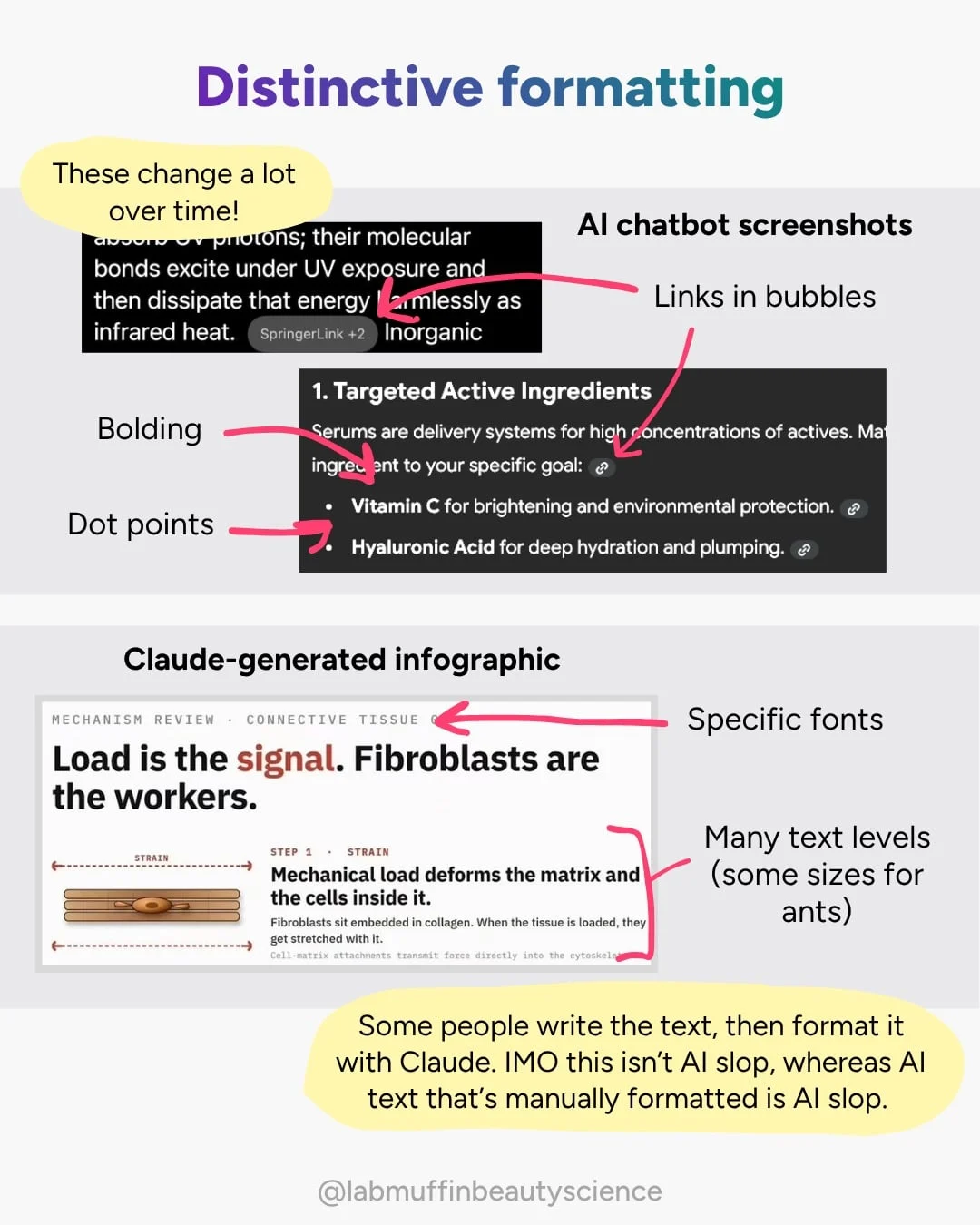
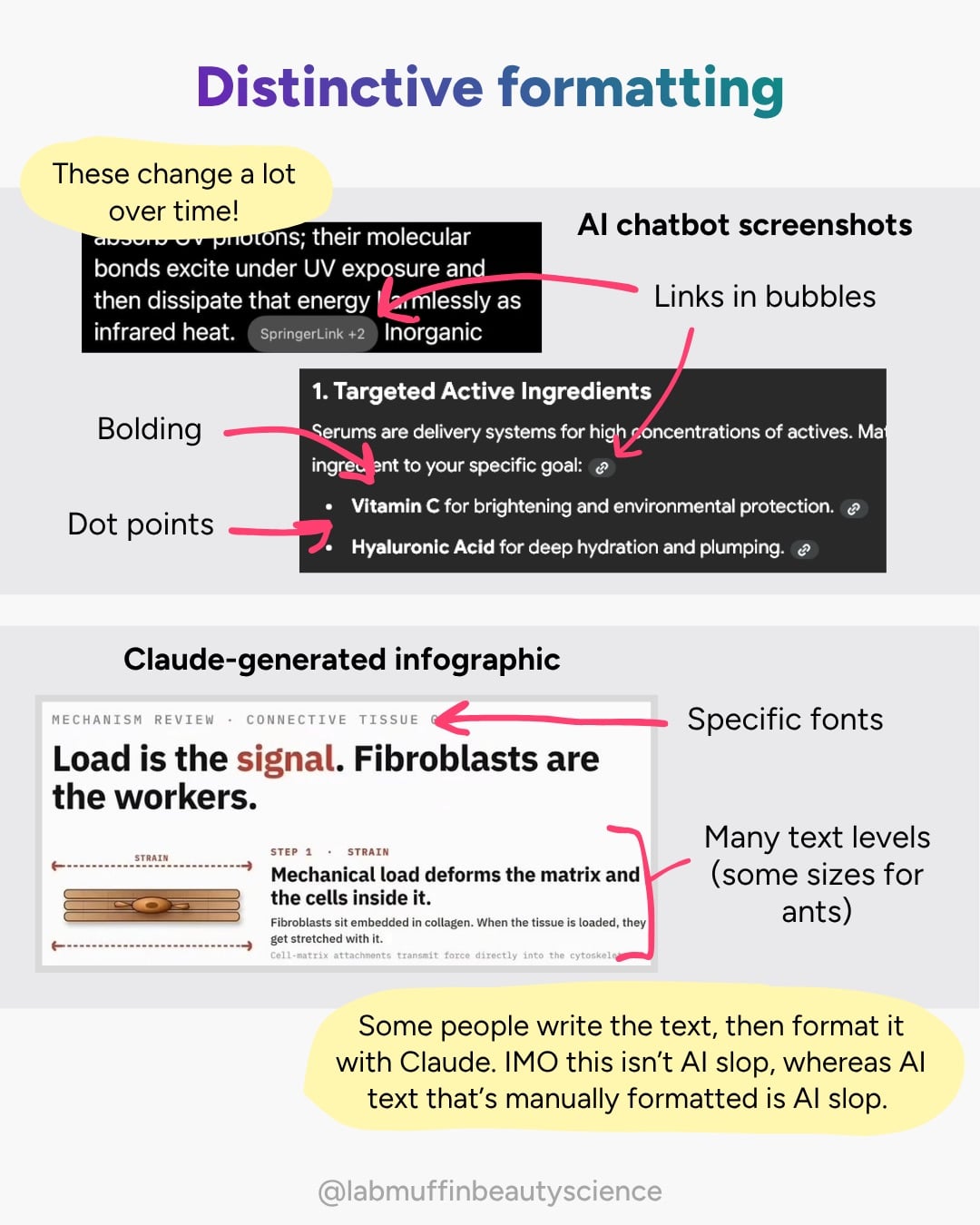
In tandem with textual errors, visual formatting has emerged as a primary battleground for AI science slop. Content creators frequently employ specialized AI models—such as Claude—to generate structured infographics, summary carousels, and visual study breakdowns. While some creators manually draft their core arguments before utilizing AI solely for graphic layout, a practice viewed by some analysts as distinct from wholesale generation, the inverse approach is vastly more common and problematic. Automated text generation subsequently paired with automated infographic design produces fully synthetic educational artifacts that present unverified, hallucinated claims with polished visual legitimacy.
Implications for Public Science Literacy and Consumer Trust
The proliferation of AI science slop poses profound challenges for the scientific community, public educators, and digital consumers. In specialized fields such as dermatology, nutritional science, and public health, misinformation disseminated with synthetic confidence can lead to adverse consumer behaviors, financial exploitation, and degraded health outcomes. When individuals rely on unverified, AI-generated summaries regarding complex biological treatments, they risk exposing themselves to flawed protocols that lack empirical backing.
Moreover, the normalization of AI slop threatens to erode public trust in legitimate science communication. As audiences become increasingly aware that digital spaces are saturated with unverified machine-generated content, skepticism inevitably spills over toward genuine experts who adhere to rigorous verification standards. This erosion of epistemic trust complicates efforts to communicate consensus on critical scientific matters, ranging from preventative medicine to environmental science.
Response Strategies and Recommendations for Verification
Experts emphasize that public callouts and direct confrontations with creators who utilize AI slop are rarely productive. In many cases, publishers relying on automated tools either remain willfully ignorant of LLM accuracy limitations or operate with an undiscerning attitude toward synthetic media. Consequently, digital literacy advocates recommend passive mitigation strategies, such as unfollowing unverified sources and independently cross-referencing extraordinary scientific claims against primary, peer-reviewed literature.
As artificial intelligence continues to integrate into the digital publishing ecosystem, the burden of verification increasingly falls upon the consumer. By understanding the structural, linguistic, and behavioral signatures of AI science slop—ranging from hyper-prolific output and exaggerated prose to inhuman logical errors—audiences can better navigate an increasingly crowded and synthetic information landscape, ensuring that scientific inquiry remains anchored in empirical reality.
