
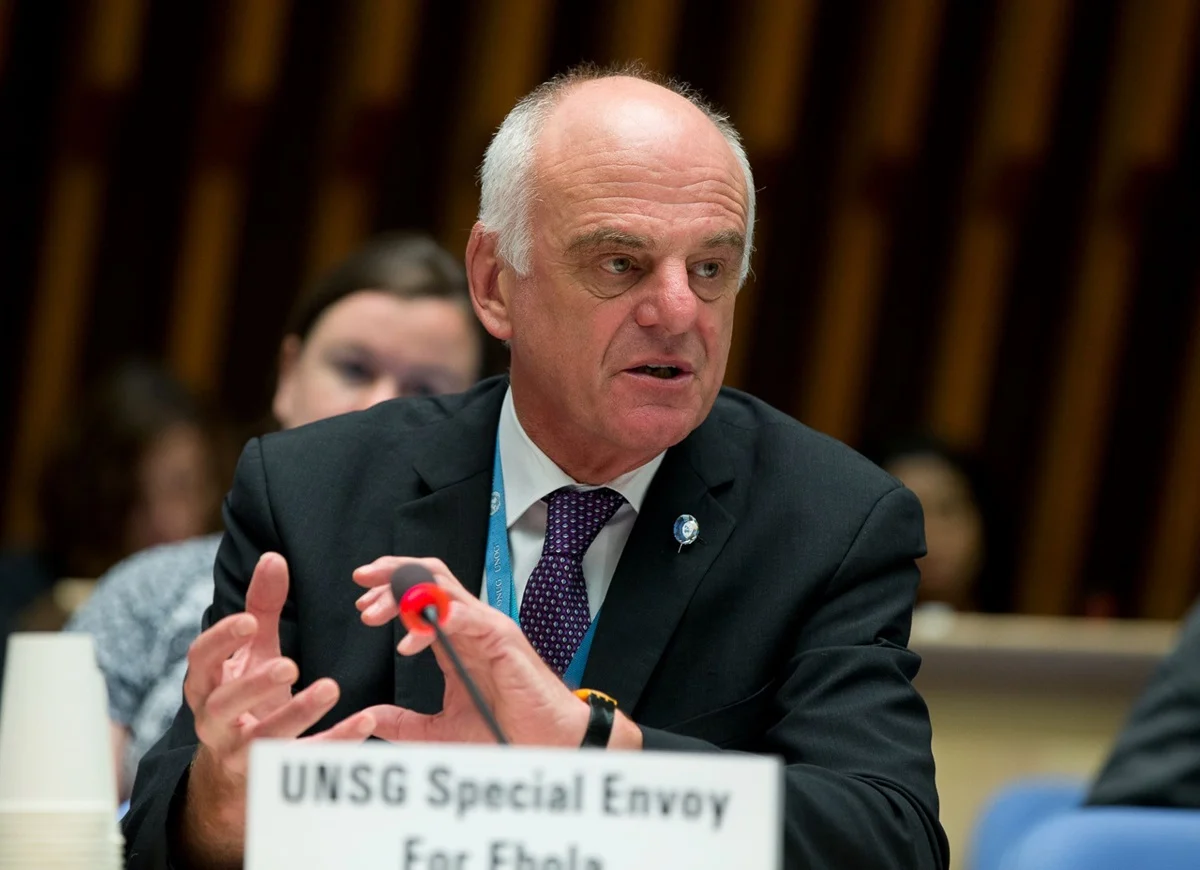
The international community is in mourning following the death of Sir David Nabarro, a towering figure in global public health, humanitarian crisis management, and sustainable development. Dr. Nabarro, who served as a World Health Organization (WHO) Special Envoy on COVID-19, passed away at his home on Friday, 25 July 2025, at the age of 75. His death marks the conclusion of a storied career that spanned over four decades, during which he became a bridge-builder between high-level policy and the urgent needs of the world’s most vulnerable populations.
Throughout his life, Sir David was defined by a unique ability to navigate complex geopolitical landscapes, whether coordinating responses to virulent outbreaks, addressing the intricate challenges of global food security, or advocating for the intersection of climate change and human health. His work, characterized by profound empathy, technical precision, and a relentless focus on equity, left an indelible mark on the institutions of the United Nations and the lives of millions worldwide.
A Legacy of Strategic Leadership and Crisis Response
Sir David’s career was defined by his presence at the epicenter of the world’s most significant health and humanitarian challenges. From the mid-1990s through the mid-2020s, his professional trajectory paralleled the evolution of modern global health architecture.
In the late 1990s and early 2000s, while serving at the WHO, Dr. Nabarro was instrumental in the Roll Back Malaria project. During this period, he recognized that health outcomes were inextricably linked to structural inequality. This insight led him to take on increasingly complex roles within the United Nations system. His tenure as the UN System Senior Coordinator for Avian and Pandemic Influenza (2005–2014) established the blueprint for how international bodies should handle large-scale infectious disease threats, emphasizing the necessity of cross-sectoral collaboration.
Perhaps his most visible contributions occurred during periods of intense global instability. As the UN Secretary-General’s Special Envoy for the West Africa Ebola Outbreak Response from 2014 to 2015, Dr. Nabarro was credited with mobilizing the international effort that eventually curtailed the devastating epidemic. His ability to synchronize the efforts of multiple sovereign nations and non-governmental organizations during that crisis is widely cited by public health experts as a masterclass in crisis management.
Chronology of a Decades-Long Public Service
To understand the scope of Sir David’s impact, one must review the timeline of his diverse and demanding responsibilities:
- 1999–2005: Served in senior leadership at the WHO, including as Executive Director for the Roll Back Malaria Project and the Director-General’s Special Representative for Health Action in Crises.
- 2005–2014: Appointed UN System Senior Coordinator for Avian and Pandemic Influenza.
- 2008–2014: Acted as the UN Secretary-General’s Special Representative for Food Security and Nutrition.
- 2011–2014: Served as Assistant Secretary-General and Coordinator of the Movement for Scaling Up Nutrition.
- 2014–2015: Led the UN’s response to the Ebola crisis in West Africa as the Secretary-General’s Special Envoy.
- 2016–2017: Served as Under-Secretary-General and Special Adviser for the 2030 Agenda for Sustainable Development and Climate Change.
- 2018: Co-founded the 4SD Foundation (Skills Systems and Synergies for Sustainable Development) to train the next generation of global leaders.
- 2020–2025: Appointed WHO Director-General’s Special Envoy on COVID-19.
- 2023: Knighted by King Charles III for his monumental contributions to global health and service to humanity.
The Architect of Food Systems and Climate Advocacy
Beyond his work in infectious disease, Sir David was a pioneering voice in the movement to reform global food systems. He understood early on that malnutrition and obesity were not merely clinical issues, but the results of flawed economic, agricultural, and environmental policies.
In October 2018, his leadership in this field was recognized when he received the prestigious World Food Prize. Following this, he curated the Food Systems Dialogues, a series of international consultations that were vital to the preparation of the 2021 UN Food Systems Summit. His approach was always "systems-based," meaning he viewed food, energy, finance, and climate change as a single, integrated challenge. When the war in Ukraine threatened global food supply chains in 2022, he was a key figure in the UN Secretary-General’s crisis response group, where he co-led the food workstream, applying his characteristic calm and strategic foresight to a rapidly deteriorating situation.
Institutional Responses and Professional Tributes
The announcement of his passing elicited an outpouring of grief from the highest echelons of global governance. WHO Director-General Dr. Tedros Adhanom Ghebreyesus expressed deep sorrow, describing Dr. Nabarro as a "dear friend" and a "wise, generous mentor."
"David was a great champion of global health and health equity," Dr. Tedros noted in his official statement. "His work touched and impacted so many lives across the world. We will dearly miss his expertise, wisdom, and kindness."
The 4SD Foundation, the organization he co-founded with Florence Lasbennes to foster sustainable development, issued a statement highlighting the personal loss felt by those who worked closely with him. The foundation emphasized his commitment to shifting systems "from within," a philosophy he taught to hundreds of students and young professionals. His family, in a subsequent statement, expressed their gratitude for the global response, noting, "Across the fields of international development, especially public health, food systems transformation, nutrition and crisis response, we are proud to see how his legacy will continue through so many compassionate leaders working to shift systems from within."
Implications for the Future of Global Health
The loss of Sir David Nabarro occurs at a critical juncture for international health institutions. As the world continues to grapple with the post-pandemic recovery, the threat of climate-induced health crises, and the fragility of global food networks, the loss of his institutional memory and diplomatic acumen is significant.
His methodology—which involved bringing together disparate groups, from indigenous farmers to UN under-secretaries—served as a vital counterbalance to the often siloed nature of international aid. Analysts note that the "Nabarro model" of facilitation, which prioritized listening and multi-stakeholder dialogue over top-down mandates, has become a gold standard for global health diplomacy. The challenge for the WHO and the United Nations moving forward will be to preserve this collaborative spirit in his absence.
Furthermore, his work at Imperial College London as Chair of Global Health underscored his commitment to academia and the training of future leaders. By bridging the gap between field work and higher education, he ensured that his expertise was passed down to a new generation. The memorial services and the online tribute page, which has already seen thousands of entries from across the globe, serve as a testament to the breadth of his influence.
A Final Remembrance
Sir David Nabarro’s career was more than a list of titles; it was a testament to the idea that international cooperation, when practiced with humility and technical rigor, can fundamentally improve the human condition. Whether he was on the ground in the wake of a natural disaster or in the boardrooms of Geneva and New York, he remained a constant advocate for the "disadvantaged people worldwide," a phrase he often used to define the ultimate beneficiary of his work.
He is survived by his wife, Flo, his children—Tom, Ollie, Polly, Josie, and Lucas—and his seven grandchildren. A private funeral is scheduled for 4 August, with a series of public memorial services expected to follow in the coming weeks, allowing the international community to honor a man whose life’s work provided a roadmap for a more equitable and resilient world.
As the global health sector reflects on his passing, the consensus among his peers is clear: the most fitting tribute to Sir David Nabarro will be the continued success of the systems he built, the leaders he mentored, and the humanitarian ideals he championed until his final days. His life remains a beacon for those who believe that, even in the face of the most daunting global crises, coordinated action and human compassion can prevail.
