
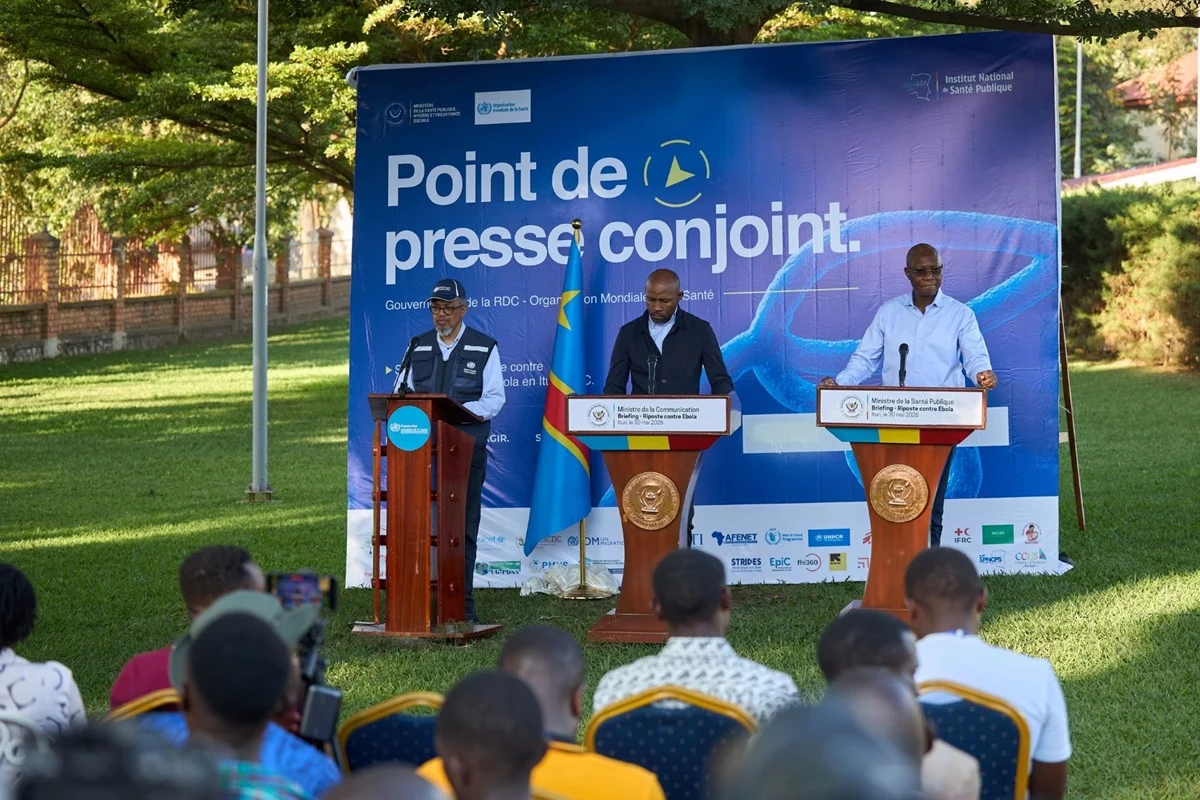
The Government of the Democratic Republic of the Congo (DRC) and the World Health Organization (WHO) have officially reaffirmed their strategic partnership and shared commitment to safeguarding the health of the population in Ituri Province and across the nation following a high-level joint mission to Bunia. This mission, led by the DRC Minister of Health, Dr. Samuel Roger Kamba, and the Minister of Communication and Media, Mr. Patrick Muyaya Katembwe, featured a significant visit from the WHO Director-General, Dr. Tedros Adhanom Ghebreyesus, signaling the gravity of the current epidemiological situation. The delegation arrived in the provincial capital of Ituri to assess the scale of the ongoing Ebola virus disease (EVD) outbreak and to synchronize the national and international response mechanisms in a region already grappling with complex humanitarian challenges.
This diplomatic and technical intervention comes at a critical juncture for the DRC’s public health infrastructure. The country is currently responding to an outbreak of Ebola caused by the Bundibugyo virus (BDBV), a strain that presents unique clinical and logistical hurdles compared to the more common Zaire ebolavirus. According to reports from the Ministry of Health, the situation is evolving rapidly, with confirmed cases and fatalities notified across several health zones in Ituri, North Kivu, and South Kivu. The geographical spread across three provinces underscores the high risk of regional transmission and the urgent need for a unified, multi-sectoral approach to containment.
Historical Context and the Bundibugyo Challenge
The Democratic Republic of the Congo is no stranger to Ebola, having experienced more outbreaks than any other nation since the virus was first identified near the Ebola River in 1976. However, the current emergence of the Bundibugyo strain introduces specific complexities. Unlike the Zaire strain, for which the Ervebo vaccine and specific monoclonal antibody treatments (such as Ebanga and mAb114) have been licensed and successfully deployed in recent years, there is currently no licensed vaccine or therapeutic specifically approved for the Bundibugyo virus.
The Bundibugyo strain was first identified in 2007 during an outbreak in the Bundibugyo District of neighboring Uganda. While historically associated with lower case fatality rates than the Zaire strain, it remains a highly lethal pathogen capable of causing extensive community transmission if not managed with rigorous public health interventions. The absence of a "silver bullet" pharmaceutical tool means the DRC and its partners must rely on the fundamental pillars of outbreak control: early detection, isolation, contact tracing, and safe, dignified burials.
Chronology of the Current Response
The response to the current outbreak has moved through several distinct phases since the initial notification of suspected cases. In the early weeks, provincial health divisions in Ituri noted an unusual cluster of hemorrhagic fever cases, prompting immediate laboratory investigation. Once the Bundibugyo virus was confirmed through genomic sequencing at the National Institute of Biomedical Research (INRB) in Kinshasa, the DRC Government declared an official outbreak and activated the National Coordination Committee.
The visit by Dr. Tedros and the ministerial delegation marks the transition into an intensified "surge" phase. During their time in Bunia, the officials met with provincial authorities, frontline health workers, and humanitarian actors to identify bottlenecks in the response. This visit has resulted in a renewed focus on mobilizing additional resources and ensuring that life-saving interventions reach affected communities with greater speed and equity. The timeline for the coming weeks involves the rapid scaling of laboratory capacity in the eastern provinces to reduce the turnaround time for test results, which is essential for interrupting the chain of transmission.
Comprehensive National Leadership and WHO Support
The DRC Government is exercising firm leadership over the comprehensive national response, integrating efforts between the central government in Kinshasa and provincial authorities in the affected regions. This decentralized yet coordinated approach is vital given the logistical difficulties of operating in eastern DRC, where infrastructure is often limited and security concerns can impede the movement of medical teams.
WHO, acting as the primary technical partner, has deployed a surge of epidemiologists, logisticians, and community engagement experts to support the Ministry of Health. This collaboration extends to the broader United Nations system and various health and humanitarian partners, including the Africa Centres for Disease Control and Prevention (Africa CDC). The collective goal is to strengthen coordination mechanisms to avoid the duplication of efforts and ensure that every dollar of the response budget is utilized effectively. Central to this strategy is the mobilization of the "Contingency Fund for Emergencies," which allows for the rapid procurement of personal protective equipment (PPE), laboratory reagents, and specialized medical supplies.
The Role of Community Engagement and Local Leadership
A central theme emphasized by both Dr. Kamba and Dr. Tedros during their mission is that local communities are at the heart of the solution. Past outbreaks in the DRC have demonstrated that technical medical interventions are only effective if they are supported by the trust and active participation of the population. In some instances, misinformation and cultural resistance to safe burial practices have inadvertently fueled the spread of the virus.
To mitigate these risks, national and provincial authorities are intensifying dialogue with a wide array of local stakeholders. This includes community leaders, women’s groups, youth representatives, religious leaders, and the private sector. By engaging these groups, the response teams aim to co-develop solutions that are culturally appropriate and effective. For example, adapting safe and dignified burial protocols to respect local traditions while maintaining biosafety standards is a priority. This "bottom-up" approach is designed to foster ownership of the response, ensuring that protective behaviors—such as regular hand hygiene and early care-seeking—become community-led norms rather than externally imposed mandates.
Advancing Scientific Research Amidst the Crisis
Despite the lack of a licensed vaccine for the Bundibugyo strain, the Ministry of Health and WHO are viewing this outbreak as an opportunity to advance medical science. Efforts are currently underway to rapidly initiate randomized control trials (RCTs) on candidate vaccines and experimental treatments. These trials, conducted under strict ethical guidelines, are essential for developing the tools needed to combat future Bundibugyo outbreaks.
The DRC’s extensive experience in conducting clinical trials during active outbreaks—most notably during the 2018–2020 North Kivu/Ituri Zaire Ebola outbreak—provides a solid foundation for these efforts. By integrating research into the emergency response, the DRC is contributing to global health security, ensuring that the lessons learned in Bunia will benefit the entire international community.
Persistent Challenges and Epidemiological Surveillance
While the DRC brings unparalleled experience to this response, several persistent challenges remain. The eastern part of the country faces a complex security environment, which can restrict the access of surveillance teams to certain health zones. Early detection and isolation of cases remain difficult in areas where primary healthcare infrastructure is weak. Furthermore, contact tracing—the process of identifying and monitoring every person who has come into contact with an infected individual—is a labor-intensive task that requires significant human resources and community cooperation.
The Government and WHO have issued a joint call to all communities to remain vigilant. The emphasis is on "active case finding," where health workers go door-to-door to identify symptomatic individuals before they can further spread the virus. Robust infection prevention and control (IPC) measures in health facilities are also being prioritized to prevent "nosocomial" transmission, where patients or health workers are infected within the clinical setting.
Strengthening Long-Term Health System Resilience
Both the DRC Government and WHO have made it clear that the response to the Ebola outbreak must not occur in a vacuum. Instead, it must be used as a catalyst to maintain and strengthen primary healthcare and essential services. The objective is to ensure that while the focus is on Ebola, other critical health issues—such as malaria, measles, and maternal health—are not neglected.
Investments made during this crisis in laboratory infrastructure, health worker training, and surveillance systems are intended to leave a lasting legacy. By building a more resilient health system, Ituri Province and the DRC as a whole will be better equipped to detect and respond to future public health threats, whether they are viral hemorrhagic fevers or other infectious diseases.
International Solidarity and Cross-Border Cooperation
The mission concluded with a strong appeal for sustained international solidarity. The DRC Government expressed its sincere gratitude to international partners for the financial and technical support provided thus far but noted that the evolving nature of the Bundibugyo outbreak requires continued commitment.
Furthermore, the government emphasized the importance of maintaining open borders for the flow of essential goods and personnel. Experience from previous global health emergencies has shown that restrictive trade and travel measures often do more harm than good, disrupting supply chains for life-saving medical equipment and hindering the economic stability of affected regions. Cooperation between the DRC and its neighbors—Uganda, Rwanda, and Burundi—is being facilitated through the Africa CDC to ensure that entry controls at border crossings are based on scientific evidence and do not obstruct the humanitarian response.
The joint mission to Bunia serves as a testament to the power of partnership in the face of a public health crisis. With strong political leadership at the highest level of the State, the technical expertise of the WHO, and the resilience of the Congolese people, there is a firm foundation for bringing the current Bundibugyo Ebola outbreak under control. The path forward requires a combination of rigorous science, community trust, and unwavering international support to protect the health and well-being of the people of Ituri and the Democratic Republic of the Congo.
