
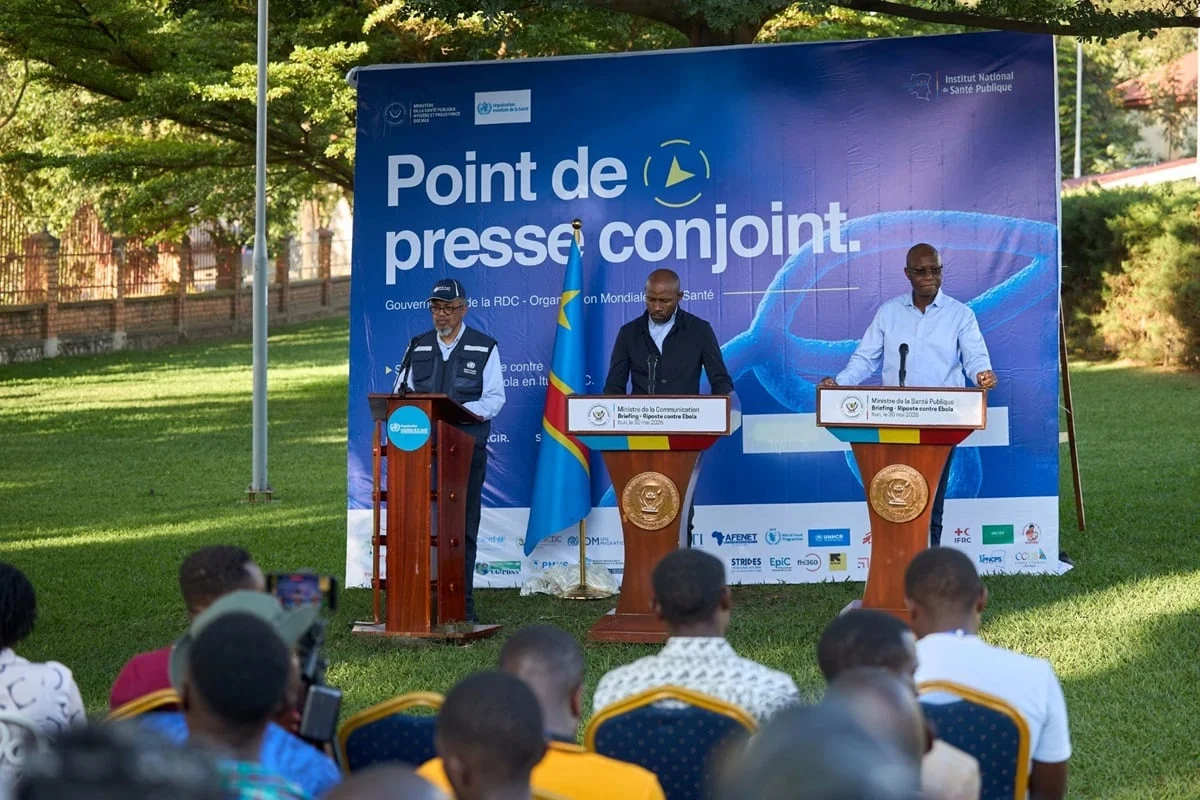
The Democratic Republic of the Congo (DRC) has entered a critical phase in its public health response following the emergence of an Ebola virus disease outbreak caused by the Bundibugyo virus. In a high-level demonstration of political will and international cooperation, a joint mission recently arrived in Bunia, the capital of Ituri Province, to assess the situation and reinforce the national response. The delegation was led by Dr. Samuel Roger Kamba, the Minister of Health, and Mr. Patrick Muyaya Katembwe, the Minister of Communication and Media, accompanied by the Director-General of the World Health Organization (WHO), Dr. Tedros Adhanom Ghebreyesus. This visit signifies a unified front between the Congolese government and the global health community as they navigate a complex epidemiological landscape across several eastern provinces.
The current outbreak is particularly concerning due to its geographical spread and the specific strain of the virus involved. While the DRC is renowned for its expertise in managing Ebola—having successfully contained numerous outbreaks since the virus was first discovered in 1976—the Bundibugyo strain presents unique hurdles. Unlike the more common Zaire ebolavirus, for which licensed vaccines and treatments exist, the Bundibugyo strain currently lacks a commercially available vaccine. This necessitates a response grounded in rigorous traditional public health measures, enhanced surveillance, and the rapid deployment of clinical research protocols.
Chronology of the Outbreak and the Joint Mission
The notification of suspected cases began in the health zones of Ituri, subsequently spreading to North Kivu and South Kivu. The Ministry of Health’s rapid response teams were deployed immediately to verify cases and begin contact tracing. On the heels of these reports, the joint mission to Bunia was organized to ensure that provincial authorities in Ituri had the necessary technical and financial backing from the central government and international partners.
During the mission, Dr. Tedros and the Congolese ministers met with local health officials, frontline workers, and community leaders. The visit served two purposes: first, to provide a morale boost to the "white coats" working in high-risk zones, and second, to finalize a strategic roadmap for containment. The chronology of this response highlights a shift from reactive measures to a proactive, "search-and-contain" strategy, utilizing the DRC’s decentralized health system to reach remote areas where the virus may be circulating undetected.
Epidemiological Context and the Bundibugyo Strain
The Bundibugyo ebolavirus (BDBV) was first identified in 2007 during an outbreak in the Bundibugyo District of western Uganda, which borders the DRC. Historically, the case-fatality rate for this strain has ranged from 25% to 50%, which, while lower than the Zaire strain’s 60% to 90%, remains a severe threat to public health. The absence of a licensed vaccine means that the "ring vaccination" strategy, which was highly effective in previous DRC outbreaks, cannot be immediately applied here.
As a result, the Ministry of Health, in collaboration with the WHO and the Africa Centres for Disease Control and Prevention (Africa CDC), is prioritizing the initiation of randomized control trials (RCTs). These trials will evaluate candidate vaccines and therapeutic treatments under strict ethical and scientific protocols. The goal is not only to provide immediate care to patients but to contribute to the global body of knowledge that will eventually lead to the licensure of a Bundibugyo-specific vaccine.
Strengthening Surveillance and Laboratory Capacity
A central pillar of the current response is the intensification of laboratory testing and surveillance. In Ituri and neighboring provinces, the government is working to reduce the "turnaround time" for blood samples. Rapid diagnosis is essential for isolating cases and preventing the virus from spreading within households and health facilities.
WHO has facilitated the delivery of specialized reagents and equipment to provincial laboratories, enabling local technicians to perform polymerase chain reaction (PCR) tests on-site. This decentralization of diagnostic power is a lesson learned from the 2018–2020 North Kivu outbreak. By confirming cases within hours rather than days, response teams can conduct contact tracing with greater precision. Currently, surveillance teams are monitoring hundreds of contacts across multiple health zones, a logistical feat that requires significant manpower and reliable transport in a region often hampered by difficult terrain and security challenges.
Community Engagement as the Heart of the Solution
Both Minister Patrick Muyaya and Dr. Tedros emphasized that the medical response cannot succeed without the "social vaccine" of community trust. In the past, Ebola responses in the DRC have been complicated by misinformation, cultural resistance to safe burial practices, and a lack of dialogue between responders and local residents.
To address this, the government is intensifying its communication strategy. This involves deep engagement with women’s groups, youth representatives, religious leaders, and the private sector. The objective is to co-develop solutions that respect local customs while ensuring safety. For instance, the concept of "Safe and Dignified Burials" (SDB) has been adapted to allow family members to participate in the process at a safe distance, honoring the deceased without risking further infection.
Minister Muyaya highlighted the role of the media in this effort, stating that accurate information is just as vital as medical supplies. By utilizing local radio stations and community town halls, the government aims to debunk myths and encourage early care-seeking behavior. Evidence shows that when patients seek care at an Ebola Treatment Center (ETC) early in the course of their illness, their chances of survival increase significantly, even in the absence of specialized drugs.
Challenges in Detection and Infection Control
Despite the robust framework, persistent challenges remain. The early symptoms of Ebola—fever, headache, and muscle pain—closely resemble those of malaria and typhoid, which are endemic in the DRC. This makes early detection difficult without widespread testing. Furthermore, infection prevention and control (IPC) in general health facilities is a priority. Many infections in previous outbreaks occurred when patients visited local clinics for other ailments and were inadvertently exposed to the virus.
The WHO is currently supporting the Ministry of Health in training thousands of health workers on IPC protocols. This includes the proper use of personal protective equipment (PPE), the establishment of screening points at clinic entrances, and the implementation of rigorous hand hygiene stations. The focus is on making every health facility a "safe zone" for both patients and staff.
The Role of International Solidarity and Open Borders
The DRC government and the WHO have issued a joint call for sustained international support. While the DRC brings "unparalleled experience" to the table, the financial and logistical burden of a multi-province outbreak is substantial. The Africa CDC has also been instrumental in coordinating regional surveillance, ensuring that neighboring countries like Uganda, Rwanda, and South Sudan are on high alert.
Crucially, the government and WHO have advocated for keeping borders open. Experience has shown that closing borders can be counterproductive, as it encourages people to use unofficial crossing points where health screening is impossible. Instead, the focus is on strengthening entry controls and "Points of Entry" (PoE) health checks. This ensures that the flow of medical supplies, personnel, and legitimate trade continues, preventing an economic crisis from compounding the health emergency.
Building Long-Term Health System Resilience
A recurring theme of the mission to Bunia was the "legacy" of the response. The investments being made today—the upgraded laboratories, the trained health workforce, and the enhanced surveillance systems—are intended to outlast the current outbreak. The goal is to strengthen the DRC’s primary health care system so that it can better manage not only Ebola but also measles, cholera, and maternal health challenges.
Dr. Samuel Roger Kamba remarked that the response must not come at the expense of essential services. Immunization programs, prenatal care, and malaria treatments must continue uninterrupted. By integrating the Ebola response into the broader health system, the DRC is working toward universal health coverage and long-term resilience.
Analysis of Implications
The current situation in the DRC is a litmus test for the "New Public Health Order" championed by African health leaders. It emphasizes local leadership, regional cooperation, and the rapid application of science. If the RCTs for Bundibugyo vaccines prove successful, this outbreak could mark a historic turning point in the fight against filoviruses.
Furthermore, the involvement of the Minister of Communication underscores the modern reality of outbreak management: it is as much a battle for hearts and minds as it is a biological struggle. The DRC’s ability to stabilize Ituri—a province that has also faced internal displacement and security issues—will be a testament to the strength of its state institutions and the efficacy of international partnerships.
Conclusion and Outlook
As the joint mission concluded, the message from Bunia was one of cautious optimism. The DRC’s history of overcoming twelve previous Ebola outbreaks provides a foundation of confidence. However, the unique nature of the Bundibugyo strain and the volatile security context in the east mean that there is no room for complacency.
The partnership between the DRC authorities, the WHO, and the Africa CDC remains the cornerstone of the containment effort. With continued community engagement, the application of rigorous science, and sustained international funding, the government is well-positioned to interrupt the chain of transmission. The global health community continues to watch closely, recognizing that a victory against Ebola in the heart of Africa is a victory for global health security everywhere. The resilience of the people of Ituri, supported by their government and the world, remains the most powerful tool in bringing this outbreak under control.
