
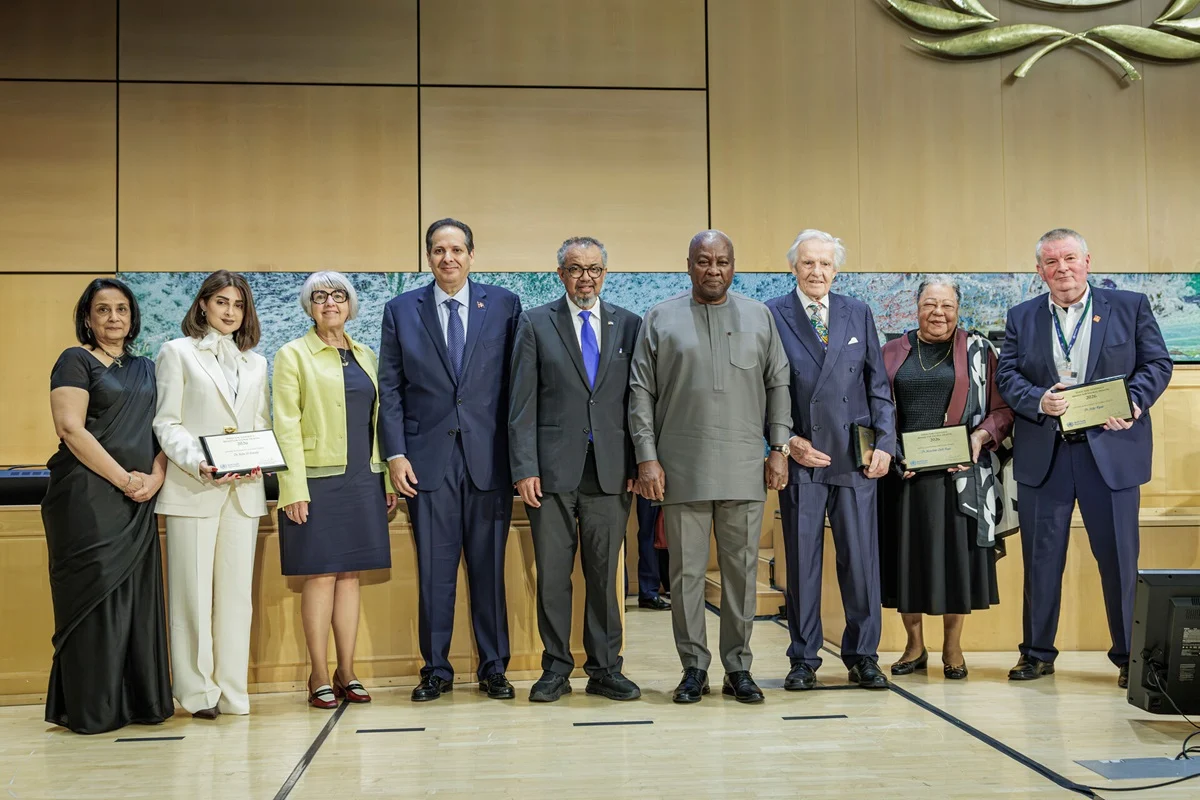
The Seventy-ninth World Health Assembly, convening in Geneva under the overarching theme of "Reshaping global health: a shared responsibility," served as the backdrop for a significant recognition of lifelong service to humanity as WHO Director-General Dr. Tedros Adhanom Ghebreyesus presented the Director-General’s Award for Global Health to four exceptional leaders. This year’s laureates—Dr. Tore Godal, Dr. Merceline Dahl-Regis, Dr. Mike Ryan, and Dr. Heba El Sewedy—represent a diverse spectrum of public health disciplines, ranging from high-level immunization strategy and disease elimination to emergency frontline response and humanitarian social justice. Established in 2019, these awards were designed to highlight individuals whose leadership has not merely been theoretical but has resulted in tangible, measurable improvements in health outcomes for millions of people worldwide.
In his address to the Assembly, Dr. Tedros emphasized that the contributions of these four individuals encapsulate the spirit of the WHO’s mission. He noted that their work transcends borders and decades, providing the foundational pillars upon which the current global health architecture stands. The ceremony occurred at a pivotal moment for the World Health Organization (WHO), as member states continue to navigate the complexities of post-pandemic recovery, the negotiation of a new pandemic treaty, and the increasing frequency of health emergencies driven by climate change and geopolitical instability.
Dr. Tore Godal: Architect of Global Immunization Frameworks
Dr. Tore Godal was honored for what many peers describe as a transformative career that fundamentally altered the trajectory of infectious disease control. His recognition stems from a lifetime of bridging the gap between scientific innovation and large-scale public health implementation. Throughout the latter half of the 20th century and into the 21st, Dr. Godal was instrumental in elevating vaccines from a routine medical intervention to a cornerstone of global development policy.
Perhaps his most enduring legacy is his role in the founding of Gavi, the Vaccine Alliance. Before Gavi’s inception in 2000, the introduction of new vaccines in low-income countries often lagged decades behind their deployment in wealthy nations. Dr. Godal’s vision helped create a public-private partnership model that has since immunized over 1 billion children and prevented more than 17 million deaths. His leadership also extended to the establishment of the Coalition for Epidemic Preparedness Innovations (CEPI) and the Roll Back Malaria partnership, both of which have become essential components of the global health security infrastructure.
Beyond immunization, Dr. Godal’s tenure as the head of the WHO’s Special Programme for Research and Training in Tropical Diseases (TDR) saw major breakthroughs in the fight against neglected tropical diseases (NTDs). He was a primary advocate for the expansion of community-based ivermectin distribution, a strategy that proved revolutionary in the control of onchocerciasis, commonly known as river blindness. By empowering local communities to manage their own treatment programs, Dr. Godal helped protect millions from permanent disability, demonstrating a model of sustainable health intervention that remains a gold standard today.
Dr. Merceline Dahl-Regis: A Pioneer in Regional Disease Elimination
The award presented to Dr. Merceline Dahl-Regis recognizes her tireless advocacy and technical leadership in the Region of the Americas. A Bahamian physician and public health expert, Dr. Dahl-Regis is widely credited with spearheading the initiatives that led to the Americas becoming the first region in the world to be declared free of measles and rubella. This milestone, achieved through rigorous surveillance, political commitment, and synchronized vaccination campaigns, proved that regional elimination of highly contagious diseases was possible even in diverse and resource-constrained settings.
Dr. Dahl-Regis’s work has consistently focused on the most vulnerable populations. Her leadership in the Dual Elimination Initiative was critical in addressing mother-to-child transmission of syphilis and HIV. By integrating these specific health targets into primary healthcare systems, she ensured that maternal and child health remained a priority for national governments across the Caribbean and Latin America. Her approach has always been holistic, recognizing that health outcomes are inextricably linked to social determinants and regional cooperation.
Data from the Pan American Health Organization (PAHO) indicates that the frameworks established under her guidance have significantly reduced infant mortality rates across the region. Her career serves as a testament to the power of regional solidarity. In her various roles, including her work with the WHO’s Strategic Advisory Group of Experts (SAGE) on Immunization, she has provided a blueprint for how small island states and developing nations can lead the way in global health innovation and policy setting.
Dr. Mike Ryan: Leading the Frontline of Health Emergencies
Dr. Mike Ryan, currently the Executive Director of the WHO Health Emergencies Programme, received the Global Health Leaders Award for his unparalleled contributions to emergency preparedness and response. Known for his "boots-on-the-ground" philosophy, Dr. Ryan has been a fixture in nearly every major international health crisis of the last quarter-century. He was a founding member of the Global Outbreak Alert and Response Network (GOARN), a mechanism that revolutionized how the world tracks and responds to epidemic threats by mobilizing international resources and expertise.
Dr. Ryan’s portfolio of leadership includes the operational responses to SARS, cholera, Ebola, and polio. However, it was his role during the COVID-19 pandemic that made him a household name globally. His ability to communicate complex scientific data with clarity and urgency helped guide national responses during the height of the crisis. Throughout the pandemic, Dr. Ryan remained a vocal advocate for equity, frequently reminding the global community that a virus anywhere is a threat everywhere.
His work often takes him into the world’s most challenging environments, including conflict zones and areas with collapsed infrastructure. His recognition at the 79th WHA highlights the necessity of having robust, rapid-response systems in place. Analysts point out that Dr. Ryan’s leadership style—characterized by transparency and a focus on operational excellence—has been vital in maintaining the WHO’s credibility during periods of intense political pressure. His efforts have not only saved lives in the immediate aftermath of outbreaks but have also strengthened the long-term resilience of national health systems.
Dr. Heba El Sewedy: Humanitarian Action and Social Justice
The inclusion of Dr. Heba El Sewedy among the laureates underscores the vital role of non-governmental organizations and humanitarian activists in the global health ecosystem. As the founder of the Ahl Masr Foundation in Egypt, Dr. El Sewedy has dedicated her life to a frequently overlooked area of public health: the prevention and treatment of burn injuries. In many parts of the world, burn victims face significant stigma and a lack of specialized medical care, often leading to lifelong physical and psychological trauma.
Under Dr. El Sewedy’s leadership, the Ahl Masr Foundation has pioneered a comprehensive care model that includes emergency medical intervention, long-term rehabilitation, and social reintegration. Her work has been instrumental in the construction of the Ahl Masr Burn Hospital, the first and largest non-profit burn hospital and research center in the Middle East and Africa. This facility provides free treatment to victims, many of whom come from impoverished backgrounds where household accidents involving fire are common.
Furthermore, Dr. El Sewedy’s humanitarian reach has extended to providing critical medical and psychological support to those affected by the conflict in Gaza. Her foundation’s ability to mobilize resources and provide aid in high-conflict areas has been a lifeline for many. By focusing on "compassionate, people-centered care," Dr. El Sewedy has become a source of inspiration for a new generation of health advocates who view social justice as an inseparable component of public health.
Context and Implications: Reshaping Global Health
The 79th World Health Assembly is taking place at a time when the global health community is at a crossroads. The theme, "Reshaping global health: a shared responsibility," reflects a growing consensus that the traditional donor-recipient model of international health is no longer sufficient. The achievements of this year’s awardees illustrate a shift toward integrated, sustainable, and locally-led health initiatives.
The awards serve as a strategic reminder of the progress made over the last several decades. For instance, the work of Dr. Godal and Dr. Dahl-Regis provides the historical context for current discussions on the "Big Catch-up" initiative, a global effort to restore immunization levels that declined during the COVID-19 pandemic. Meanwhile, the work of Dr. Ryan and Dr. El Sewedy highlights the ongoing need for humanitarian corridors and protected health spaces in an increasingly volatile world.
Industry analysts suggest that by honoring these four individuals, the WHO is signaling its priorities for the coming decade:
- Strengthening the Vaccine Pipeline: Ensuring that the innovations of the past are protected and expanded to cover emerging threats.
- Regional Empowerment: Supporting leaders who can implement global strategies at a local level, as seen in the Americas.
- Emergency Resilience: Investing in the human capital and systems required to manage the next "Disease X."
- Equity and Dignity: Moving beyond clinical outcomes to address the psychological and social well-being of survivors of trauma and disease.
A Chronology of Global Health Excellence
The careers of the 2026 laureates provide a timeline of the evolution of modern public health:
- 1970s-1980s: Dr. Tore Godal begins his work in tropical medicine, laying the groundwork for community-based treatments for NTDs.
- 1990s: Dr. Merceline Dahl-Regis initiates the push for measles elimination in the Caribbean, setting a precedent for the entire Western Hemisphere.
- 2000: The launch of Gavi and GOARN, with Dr. Godal and Dr. Ryan playing central roles, marking the beginning of a more coordinated global response to health.
- 2013: Dr. Heba El Sewedy founds the Ahl Masr Foundation, bringing the issue of burn trauma to the forefront of the Middle Eastern health agenda.
- 2016: The Americas are declared free of measles, a crowning achievement for the strategies championed by Dr. Dahl-Regis.
- 2020-2023: Dr. Mike Ryan leads the WHO’s operational response to COVID-19, the largest global health emergency in the organization’s history.
- 2026: The 79th WHA recognizes these lifetime achievements, linking past successes to the future goal of "Health for All."
Conclusion: The Path Forward
As the 79th World Health Assembly continues its deliberations, the stories of the four Global Health Leaders Award recipients provide a sense of possibility. Their diverse backgrounds—spanning Norway, the Bahamas, Ireland, and Egypt—reflect the universal nature of the challenge and the necessity of a globalized response.
The recognition of these leaders is not merely a look backward at past triumphs but a call to action for the delegates present in Geneva. The "shared responsibility" mentioned in the Assembly’s theme requires the same level of political courage, scientific rigor, and humanitarian empathy demonstrated by the laureates. As the world faces new threats, from the health impacts of climate change to the rise of antimicrobial resistance, the legacies of Dr. Godal, Dr. Dahl-Regis, Dr. Ryan, and Dr. El Sewedy offer a roadmap for a healthier, safer, and more equitable global society. Their work serves as a reminder that while the challenges are immense, the impact of dedicated leadership can be measured in the millions of lives saved and the communities transformed.
