
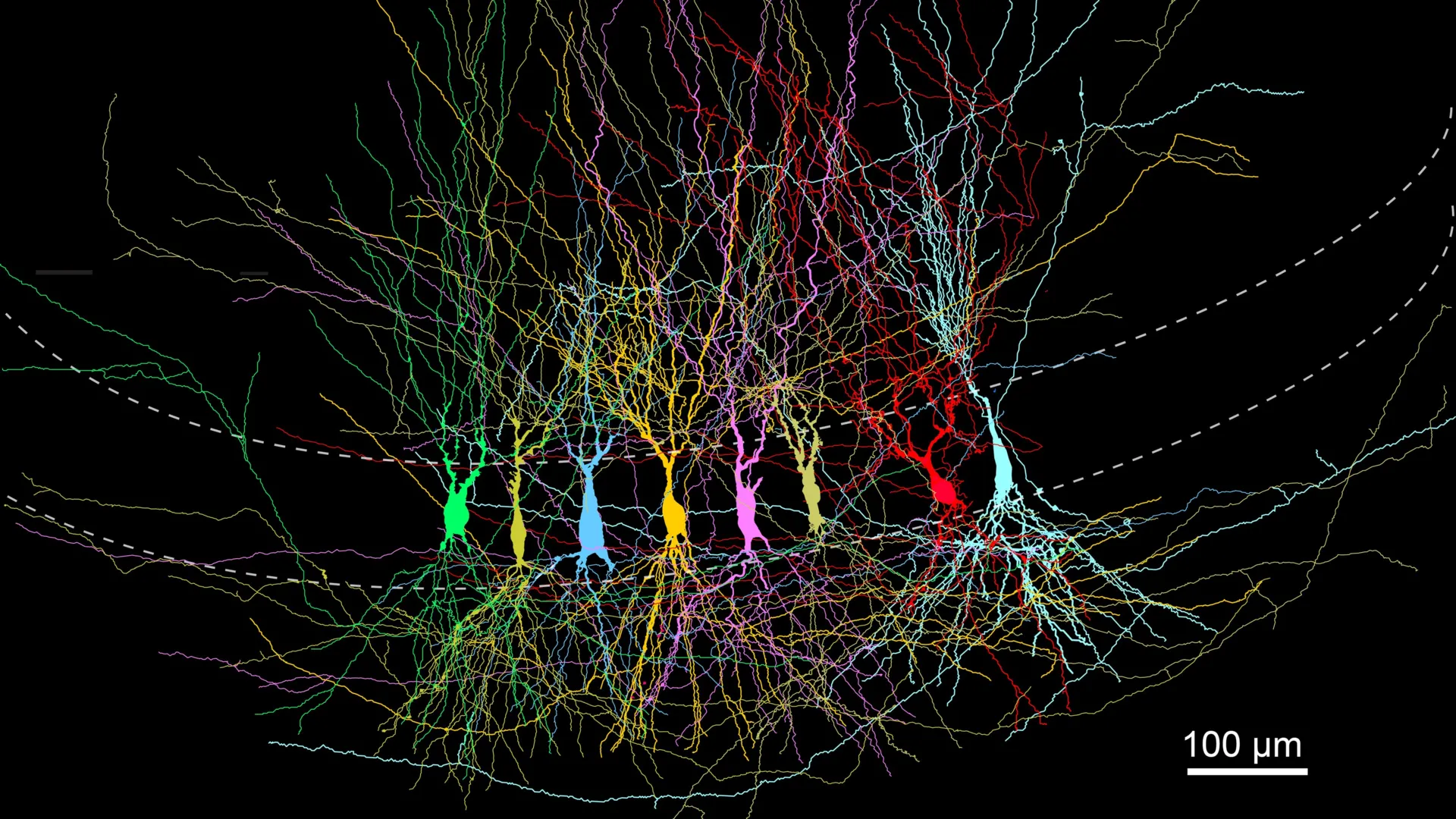
The hippocampus, a seahorse-shaped structure nestled deep within the brain, serves as a cornerstone of our ability to form memories and navigate the complex tapestry of our environment. Its intricate mechanisms are responsible for transforming fleeting sensory experiences into enduring recollections, thereby enabling us to learn, adapt, and build upon our accumulated knowledge. Scientists at the Institute of Science and Technology Austria (ISTA), under the leadership of Magdalena Walz Professor for Life Sciences Peter Jonas, have embarked on an ambitious journey to meticulously dissect the developmental trajectory of this vital brain region. Their groundbreaking research, recently published in the prestigious journal Nature Communications, offers profound insights into the intricate genesis of one of the hippocampus’s primary neural networks, challenging long-held notions about early brain development.
The Age-Old Debate: Blank Slate or Full Slate?
For centuries, philosophers and scientists have grappled with a fundamental question concerning human development: are we born as a "tabula rasa"—a blank slate upon which experience etches its indelible marks—or do we arrive with a predetermined blueprint, a "tabula plena," where innate predispositions largely dictate our future? This dichotomy, deeply embedded in the nature versus nurture debate, finds a compelling biological parallel in the intricate dance between genetic instructions and environmental influences that sculpt the developing organism.
The ISTA research team has applied this philosophical framework to the hippocampus, the brain’s master architect of memory and spatial cognition. Their objective was to illuminate the postnatal evolution of its internal neural architecture, seeking to determine whether it more closely resembles a nascent, empty canvas or a pre-populated, intricate network.
Illuminating the CA3 Circuit: A Focus on Memory’s Foundation
The scientists focused their investigation on a critical hippocampal circuit comprised of CA3 pyramidal neurons. These specialized cells are indispensable for the encoding, consolidation, and retrieval of memories. Their remarkable functionality hinges on a property known as plasticity, the brain’s inherent capacity to adapt and reorganize by modifying the strength of synaptic connections, or even by altering its structural architecture. This plasticity is the very engine that allows us to learn and remember.
To unravel the developmental secrets of this crucial network, the research team, spearheaded by ISTA alumnus Victor Vargas-Barroso, meticulously studied the brains of mice at three distinct developmental epochs: the early postnatal period (days 7-8), adolescence (days 18-25), and adulthood (days 45-50). This temporal dissection allowed for a granular examination of how neural connections and network properties evolve over time.
Precision Tools for a Microscopic World
The research employed a sophisticated arsenal of cutting-edge techniques to capture the functional dynamics of these developing neural networks. The patch-clamp technique, a cornerstone of electrophysiology, was instrumental in measuring the minute electrical signals emanating from specific neuronal compartments, including presynaptic terminals—the signaling end of a neuron—and dendrites, the branched extensions that receive signals. This method provided unparalleled resolution into the electrical activity that underpins neural communication.
Complementing the electrophysiological recordings, the team utilized advanced imaging modalities and precision laser-based stimulation techniques. These powerful tools allowed for the visualization of cellular activity in real-time and enabled the precise activation of individual neural connections. This combination of functional and structural analysis provided a holistic understanding of how the CA3 network matures.
From Dense and Disordered to Streamlined and Sophisticated
The findings that emerged from this meticulous investigation were both striking and counterintuitive. Contrary to what might be expected, the CA3 network in its nascent stages of development was found to be exceptionally dense, characterized by a multitude of connections that appeared largely random in their organization. As the brain progressed through adolescence and into adulthood, this initial exuberance of connections underwent a remarkable transformation. The network became less crowded, yet simultaneously more organized, efficient, and refined in its functional architecture.
Professor Jonas articulated the surprising nature of these findings: "This discovery was quite surprising," he stated. "Intuitively, one might expect that a network grows and becomes denser over time. Here, we see the opposite. It follows what we call a pruning model: it starts out full, and then it becomes streamlined and optimized." This observation directly challenges the prevailing assumption that neural networks expand their connectivity as they mature. Instead, the ISTA research suggests a developmental strategy that prioritizes initial over-connectivity followed by a selective refinement process.
The "Full Slate" Hypothesis: Facilitating Rapid Integration
The underlying rationale for this seemingly paradoxical developmental strategy—starting dense and then pruning—is a subject of ongoing scientific inquiry. Professor Jonas proposes a compelling hypothesis: the initial phase of exuberant connectivity may serve a critical purpose in enabling neurons to rapidly establish functional links. This rapid integration is particularly crucial for the hippocampus, a brain region tasked with the formidable challenge of synthesizing diverse sensory inputs—visual, auditory, olfactory, and somatosensory—into cohesive and meaningful memories.
"That’s a complex task for neurons," Professor Jonas explained. "An initially exuberant connectivity, followed by selective pruning, might be exactly what enables this integration." If the brain were to begin as a true "tabula rasa," with no pre-existing connections, neurons would first need to embark on a laborious process of locating and establishing connections with their counterparts. Such a scenario could significantly impede the speed and efficiency of neural communication, thereby hindering the rapid and effective formation of memories.
Implications for Understanding Brain Development and Disorders
The implications of this research extend far beyond a nuanced understanding of hippocampal development. It provides a novel framework for considering the origins of various neurodevelopmental disorders. Conditions characterized by aberrant connectivity, such as autism spectrum disorder or schizophrenia, might stem from disruptions in this delicate pruning process. An overabundance of synaptic connections, or a failure to eliminate unnecessary ones, could lead to circuit dysfunction and the manifestation of behavioral and cognitive symptoms.
Furthermore, the findings offer a new perspective on learning and cognitive plasticity throughout life. The understanding that the brain undergoes a period of refinement rather than pure expansion suggests that interventions aimed at enhancing learning or cognitive function might need to consider the existing architecture and the efficiency of neural communication.
A Shift in Perspective: From Building to Sculpting
This research signals a significant shift in our understanding of how the brain constructs its intricate networks. Instead of viewing brain development as a process of simply adding new components, it suggests a more dynamic model of sculpting. The brain, particularly the hippocampus, appears to begin with a rich, albeit somewhat unorganized, tapestry of connections, which is then meticulously refined and optimized through a process of selective elimination. This "full slate" model, characterized by initial exuberance followed by pruning, appears to be a highly efficient strategy for enabling the rapid integration of information essential for memory formation and spatial navigation.
The study’s findings, meticulously documented and rigorously validated, contribute significantly to the ongoing quest to decipher the complexities of the human brain. By providing a detailed account of the developmental trajectory of the CA3 hippocampal network, this research not only enriches our fundamental knowledge of neuroscience but also opens new avenues for investigating the origins of cognitive disorders and for developing more targeted therapeutic interventions. The journey from a dense, seemingly random network to a highly organized and efficient system underscores the remarkable plasticity and adaptability of the developing brain, fundamentally reshaping our understanding of the "blank slate" versus "full slate" debate.
